-
Any Questions teco.beautome@gmail.com
最后更新:
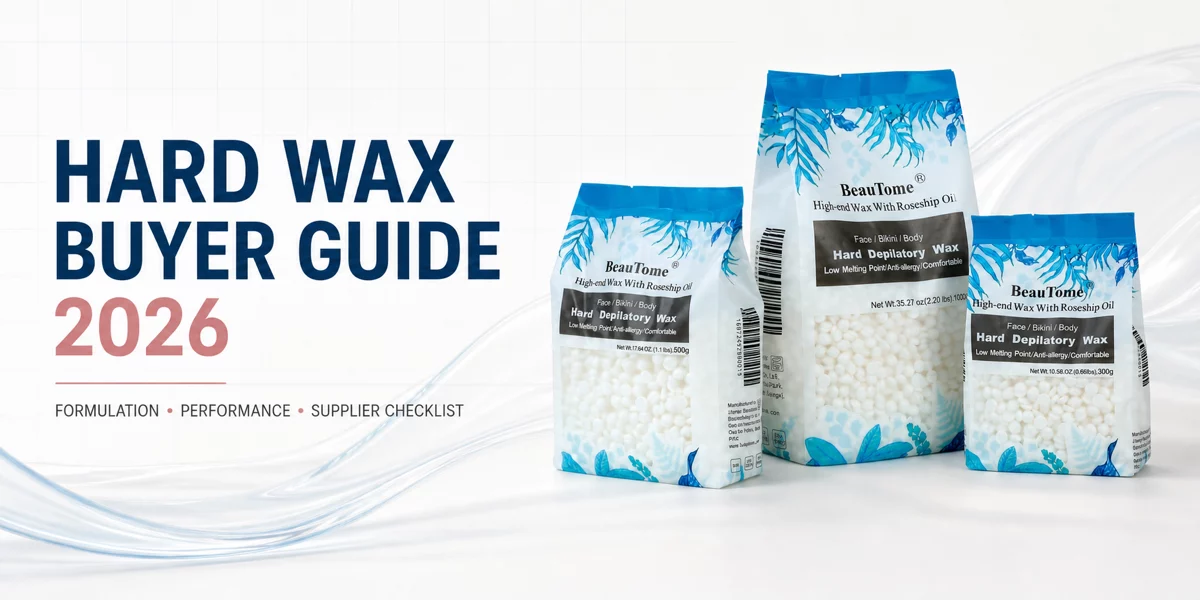
The Complete Hard Wax Buyer Guide (2026 Definitive Edition)
A practical 2026 hard wax buyer guide for beauty brands covering formulation choices, sample testing, supplier qualification, regulatory readiness, total cost, and OEM production approval.
 ByTeco
Buying hard wax for a beauty brand is not simply a choice between colors, fragrances, and pellet shapes. The product must fit a defined user, treatment area, heater workflow, regulatory market, packaging format, and commercial model. A wax that performs well in one technician’s room can behave differently when the load, heater, film thickness, or ambient conditions change.
This 2026 hard wax buyer guide gives brand owners, distributors, product managers, and salon-channel buyers a practical framework for comparing formulations and suppliers. It focuses on evidence you can request, tests you can repeat, and decisions you should lock before production.
Start With a Product Brief, Not a Sample Catalog
Before requesting samples, define what the finished product must do. Otherwise, every supplier will send its most popular wax and the evaluation will become subjective.
- Primary channel: professional salon, consumer retail, distributor portfolio, or private-label kit.
- Target areas: face, underarm, bikini/Brazilian, body, or mixed use.
- User skill: trained technician, beginner, or both.
- Hair and service profile: short or coarse hair, sensitive zones, full-body speed, and expected service volume.
- Formulation direction: rosin-free or traditional resin system, fragranced or fragrance-free, color direction, and claim boundaries.
- Pack and business model: retail pouch, salon bulk pack, starter kit, target MOQ, landed cost, and launch timing.
A clear brief allows a manufacturer to propose a formulation platform rather than forcing the buyer to reverse-engineer a random sample.
How Hard Wax Formulation Affects Performance
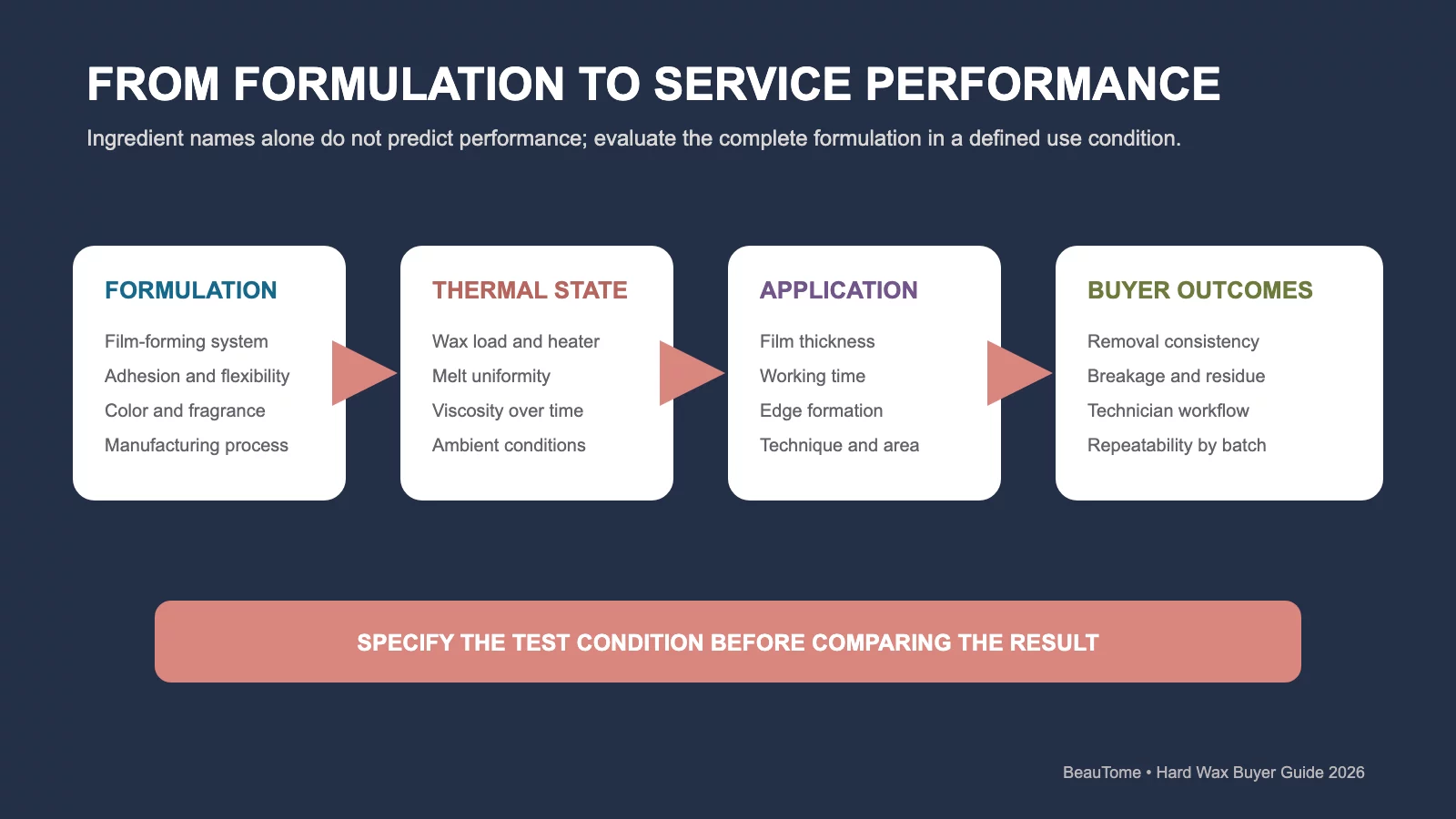
Hard wax is engineered to form a removable film without a strip. Performance comes from the complete formulation and manufacturing process—not one “hero” ingredient. Polymer and resin systems influence film strength and adhesion. Waxes, oils, plasticizing components, fillers, pigments, and fragrance can change viscosity, flexibility, cooling behavior, appearance, and sensory experience.
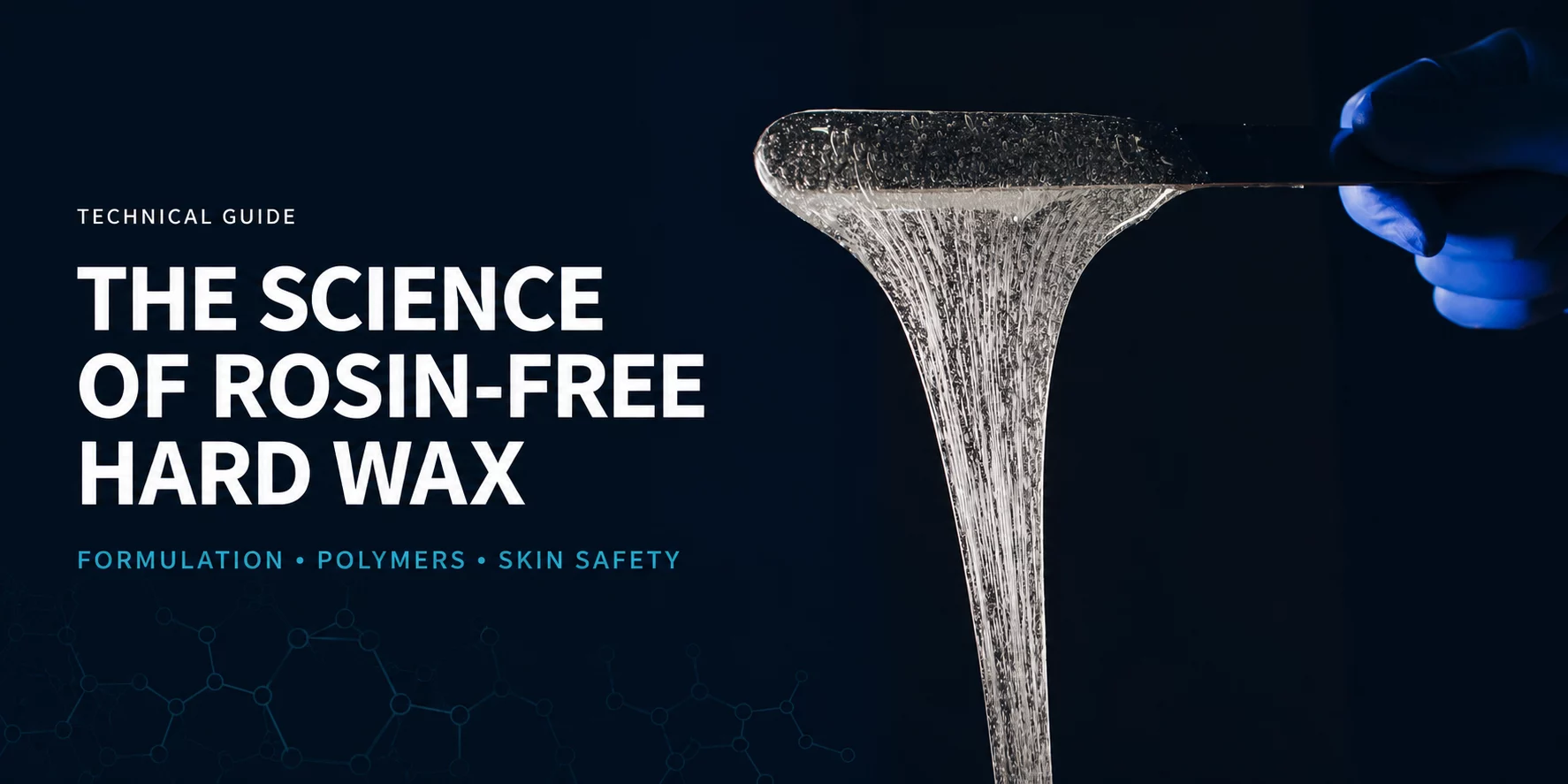
Rosin-free hard wax replaces conventional colophony-derived resin systems with alternative film-forming and tack-control approaches. That can support a specific positioning strategy, but “rosin-free” alone does not prove that a formula is hypoallergenic, painless, or suitable for every skin type. Evaluate the finished product and its documentation. For a deeper technical overview, see the science of rosin-free hard wax.
The performance attributes buyers should define
- Spreadability: whether the wax can be applied evenly within the intended working condition.
- Working time: the practical window for application and edge formation before removal.
- Film integrity: resistance to cracking, tearing, or brittle edges at the specified film thickness.
- Hair capture: removal consistency for the defined area and hair profile.
- Skin interaction: perceived pull, visible residue, redness observations, and post-service comfort—reported carefully without unsupported medical claims.
- Reheat behavior: whether normal service reheating changes viscosity, color, odor, or removal characteristics.
Rosin-Free vs. Traditional Rosin Hard Wax
| Decision area | Rosin-free direction | Traditional rosin direction |
|---|---|---|
| Positioning | Useful when the brand brief explicitly excludes colophony/rosin | Familiar category architecture with many established formulation options |
| Performance | Depends on the complete polymer and adhesion system | Depends on resin grade, modifiers, and complete formulation |
| Claims | “Rosin-free” is a composition statement, not proof of hypoallergenicity | Avoid assuming all rosin formulas perform or sensitize in the same way |
| Evaluation | Finished-product application, stability, documentation, and label review | The same finished-product and documentation review is still required |
The right choice depends on brand positioning, target customer, evidence, cost, and the supplier’s ability to deliver a stable product repeatedly. Read our complete guide to rosin-free hard wax if this is a central requirement.
Choose Hard Wax by Use Case
Facial and precision waxing
Prioritize controlled application, clean edge formation, and removal consistency at smaller film sizes. Fragrance direction and pigment contrast should be evaluated for the intended user experience, while claims about sensitive skin require appropriate substantiation.
Brazilian, bikini, and underarm services
Evaluate film flexibility, working time, grip on coarse or short hair, and the technician’s ability to build a reliable removal edge. Test across several technicians because technique can hide or exaggerate formulation differences.
Legs, arms, back, and high-throughput salons
Coverage efficiency, consistent viscosity over a longer service, reheat tolerance, and cost per treatment become more important. Measure actual consumption and usable waste instead of comparing price per kilogram alone.
Home-use retail products
A forgiving process window, clear instructions, manageable pack size, and heater compatibility matter more than technician-level speed. Consumer comprehension should be tested along with the wax itself.
A Repeatable Hard Wax Sample Test
Blind or coded comparisons reduce bias from color, fragrance, packaging, and supplier reputation. Use the same heater model, pot, wax load, room conditions, application tools, target area, and written procedure for every sample. Record the heater setting and the actual wax condition rather than treating the dial value as skin-contact temperature.
- Condition the samples: store all candidates under the same conditions and document age and batch.
- Define the heat protocol: load, melt method, stirring, hold time, and working check.
- Apply a controlled film: record area, approximate thickness, size, technique, and working time.
- Score removal: film integrity, hair capture, residue, edge quality, and technician control.
- Repeat: use more than one operator and multiple sessions before ranking suppliers.
- Review commercial reality: calculate consumption, waste, rework, packaging loss, and landed cost.
Buyer rule: never compare “melting point,” “low temperature,” “elasticity,” or “short-hair removal” claims unless the supplier defines the method and acceptance criteria.
Supplier Documentation to Request
- Current ingredient declaration in the required nomenclature and market format
- Product specification with agreed physical and sensory limits
- Safety Data Sheet where applicable to supply-chain handling requirements
- Batch certificate or certificate of analysis aligned with the specification
- Stability and packaging-compatibility evidence appropriate to the shelf-life claim
- Fragrance documentation, including applicable IFRA information for the intended use
- Colorant, allergen, restricted-substance, and market-specific declarations as required
- Manufacturing traceability, complaint handling, and formulation change-control process
IFRA explains that its standards can prohibit, restrict, or set specifications for fragrance materials, but an IFRA conformity document does not replace a finished-product safety assessment or applicable law. Review the current IFRA Standards guidance for fragranced variants.
Market Readiness in 2026
Regulatory duties depend on product classification, claims, ingredients, market, and responsible economic operator. Do not use one generic “global certificate pack” as a substitute for market review.
United States
FDA’s current cosmetic product category system includes depilatories under skin-care preparations. U.S. cosmetic companies remain responsible for product safety and applicable facility registration, product listing, labeling, adverse-event, and records obligations. Confirm how the current requirements apply to your company and product; do not market ordinary cosmetics as “FDA approved.” See the FDA’s cosmetic product categories and cosmetic product guidance.
European Union
If the product falls within the EU Cosmetics Regulation, the responsible person, safety assessment, product information file, notification, good manufacturing practice, ingredient restrictions, and labeling must be addressed before placing it on the market. The expanded fragrance-allergen labeling transition reached an important placement-on-market date on 31 July 2026, so fragranced products require current label review. Use the European Commission’s fragrance-allergen labeling information and qualified regulatory advice.
From Sample Approval to Mass Production
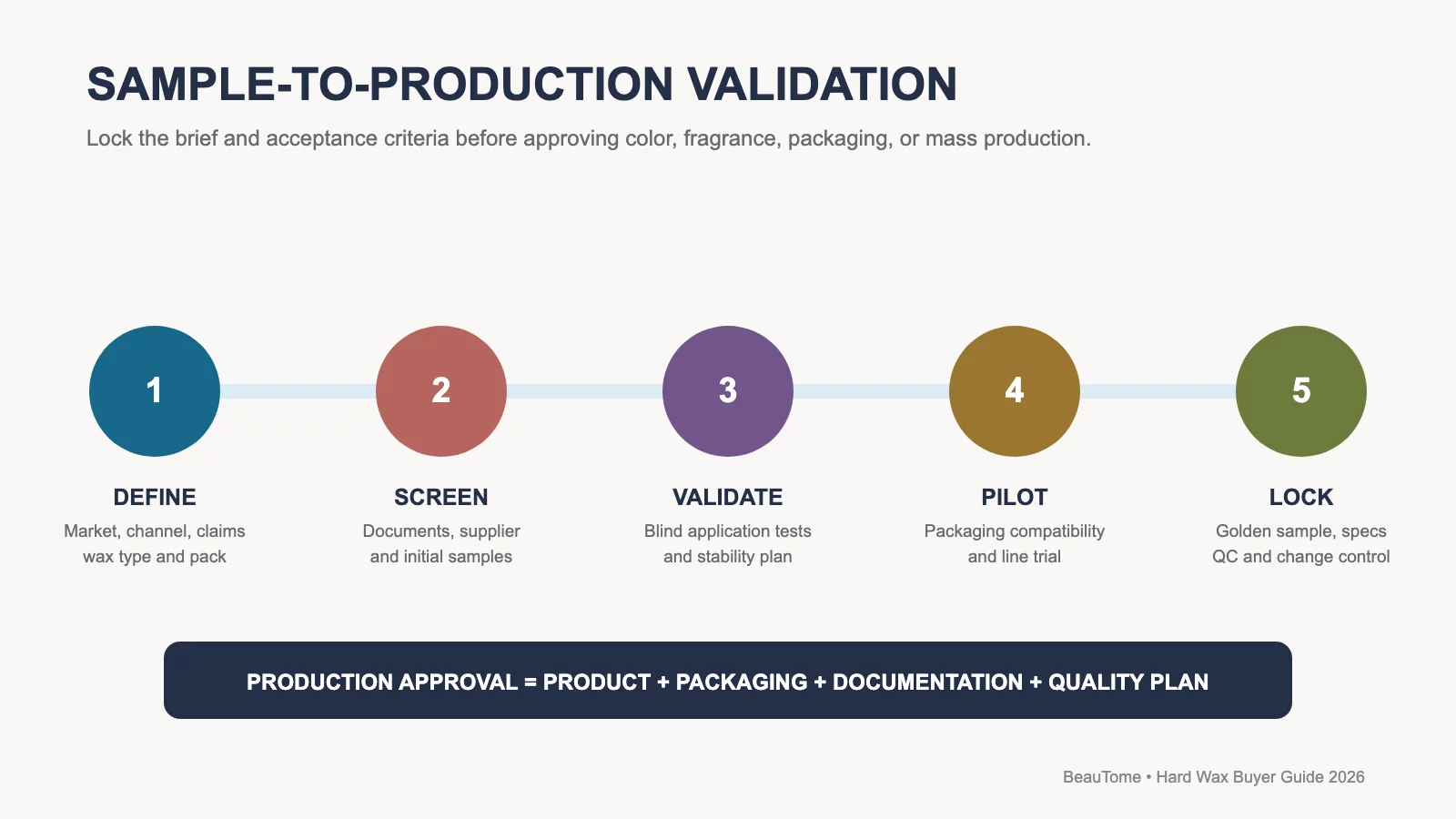
A good sample is only the beginning. Lock a signed golden sample, product specification, ingredient and fragrance version, color standard, pack artwork, fill weight, coding format, sampling plan, and change-control rules. Then validate a pilot batch using production equipment and final packaging.
Quality checks should be tied to defined limits rather than “looks good” judgments. Depending on the formulation and brief, the plan may include appearance, odor, pellet form, fill weight, softening or melt behavior, controlled application tests, film integrity, packaging seals, leakage, stability observations, and batch records. Ask who can release a batch and how deviations are investigated.
Hard Wax Cost: Compare Total Value, Not Unit Price
The quoted wax price is only one component of landed and in-use cost. Add packaging, printing, cartons, testing, documentation, freight, duty, inspection, rejected units, storage, and working capital. For salon products, also estimate grams used per service, brittle waste, residue, reapplication, and technician time.
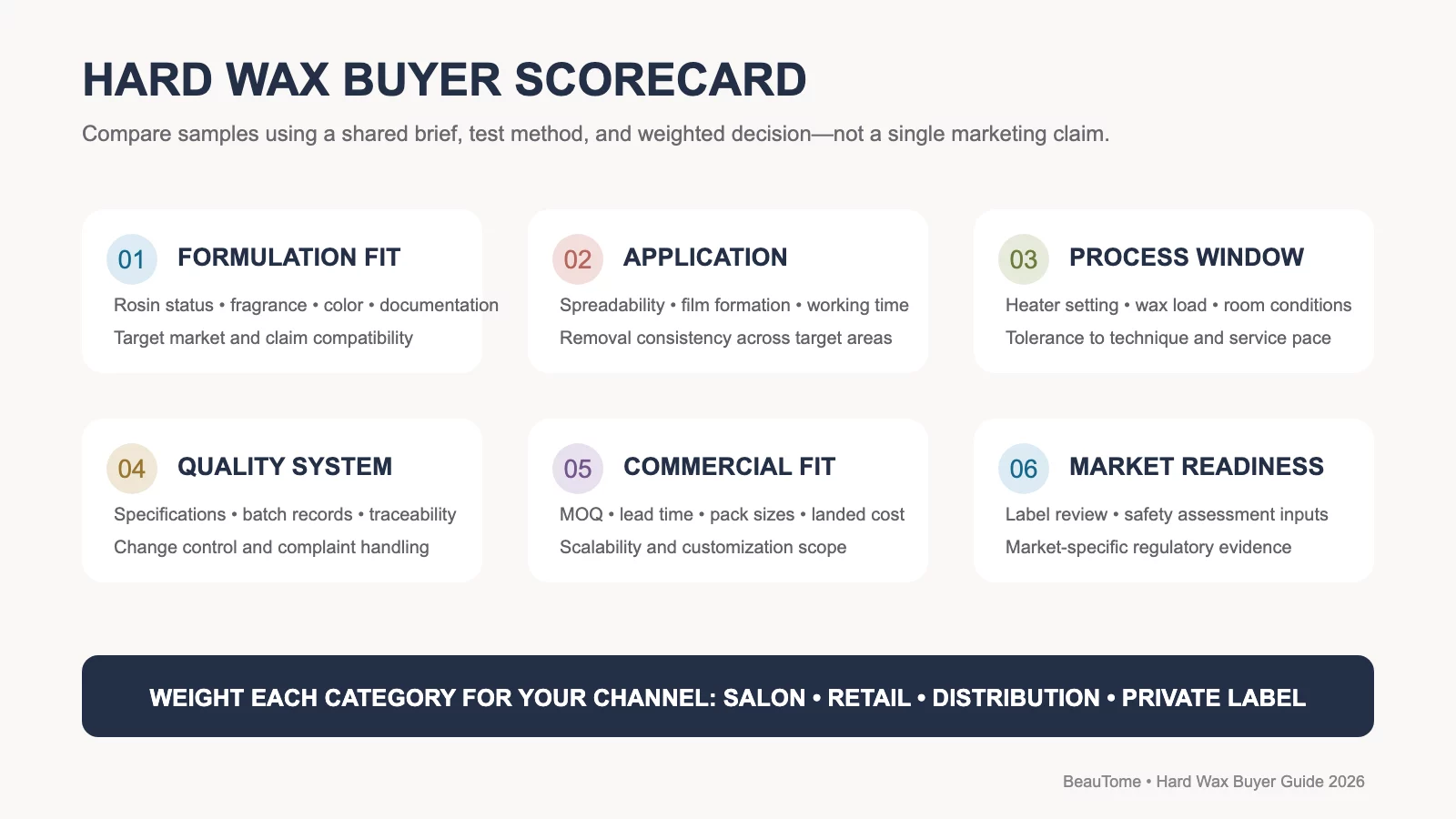
A slightly higher unit price can be commercially stronger when the product has a wider process window, lower waste, better batch repeatability, clearer documentation, or more reliable lead times. The scorecard should weight what matters to your channel.
Questions to Ask a Hard Wax Manufacturer
- Which formulation platform matches our channel, target areas, and claims—and why?
- How do you define and test spreadability, working time, film integrity, and removal consistency?
- Which sample variables must remain constant for a fair comparison?
- What stability and packaging-compatibility plan supports the proposed shelf life?
- How are fragrance, pigment, and raw-material changes controlled?
- Which records connect finished goods to raw materials and production batches?
- What can be customized at each MOQ: formula, color, fragrance, pack size, bag, carton, and kit?
- Which documents will you supply for each target market, and which remain the brand’s responsibility?
- How are complaints, deviations, and corrective actions handled?
- Can we approve a pilot batch before mass production?
Hard Wax Buyer FAQ
Is rosin-free hard wax automatically safer?
No. Rosin-free identifies a formulation choice. Finished-product safety, suitability, and claims still require appropriate assessment and evidence.
What is the best hard wax temperature?
There is no universal number. Follow the validated instructions for the specific wax and heater, observe the working condition, and check temperature appropriately before application.
How many samples should a brand test?
Enough to compare the relevant formulation directions and confirm repeatability across operators and sessions. Final approval should include a production-representative pilot, not only a laboratory sample.
For operational questions from salons and brand teams, visit the Hard Wax FAQ.
Build your 2026 hard wax sourcing brief
Share your target market, channel, application areas, rosin preference, fragrance and color direction, pack sizes, MOQ, and launch schedule. BeauTome can help map the brief to a hard wax formulation and OEM/ODM validation plan.
Planning to replace an existing salon formula? Use our rosin-free hard wax salon trial guide and blank evaluation record to compare service conditions, operator learning and consumption before rollout.
Evaluating a low-melting formula for facial or bikini-area services? Read our A1 rosin-free hard wax guide for the 48–50°C melting specification, temperature distinctions and product documentation to review.
Developing wax under your own brand? Use our private-label hard wax development guide and editable product brief to define formula changes, packaging, sample approval and quotation requirements.