-
Any Questions teco.beautome@gmail.com
最后更新:
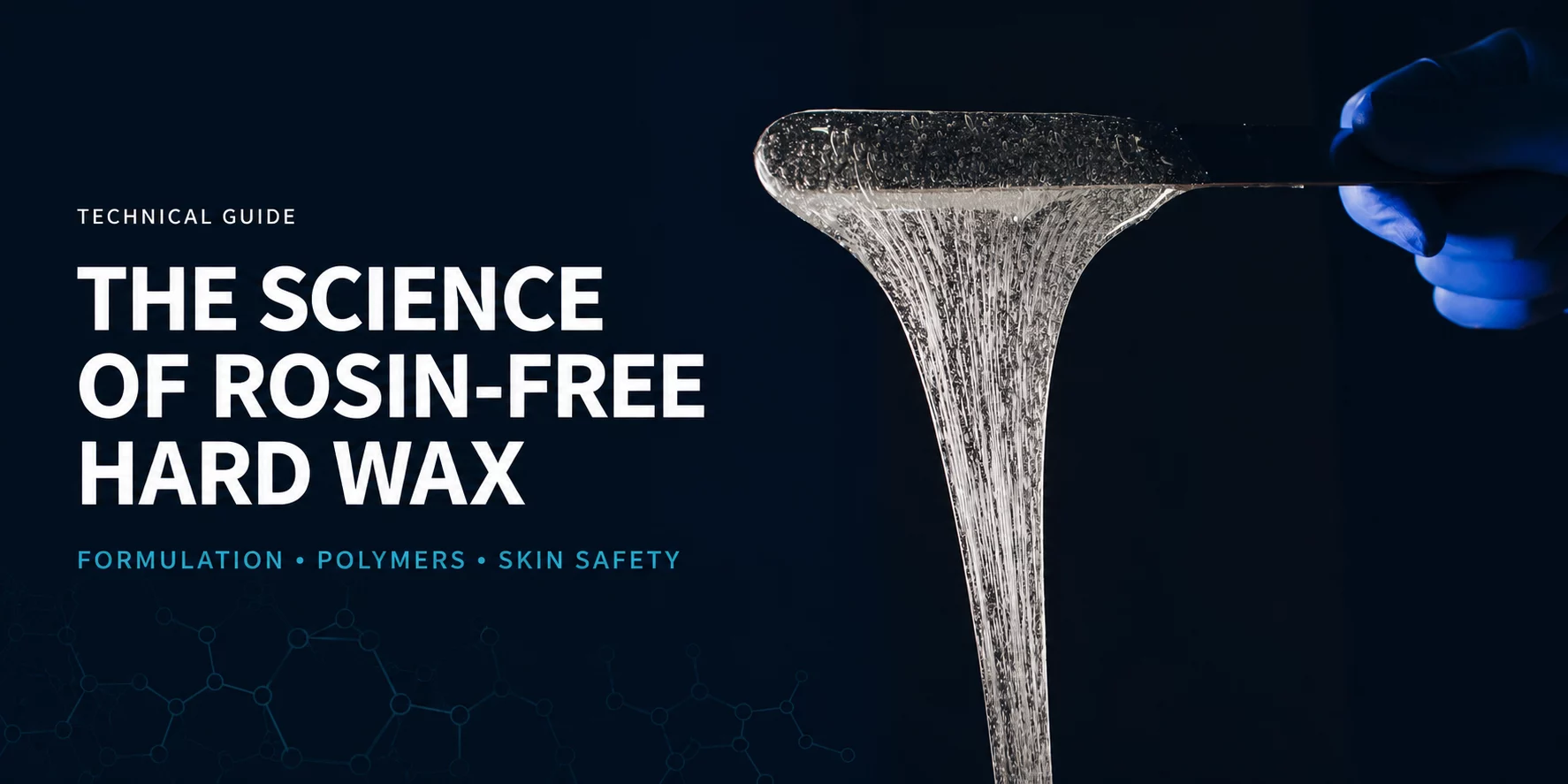
The Science of Rosin-Free Hard Wax: Formulation, Polymers, and Skin Safety
A technical guide to rosin-free hard wax formulation, polymer balance, skin-safety claims, supplier documentation, and sample validation for beauty brands.
 ByTeco
Rosin-free hard wax is not simply traditional wax with one ingredient removed. It is a different formulation strategy: the chemist must rebuild tack, flexibility, setting behavior, and clean removal with a controlled combination of synthetic resins, polymers, waxes, and plasticizing materials.
For beauty brands, that distinction matters. “Rosin-free” can support clearer positioning for customers who want to avoid colophony, but it does not automatically prove that a formula is hypoallergenic, painless, low-temperature, or suitable for every sensitive-skin user. Those claims require separate evidence.
What Does Rosin-Free Hard Wax Mean?
Rosin, also called colophony, is a natural resin derived from pine and other conifer sources. It is widely used as a tackifier because it helps a wax film grip hair. Modified rosin derivatives can also appear in depilatory products under different ingredient names.
A rosin-free hard wax is formulated without rosin or rosin-derived tackifiers. Adhesion and film formation are instead built with alternative resin and polymer systems. Buyers should verify this through the complete INCI list, raw-material declarations, and a supplier statement that covers derivatives—not only the words printed on the front label.
Buyer takeaway: “Rosin-free” is a compositional statement. It is not, by itself, a complete safety or performance specification.
Why Rosin Is a Relevant Formulation Decision
Rosin remains useful in many products, but contact allergy to colophony is well documented. A 2026 systematic review reported sensitization among dermatitis patients and emphasized that prevalence estimates apply to a clinical population, not to the general public. Case reports have also described allergic contact dermatitis linked to colophony-containing epilating products.
Research has further shown that oxidation products of rosin acids can be important allergens and that modified derivatives may not always be captured by testing with unmodified rosin alone. This is why a precise ingredient review is more useful than a vague “natural resin” claim.
Removing rosin can therefore be a meaningful product-design choice for a brand targeting ingredient-conscious or professional channels. It does not remove the possibility of irritation or allergy from fragrance, colorants, botanical extracts, preservatives, or other formula components.
How a Rosin-Free Formula Rebuilds Performance
Every hard wax must perform four connected jobs: become fluid enough to spread, wet and surround the hair, set into a removable film, and release from skin with manageable residue. A rosin-free system achieves these jobs by balancing ingredient functions rather than relying on one “hero” polymer.
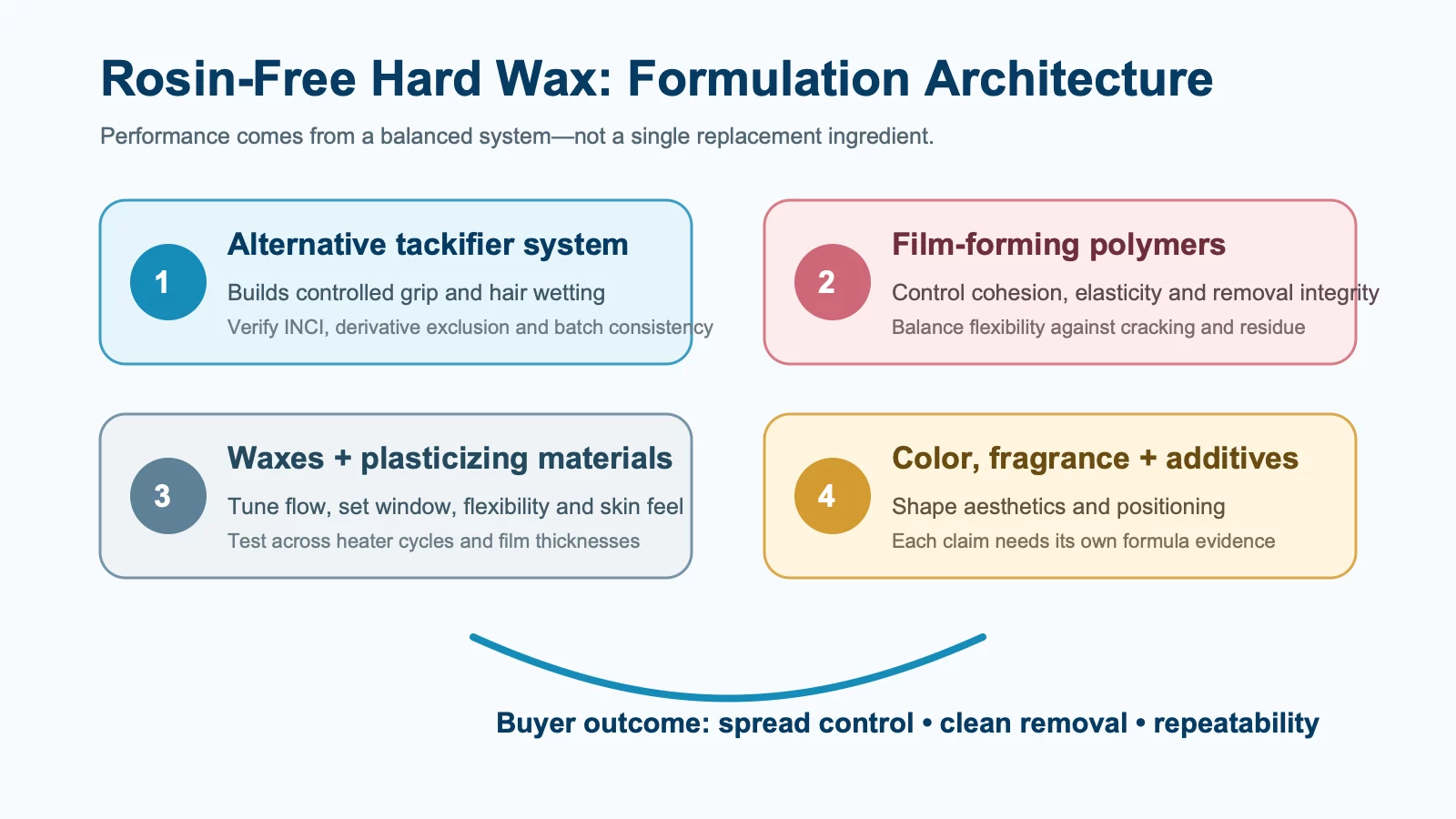
Synthetic resin or tackifier system
This part of the formula helps create adhesion to hair. The selected chemistry, molecular weight distribution, and concentration affect grip, melt viscosity, odor, color stability, and removal character. The exact trade name matters less to a buyer than repeatable performance and transparent documentation.
Film-forming polymers
Film formers give the cooled wax cohesion. Too little cohesion can produce cracking or fragments; too much stiffness can reduce conformability and make edges difficult to lift. A professional formula should tolerate reasonable variation in film thickness without becoming brittle or excessively elastic.
Waxes, plasticizers, and process aids
These materials tune softening, spread, cooling time, flexibility, and skin feel. They also influence how quickly pellets melt and how the formula behaves during a busy treatment cycle. A low heater setting does not guarantee a comfortable application if the wax is poorly mixed or applied before temperature and consistency are checked.
Pigments, fragrance, and skin-conditioning ingredients
These components shape appearance, scent, and marketing position, but each addition changes the complete system. “Rosin-free” and “fragrance-free” are separate specifications. Botanical oils or extracts may improve a brand story, yet they should not be presented as proof that the finished wax prevents redness or inflammation.
Polymer Balance Controls the Waxing Experience
Useful performance is a balance between adhesion and cohesion. Adhesion describes how the formula grips the hair; cohesion describes how well the wax film holds together during removal. If adhesion is high but cohesion is weak, the wax may leave residue or break. If cohesion is high but the film does not wet the hair effectively, removal efficiency can fall.
| Observed behavior | Possible formulation or process cause | Buyer test |
|---|---|---|
| Film cracks during removal | Excess stiffness, thin application, or overcooling | Compare multiple film thicknesses and removal times |
| Long strings or excessive softness | High temperature or insufficient cohesive strength | Record working consistency at defined temperatures |
| Hair remains after one pass | Insufficient wetting, application technique, or hair-length mismatch | Use a controlled area and standardized technique |
| Heavy residue | Adhesion/cohesion imbalance or removal too early | Evaluate residue after fixed set times |
| Performance changes through the day | Heater cycling, repeated reheating, or contamination | Run a multi-cycle salon simulation |
Melting Point, Working Temperature, and Skin Contact Are Different
These terms are often mixed together in marketing:
- Softening or melting behavior describes how the material changes as it is heated.
- Heater setpoint is the temperature selected on the warmer and may not equal the wax temperature.
- Working temperature is the range in which the mixed wax has the intended application consistency.
- Skin-contact temperature depends on the wax, spatula, room, application thickness, travel time, and technique.
For this reason, a professional protocol should specify both a temperature range and a visual or rheological endpoint, such as a smooth, controllable ribbon. Technicians should mix the wax, follow the manufacturer’s instructions, and test application temperature before use. Brands should avoid converting a heater number into a universal skin-safety promise.
Rosin-Free Does Not Mean Hypoallergenic
A credible sensitive-skin position separates four different questions: Is rosin absent? Is fragrance absent? Has the finished formula completed an appropriate safety assessment? Has product performance been evaluated under intended use conditions?
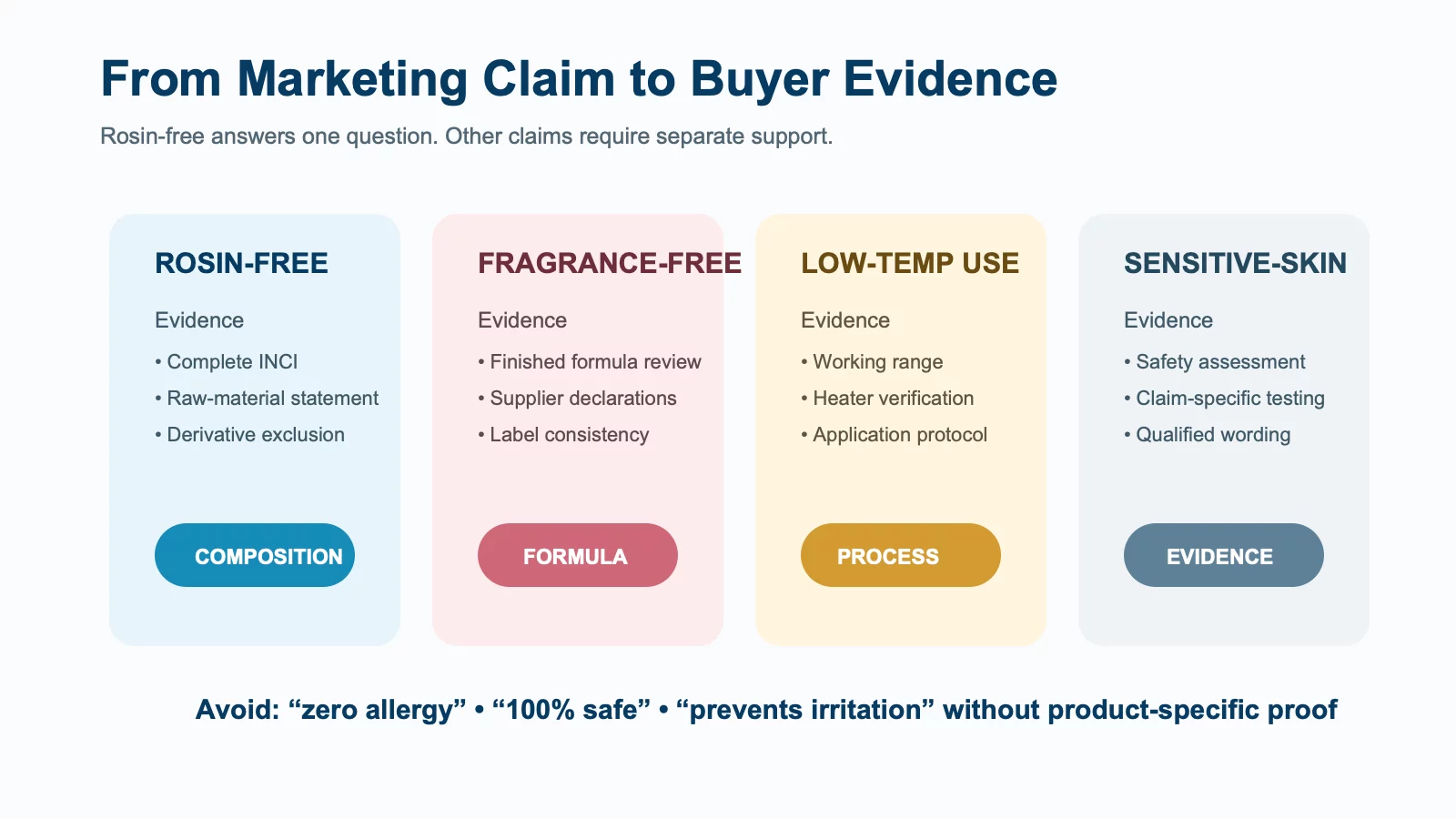
No cosmetic can guarantee that every user will avoid irritation or allergy. Skin response may relate to temperature, repeated passes, technique, pre-existing sensitivity, fragrance, dyes, botanicals, or post-wax care. A supplier should therefore support narrow, testable wording rather than broad claims such as “zero allergy,” “100% safe,” or “prevents irritation.”
What Beauty Brands Should Request from a Manufacturer
- Complete formula identity: finished-product INCI list plus confirmation that rosin and relevant derivatives are excluded.
- Raw-material traceability: supplier specifications, certificates of analysis where appropriate, and change-control procedures.
- Finished-product safety documentation: documentation suited to the target market and intended cosmetic use—not a generic SDS presented as proof of consumer safety.
- Stability and compatibility: evaluation of appearance, odor, melt behavior, packaging interaction, and performance across defined storage conditions.
- Batch specifications: agreed limits for color, odor, pellet form, working consistency, and other measurable release criteria.
- Claim support: evidence matched to each label or sales claim, including fragrance-free, vegan, sensitive-skin, low-temperature, or cruelty-free language.
Brands comparing private-label options can review BeauTome’s rosin-free hard wax product page and use the checklist above to define the exact formula, packaging, and documentation required for their market.
A Practical Sample-Validation Protocol
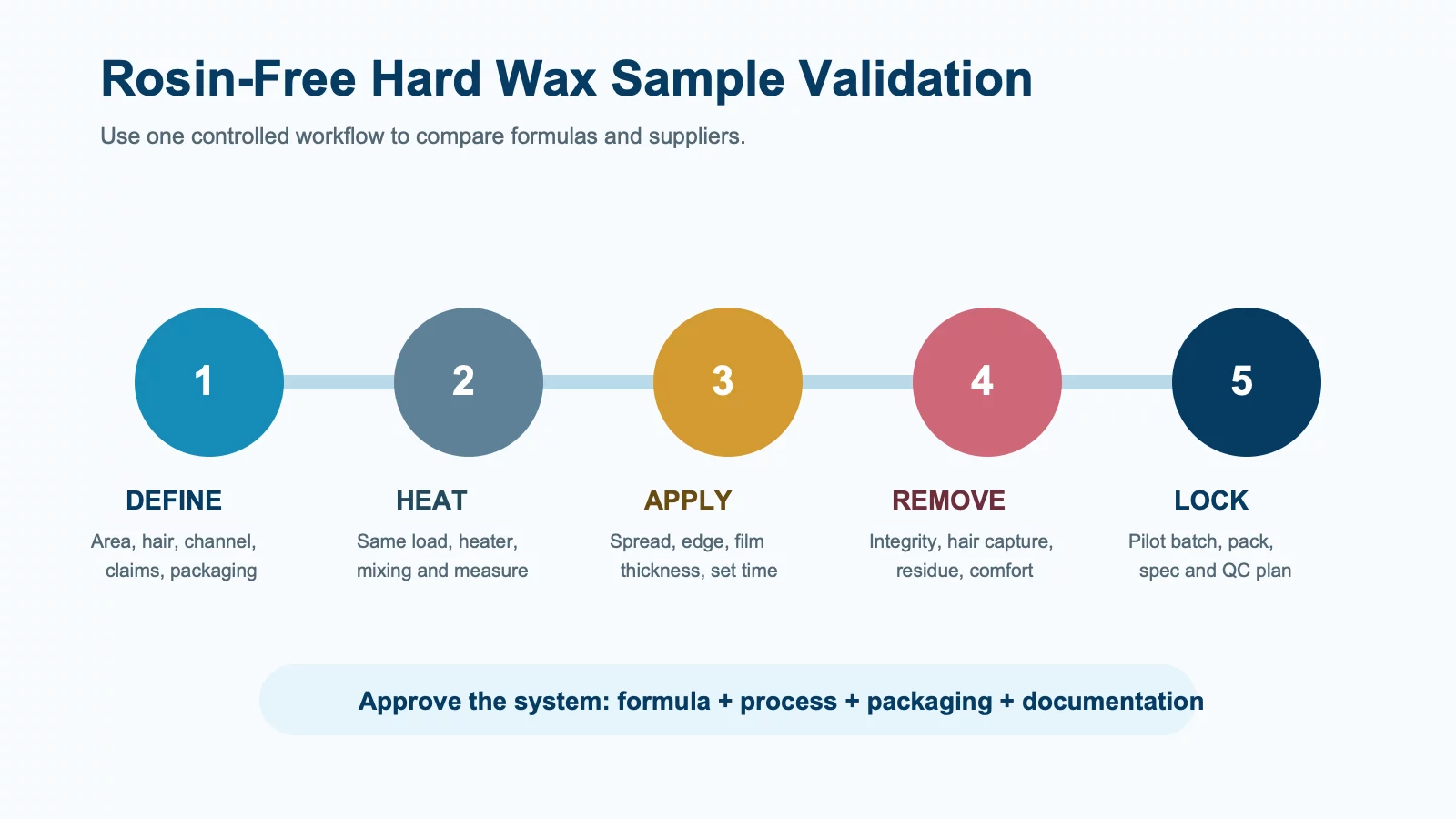
1. Define the use case before requesting samples
Record the target body areas, hair types, salon or home-use context, heater capacity, preferred working time, fragrance policy, pack size, and destination markets. Without this brief, sample feedback becomes subjective.
2. Control the heating method
Use the same heater, wax load, mixing interval, and measurement method for each formula. Record both the heater setting and actual wax temperature. Evaluate initial melt time separately from the stable working phase.
3. Compare repeatable application variables
Test spread control, edge formation, film thickness tolerance, set window, lift-tab strength, removal integrity, residue, and visible hair capture. Use trained technicians and a consistent protocol rather than one unstructured demonstration.
4. Run stability and production checks
A successful laboratory sample is not the final approval standard. Confirm pilot-batch consistency, packaging compatibility, shipping resilience, storage behavior, and the specification that production batches must meet.
How Rosin-Free Fits a Hard Wax Product Portfolio
Rosin-free wax can serve as a flagship clean-positioning formula, a sensitive-skin-oriented option, or a professional SKU designed around controlled odor and application behavior. The right role depends on channel and evidence. A salon buyer may prioritize removal consistency and working time; a retail brand may place more weight on instructions, consumer error tolerance, and claim clarity.
For broader portfolio decisions, compare this technical explanation with the complete guide to rosin-free hard wax, the 2026 hard wax buyer guide, and the hard wax FAQ. You can also review BeauTome’s wider hard wax range.
Final Buyer Perspective
The science of rosin-free hard wax is a system problem. Alternative tackifiers must work with film-forming polymers, waxes, plasticizers, pigments, and process conditions. The strongest purchasing decision is therefore based on formula transparency, repeatable application tests, safety documentation, and production controls—not on one front-label phrase.
Develop a Rosin-Free Hard Wax for Your Brand
Share your target market, use areas, fragrance policy, packaging format, and performance priorities with BeauTome. Our team can help translate the brief into a sample-validation and OEM/ODM development plan.
Sources
- Prevalence of Contact Allergy to Colophonium in Dermatitis Patients: A Systematic Review and Meta-Analysis (Contact Dermatitis, 2026).
- Allergic Contact Dermatitis Caused by Colophony in an Epilating Product (Dermatitis, 2007).
- Contact Allergy to Colophony: Chemical Identifications of Allergens, Sensitization Experiments and Clinical Experiences (Acta Dermato-Venereologica, 1988).