
-
Any Questions teco.beautome@gmail.com
最后更新:2026-10-10
Private-Label Hard Wax Development: From Product Brief to Approved Production Sample
Plan private-label hard wax development: define the formula brief, evaluate samples, approve packaging and prepare your enquiry with a free editable worksheet.
 ByTeco
Published October 10, 2026 · By Teco · For beauty brands and distributors
Private-label hard wax development starts with a written product brief and ends with approval of a defined formula, packaging and production specification. The first decision is whether an existing wax formula meets your needs or whether the project requires formulation changes. That distinction shapes sampling, documentation, minimum quantities and the quotation.
A request such as “we want our own wax brand” opens the conversation. A useful brief goes further: who will use the wax, which services it should support, what the brand wants to change, and how the sample will be judged. This guide explains those decisions and provides a downloadable hard wax development brief you can complete before contacting a supplier.
Choose the development route before requesting a price
Branding an existing formula and developing a different formula are separate project scopes. Suppliers may use OEM, ODM and private label differently, so write down the actual work rather than relying on the acronym.
| Route | What the project changes | What to confirm first |
|---|---|---|
| Existing formula with your branding | Brand artwork, agreed pack format and label information; the selected formula remains identified. | Formula code, available packaging, label responsibilities and quantity requirements. |
| Modification of an existing formula | Requested changes such as colour, scent or application characteristics, subject to technical review. | Feasibility, revised formula identity, evaluation needed and the effect on documentation and cost. |
| Development against a new performance brief | A formulation project built around agreed requirements and acceptance criteria. | Development scope, sample stages, fees, ownership terms and the decision to continue or stop. |
If an existing rosin-free hard wax already matches the intended service, evaluate that reference before requesting changes. If it does not, describe the specific gap. “A longer working window for larger sections” gives a development team a clearer question than “make it premium.” Availability of any modification must be confirmed for the project.
Step 1: turn your product idea into a usable brief
Define the customer and use case first. A professional salon range, a retail refill pouch and a first-time home-use kit have different instruction, packaging and evaluation needs.
Separate requirements into must-have, preferred and open for recommendation. This lets the supplier suggest a suitable starting formula without treating every preference as a fixed development constraint.
- Market and channel: destination countries, professional or consumer use, and salon, distributor or retail channel.
- Application: intended treatment areas, hair types and the operator’s expected level of training.
- Formula brief: rosin preference, ingredient exclusions, scent requirements and application behaviour to evaluate.
- Reference: an identified sample, with a written explanation of what you like and what needs to change.
- Commercial plan: quantity by variant, pack sizes, target cost basis and desired launch window.
Illustrative brief, not a customer case: a brand may ask for an unscented, rosin-free wax for professional small-area services, with a resealable retail refill pack. That defines a starting point. The brand still needs to agree how spreading, film formation and removal will be evaluated, and which label claims need supporting evidence.
Step 2: agree feasibility and the sample plan
Before a sample round begins, ask the supplier to identify the proposed formula, requested changes, unresolved questions and intended evaluation. Agree who will test the samples and who can approve the next stage.
A reference product is useful for comparison, but it does not by itself specify an exact formula or establish permission to reproduce another brand’s artwork. Describe observable requirements and agree any confidentiality, ownership or exclusivity terms separately.
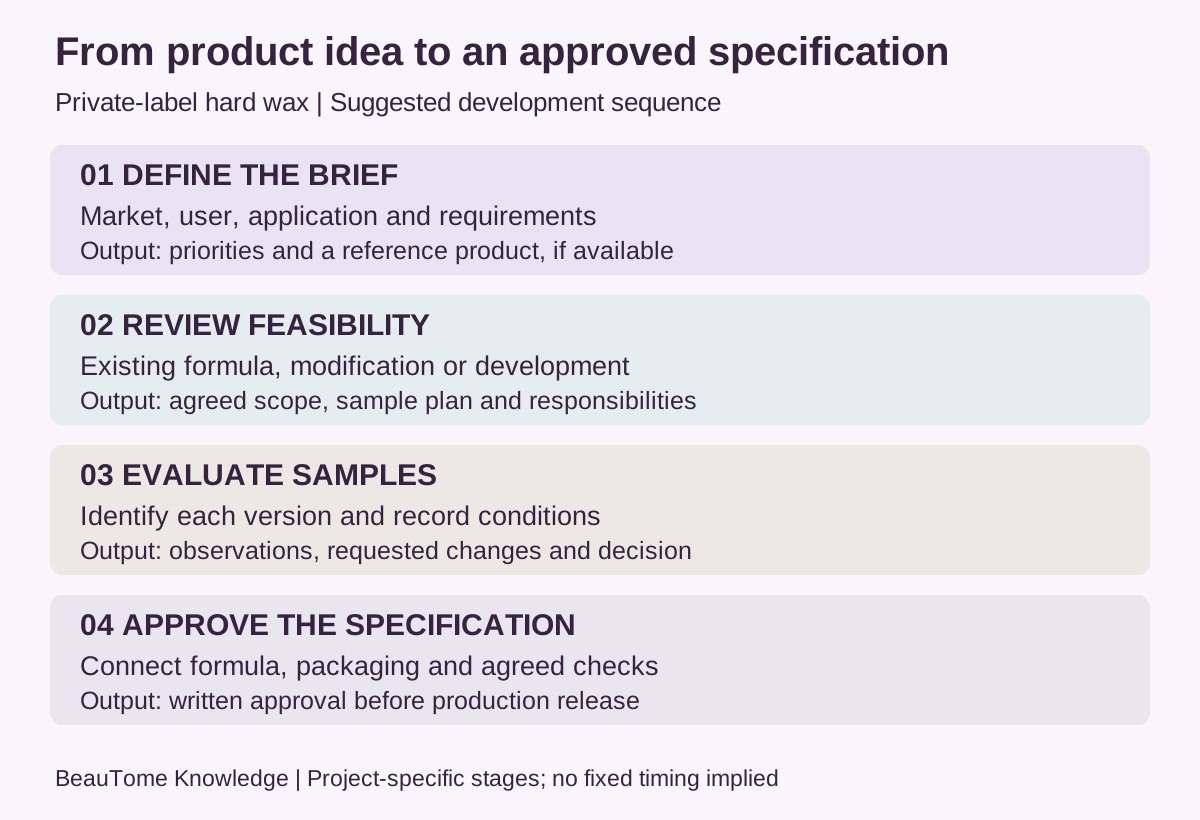
Ask for a quotation that distinguishes development and sample costs from production, packaging, testing and delivery. Have the supplier state whether a quoted lead time begins at payment, formula approval, artwork approval or another milestone. A date is only useful when its starting conditions are clear.
Step 3: evaluate samples against agreed criteria
Give each sample a code and record the conditions before comparing results. Without version control, feedback such as “the second one was better” can become impossible to trace once colour, scent or packaging also changes.
Agree the evaluation method and acceptance criteria before testing. Relevant observations may include spreading, film readiness, flexibility during removal, residue and the operator’s working window. Record the heater, wax load, temperature-check method, application thickness and relevant room conditions. Follow product instructions and an appropriate professional evaluation procedure.
Keep temperature terms precise: melting behaviour, heater setpoint and wax temperature at application are different measurements. Our A1 low-melting wax guide explains that distinction. For recording service observations, use the separate salon trial guide and record sheet.
Useful feedback states the sample code, observation, conditions and requested outcome. For example: “Sample B formed a removable film sooner than our preferred working window under the recorded conditions; please review a longer working window.” This is more actionable than “B is too fast,” and does not assume a formula change is the only solution.
Step 4: develop the pack and label alongside the formula
A finished pouch is a product component as well as a design surface. Confirm fill weight, pouch dimensions, material, seal, opening and reclosure, batch-code location and shipping-carton arrangement. Evaluate the intended pack with the approved wax; a visual mock-up alone does not establish storage or transport suitability.
Use a versioned artwork file and identify who approves technical copy, translation and legal label content. Formula changes may require another ingredient and claim review. A colour or scent choice should not be treated as purely decorative until the final variant has been reviewed.
For U.S. retail cosmetics, the FDA Cosmetics Labeling Guide covers matters including product identity, business information, net contents, ingredient declarations and label presentation. Use it as one input to the target-market review; it is not a complete market-entry checklist. Other destinations require their own review.
Agree the exact claims your brand wants to make and the evidence needed for each. A supplier’s ingredient description, a successful service trial and a finished-product safety assessment answer different questions. Avoid moving claims from a reference product onto your label without checking their relevance to your final formula.
Step 5: approve a defined production sample
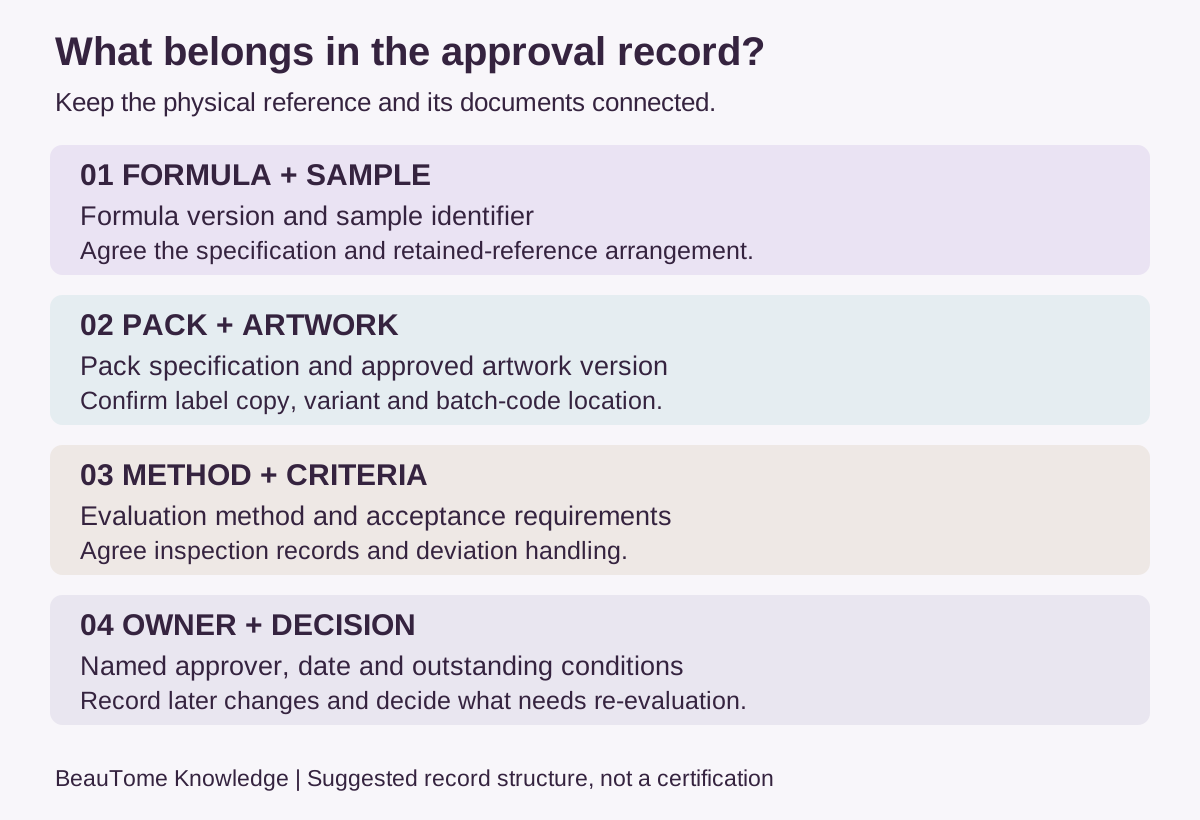
Sample approval should identify what was approved, by whom, and under which specification. A message saying “looks good” can confirm appearance while leaving formula identity, packaging or label wording unresolved.
| Approval item | Record to retain | Responsibility to agree |
|---|---|---|
| Formula and reference sample | Formula/version code, sample identifier, agreed specification and retained-reference arrangement. | Supplier technical contact and brand product approver. |
| Pack and printed artwork | Pack specification, artwork version, colour reference and approved label copy. | Supplier packaging contact and brand artwork approver. |
| Evaluation and inspection | Methods, acceptance criteria, results to supply and handling of deviations. | Named quality contacts on both sides. |
| Market documents and claims | Required documents, exact product scope, outstanding actions and release conditions. | Brand or importer’s designated market-review owner, with supplier inputs. |
| Commercial release | Confirmed quantities, costs, timing basis and shipping responsibilities. | Authorised purchasing and supplier contacts. |
Clarify whether the sample is a development sample, a packaging mock-up or a production-representative sample. Agree how initial production will be checked against the approved reference and what happens if there is a deviation. If an approved component or formula changes later, record the change and determine what needs re-evaluation before release.
What determines MOQ and lead time for custom hard wax?
Request minimum quantities for the formula batch, each colour or scent variant, and each packaging format. These may be different constraints. Also ask who holds or pays for unused printed packaging when packaging quantities exceed the first wax order.
Separate the timeline into feasibility, sample preparation, evaluation and revision, artwork approval, packaging procurement, production and shipping. An existing formula with new artwork and a new formulation project should not be assumed to follow the same schedule.
BeauTome reviews private-label packaging and custom hard wax formulation against the submitted brief. Project MOQ, development scope, documentation and timing are confirmed individually. Stock-product terms should not be carried across to a custom order.
Download the private-label hard wax development brief
Download the editable development brief (CSV). Open it in Excel, Google Sheets or another spreadsheet editor. Fill in the “Your requirement” column, mark priorities and leave genuinely undecided items open for discussion.
The worksheet covers the target market, use case, formula preferences, sample evaluation, packaging, quantity split, documentation, approval owners and change control. It is an enquiry and planning tool; requirements become agreed commitments only when both parties confirm them.
If your project is still early, start with five answers: destination market, intended user, treatment areas, what you want to customise, and expected quantity by pack or variant. Those answers help determine whether to begin with an existing formula or a separate development review.
Frequently asked questions
Can I use my own brand on an existing hard wax formula?
That is a private-label route to discuss with the supplier. Confirm the selected formula, pack options, artwork requirements, minimum quantities and market documents before treating it as an approved offer.
Can I request a different colour, scent or working behaviour?
Include the request in the brief and ask for feasibility review. The effect on formula identity, evaluation, documentation, price and minimum quantities must be confirmed for the selected variant.
Do I need a completely new formula to create a differentiated brand?
Not necessarily. Service focus, pack format, instructions and training support may form part of your product proposition. First evaluate whether an existing formula meets your must-have requirements; develop changes around specific gaps.
Does paying for development give my brand exclusive ownership?
Do not assume it does. Ask for a written agreement covering formula ownership, permitted use, exclusivity, confidentiality and any restrictions before commissioning development.
What should I send when requesting a custom wax quotation?
Send your target market, intended use, formula or reference sample, requested changes, pack specification, quantity by variant and desired launch window. Identify which items are fixed and which need supplier recommendations.
Start your hard wax development brief with BeauTome
Use the worksheet to organise your requirements, then share your project brief with BeauTome. We can review the product route, sampling needs and packaging scope before confirming project-specific terms. Explore the hard wax range if you want an existing formula as the starting reference.
Sources and scope
- BeauTome OEM/ODM and private-label services: current scope for project review; availability and commercial terms require a written project confirmation.
- U.S. FDA Cosmetics Labeling Guide, accessed October 10, 2026: U.S. label-planning reference.
- The development stages, approval table and downloadable brief are BeauTome’s suggested buyer-planning framework. They do not report a customer project, measured product result or universal factory process.