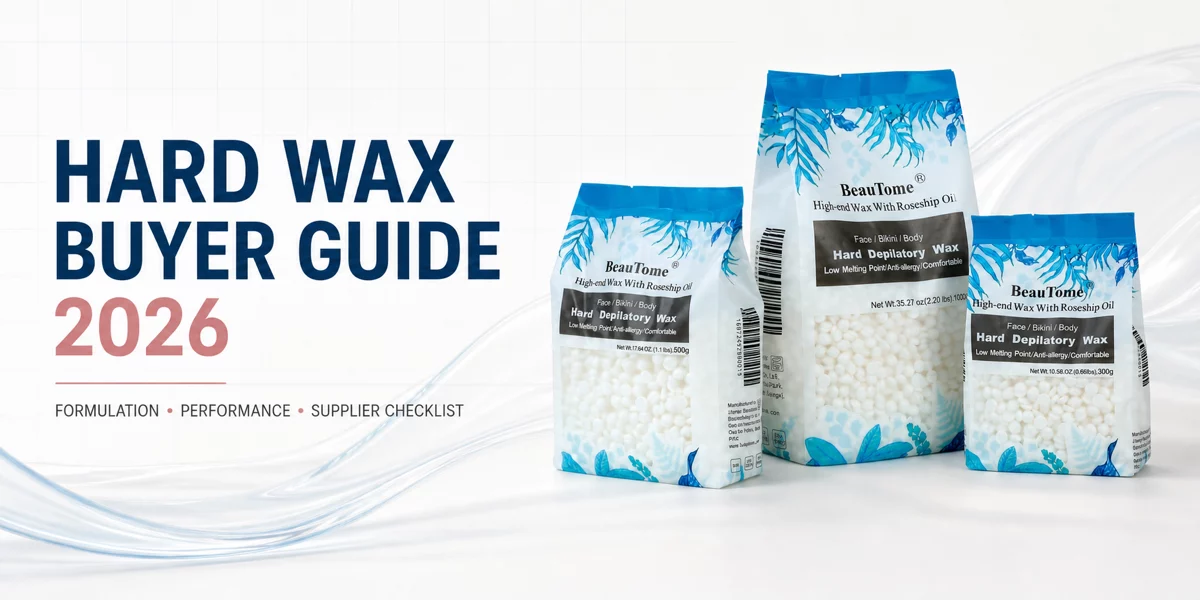
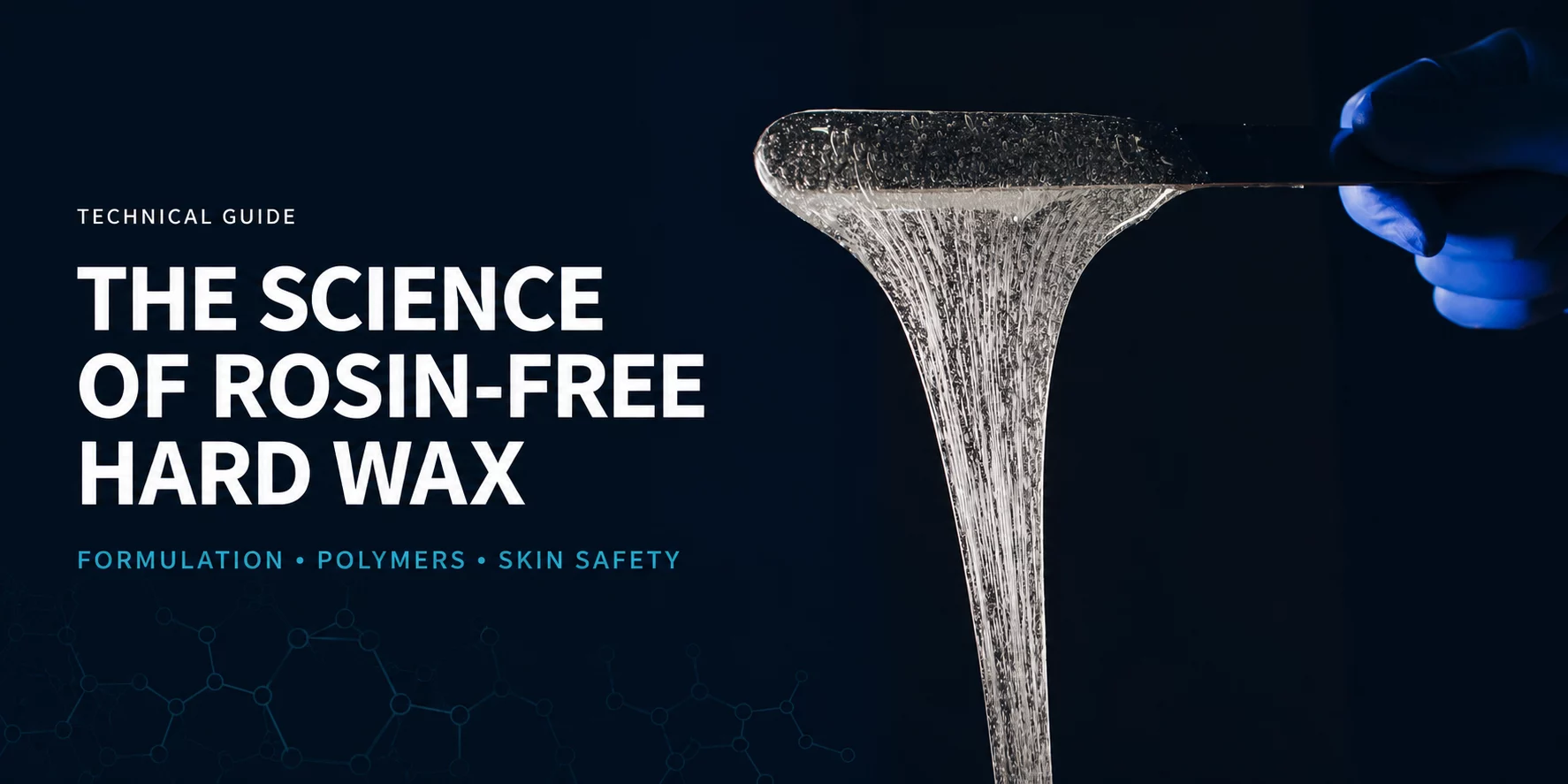
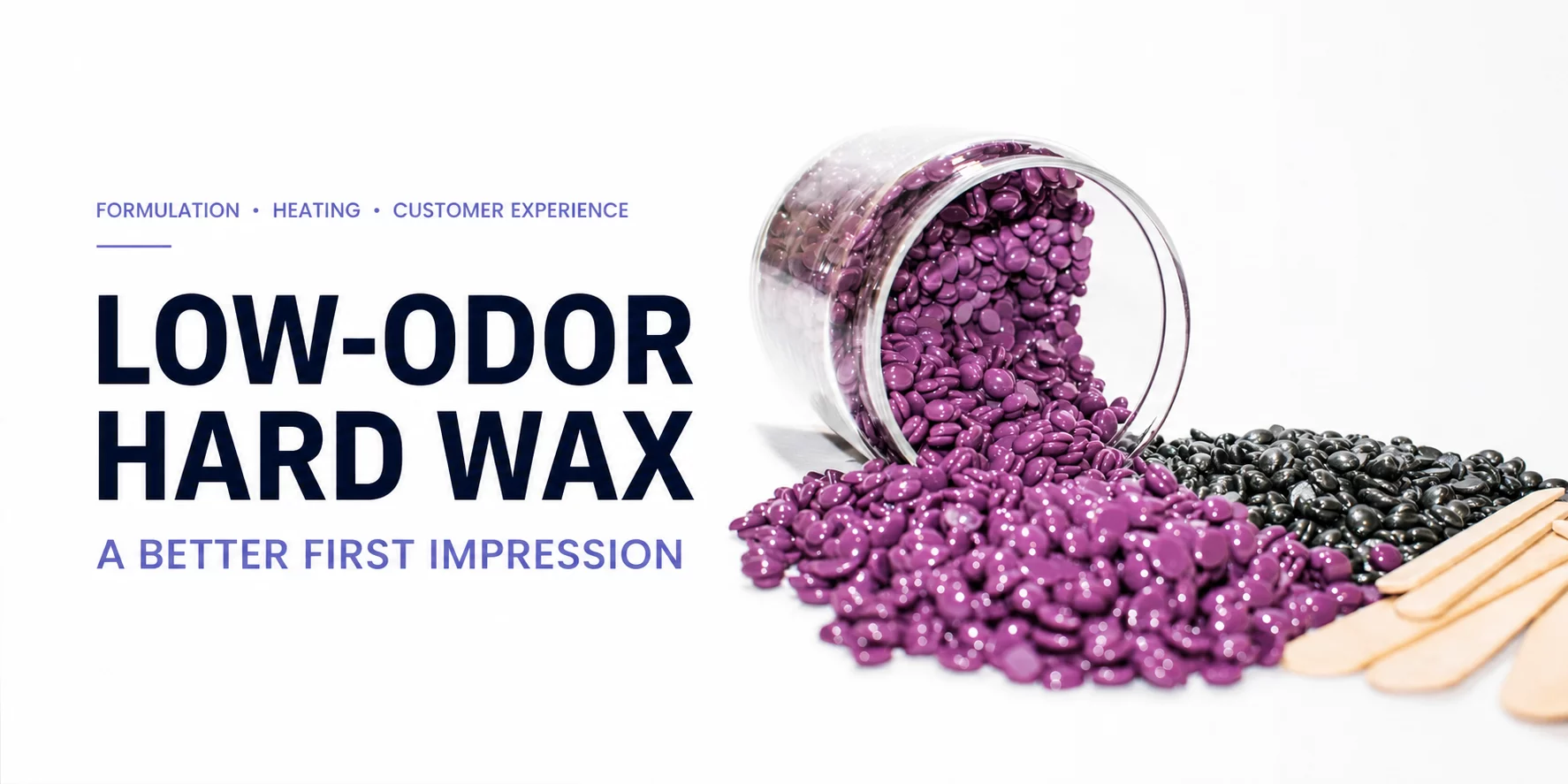
-
Any Questions teco.beautome@gmail.com
最后更新:
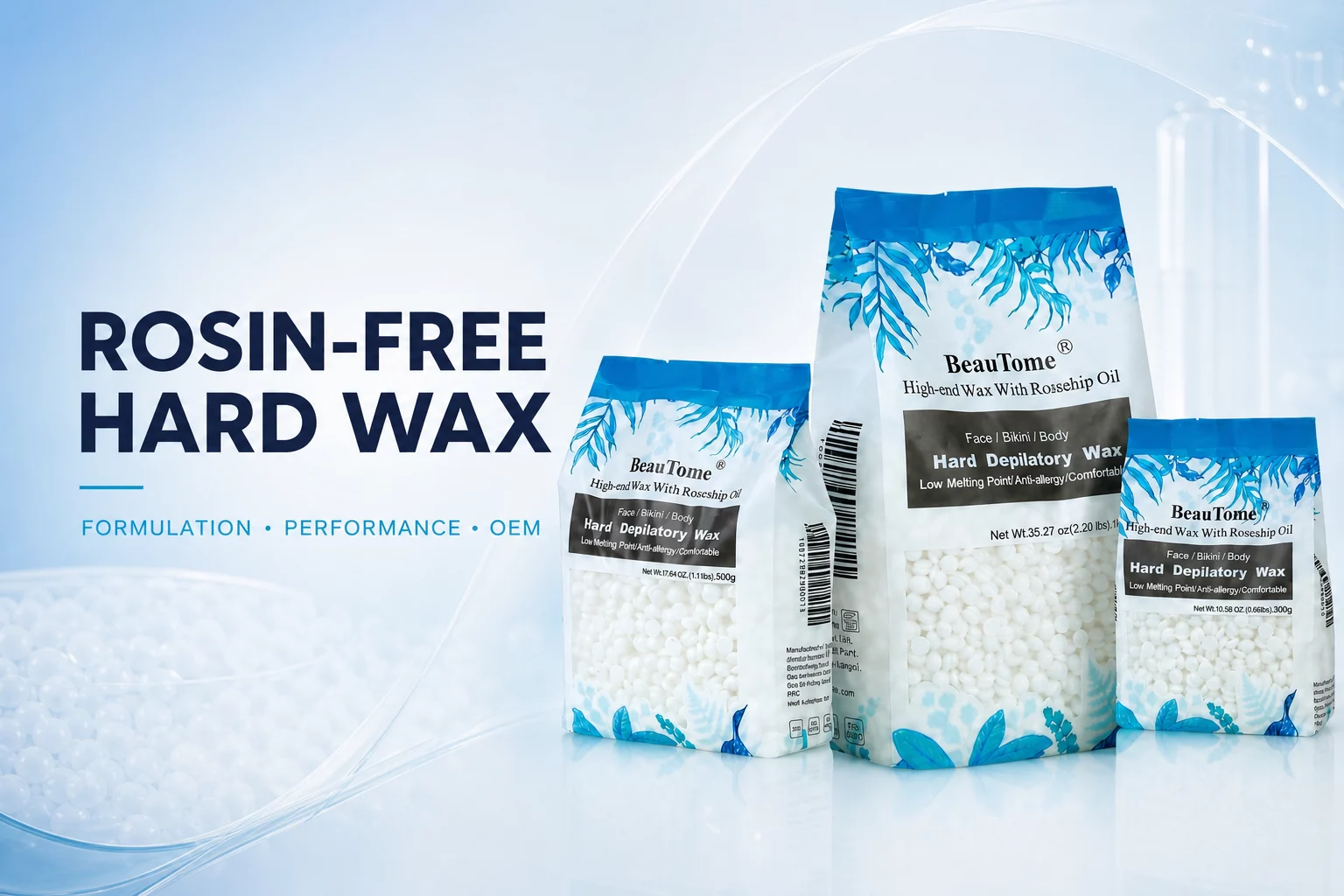
The Complete Guide to Rosin-Free Hard Wax for Beauty Brands
Rosin-free hard wax gives beauty brands a clear formulation story, but product quality depends on much more than removing rosin. This guide explains polymer systems, working behavior, sample testing, documentation, compliance, packaging, and OEM decisions for private-label and professional salon brands.
 ByTeco
A formulation, performance, quality, and sourcing guide for private-label beauty brands.
Rosin-free hard wax is a stripless depilatory wax formulated without colophony or rosin-derived tackifiers. Instead of depending on natural rosin for adhesion, these formulas typically use synthetic hydrocarbon resins, film-forming polymers, waxes, and plasticizing components to create the grip, flexibility, and working consistency required for professional hair removal.
For beauty brands, however, “rosin-free” is only the starting point. A commercially successful formula must also spread consistently, set within a practical service window, remove different hair types cleanly, remain flexible during the pull, tolerate repeated heating, and support defensible product claims in the target market.
This guide explains how rosin-free hard wax works, what determines quality, how to evaluate samples, what documentation to request, and how to build a private-label product that fits a specific customer and price position.
What Does Rosin-Free Hard Wax Mean?
Rosin—also called colophony—is a natural resin obtained from pine and related sources. It has long been used in adhesive products because of its tack. In a conventional depilatory wax, rosin or modified rosin derivatives may contribute to hair grip, viscosity, and film formation.
A rosin-free formula replaces that adhesive system with alternatives selected to produce the required melt, spread, set, and removal behavior. Depending on the performance target, a formulation may combine synthetic resins, ethylene copolymers, microcrystalline or synthetic waxes, mineral or botanical oils, pigments, and other functional ingredients.
Rosin-free does not automatically mean fragrance-free, vegan, natural, organic, hypoallergenic, or suitable for every skin type. Those are separate formulation or claim questions. The U.S. FDA notes that there is no federal definition governing the term “hypoallergenic,” so brands should only use it when their finished-product assessment and claim substantiation support it.
For a deeper look at the material science, see our article on rosin-free hard wax formulation and polymers.
Why Beauty Brands Choose Rosin-Free Formulas
1. A clear ingredient-positioning story
Rosin-free gives brands a specific and understandable formulation distinction. It is especially relevant when a product line is positioned for professional salons, facial or intimate waxing, fragrance-conscious users, or customers who actively avoid colophony.
2. Greater control over the performance profile
Synthetic resin and polymer systems can be adjusted to target different levels of flexibility, set time, film strength, viscosity, and grip. This gives an OEM development team more room to tune a formula for coarse hair, short hair, thin-layer application, humid climates, or high-volume salon work.
3. Premium product differentiation
Rosin-free formulas often sit above entry-level wax in a brand architecture because the buyer is purchasing more than beads in a bag. The commercial proposition may include a more controlled formula, stronger documentation, fragrance-free options, stability work, application testing, packaging development, and regional compliance support.
How a Rosin-Free Hard Wax Formula Is Built
No single ingredient determines whether a hard wax performs well. The finished behavior comes from the balance among several functional groups.
| Formulation component | Typical function | What buyers should observe |
|---|---|---|
| Synthetic resin or tackifier system | Hair grip, cohesion, film formation | Clean removal without excessive residue |
| Film-forming polymer | Elasticity and resistance to snapping | Strip stretches without breaking prematurely |
| Waxes | Hardness, melt profile, set behavior | Predictable softening and cooling |
| Plasticizing or emollient phase | Spreadability and flexibility | Smooth application rather than brittle or rubbery film |
| Pigments and fillers | Appearance, opacity, rheology | Uniform color and no settling or speckling |
| Fragrance or skin-conditioning additions | Sensory and positioning benefits | Compatibility, odor stability, and compliant labeling |
Changing one component can affect several characteristics at once. For example, increasing flexibility may also change set time or the thickness needed for a clean pull. That is why sample evaluation should use a defined protocol rather than a single informal test.
Temperature: Separate Melting, Working, and Skin-Contact Conditions
Temperature claims are frequently oversimplified. A wax heater setpoint is not necessarily the wax temperature in the center of the pot, and the temperature used to melt a full load is not automatically the appropriate temperature for application.
- Melting phase: the formula is heated until the required amount becomes uniform.
- Working phase: the operator reduces or regulates heat until the wax reaches the viscosity recommended by the manufacturer.
- Pre-application check: the operator confirms consistency and tests temperature according to product instructions before applying wax to a larger area.
There is no universal working temperature for every rosin-free formula. Polymer system, pot volume, room conditions, heater control, application thickness, and service area all influence the practical window. A responsible brand should publish product-specific directions instead of promoting one number as a universal safety guarantee.
The Performance Criteria That Matter Most
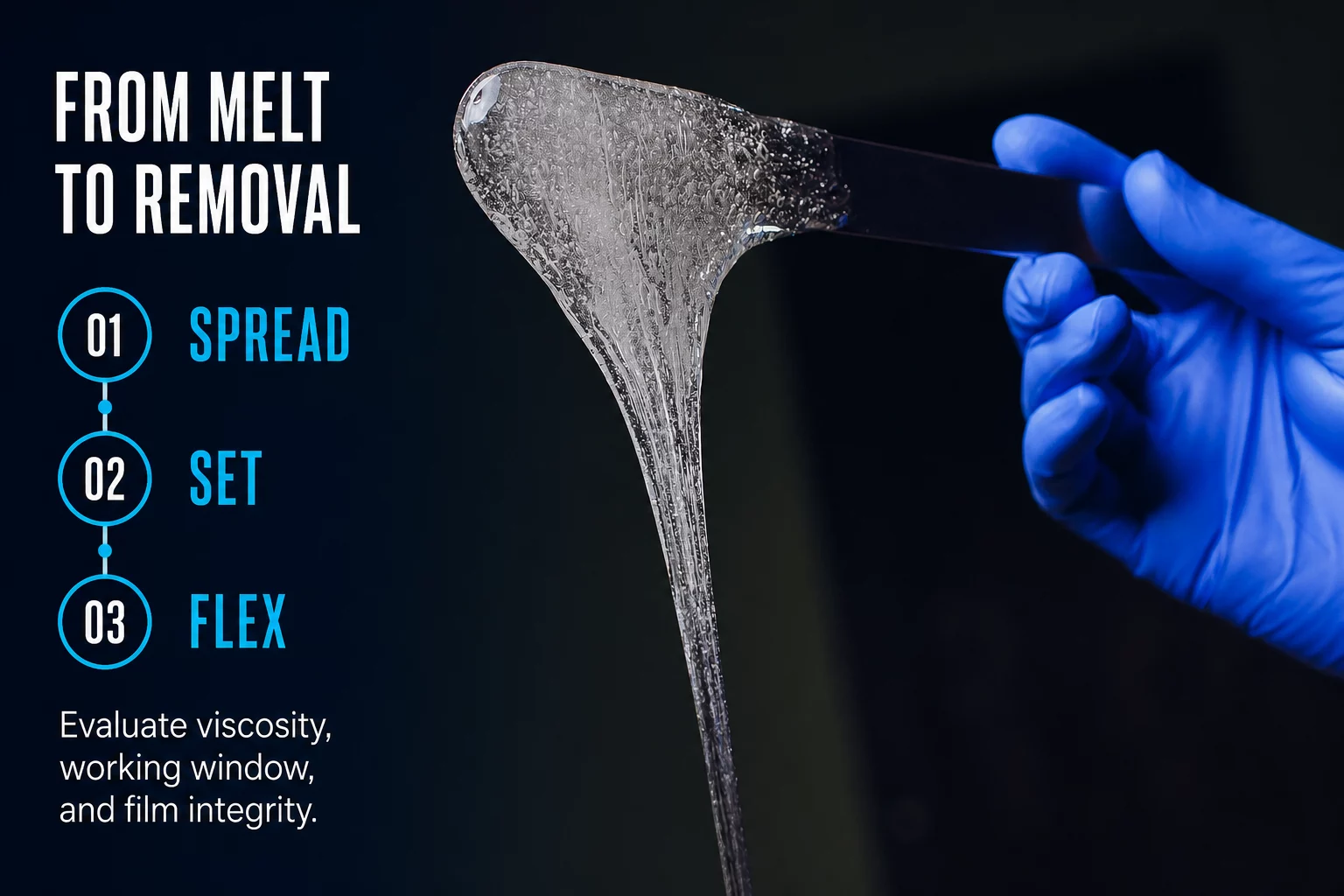
Spreadability
The wax should move smoothly from spatula to skin at the recommended working condition. Excessive drag makes an even layer difficult; overly fluid wax can reduce control and create an inconsistent edge.
Set time and service window
Fast setting can improve salon throughput, but “faster” is not always better. The technician still needs enough time to shape the application and create a reliable removal lip. Evaluate set time under more than one room temperature and humidity condition.
Elasticity and film strength
A good strip should tolerate the deformation required for removal without cracking into fragments. At the same time, excessive softness can make the film difficult to lift. The correct balance depends on the intended service and application thickness.
Hair grip and clean removal
Test the formula on the hair types and body areas included in the product positioning. A formula designed for fine facial hair may require a different balance from one intended for coarse Brazilian or men’s grooming services.
Residue and repeated heating stability
Observe whether the wax leaves tacky residue and whether color, odor, viscosity, or brittleness changes during a realistic salon session. Testing only a freshly melted cup does not represent repeated professional use.
How to Evaluate a Manufacturer’s Sample
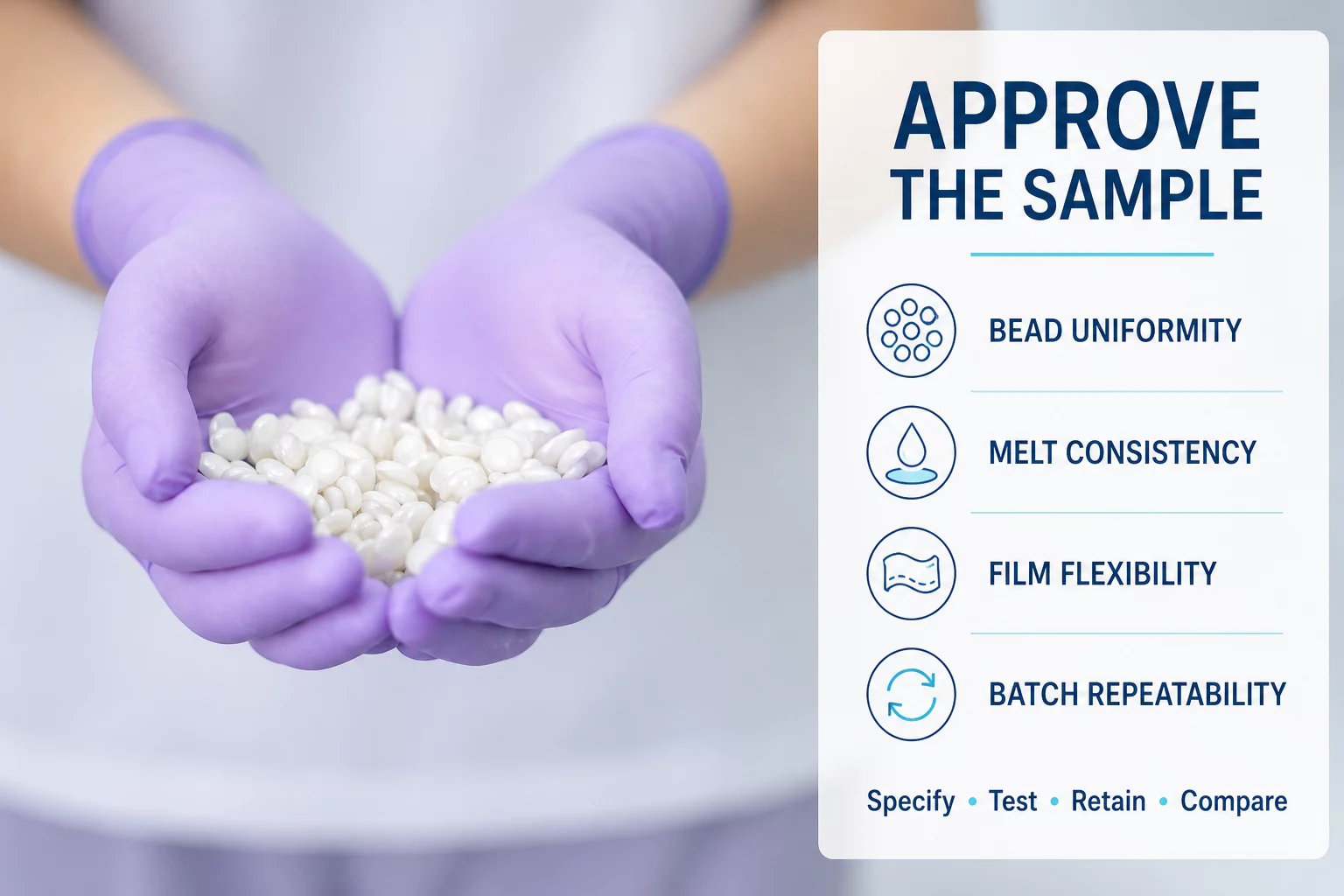
A structured scorecard helps a buying team compare formulas without allowing color, fragrance, or packaging to dominate the decision.
- Record the sample code, batch number, formula version, and date.
- Use the same heater, wax load, spatula, and room conditions for comparison.
- Measure the time needed to reach a uniform working consistency.
- Assess spreadability at the supplier’s recommended condition.
- Record application thickness and set time.
- Test lift-edge formation, elasticity, breakage, hair removal, and residue.
- Repeat after the wax has remained heated for a defined period.
- Run salon trials with trained professionals before approving the formula.
- Freeze the approved master sample and written specification before mass production.
For more application and troubleshooting questions, use our professional hard wax FAQ.
Choosing the Right Formula for Your Market
| Target use | Typical priorities | Questions to test |
|---|---|---|
| Facial and precision waxing | Control, visibility, fine-hair grip, clean edge | Can technicians apply small, accurate shapes? |
| Brazilian and intimate services | Coarse-hair grip, flexibility, manageable set time | Does the strip remain intact on thicker applications? |
| Underarms and body | Versatility, speed, low residue | Does performance remain consistent across hair types? |
| High-volume salons | Pot stability, repeatability, service efficiency | Does viscosity remain usable during a long session? |
| Home-use retail | Clear instructions, forgiving working window, convenient pack | Can the intended user recognize the correct consistency? |
A single “universal” formula can simplify inventory, while a segmented range can create clearer specialist positioning. The right decision depends on channel, technician skill, expected retail price, pack size, and how much consumer education the brand can provide.
OEM and Private-Label Customization Options
Customization should begin with performance, not color. Once the target formula is approved, a manufacturer can assess which aesthetic and packaging changes are technically compatible.
- Performance profile: flexibility, grip, set time, viscosity, and recommended layer thickness.
- Sensory profile: fragrance-free or fragranced variants, color, opacity, and bead appearance.
- Positioning ingredients: selected oils or skin-conditioning ingredients, subject to compatibility and claim review.
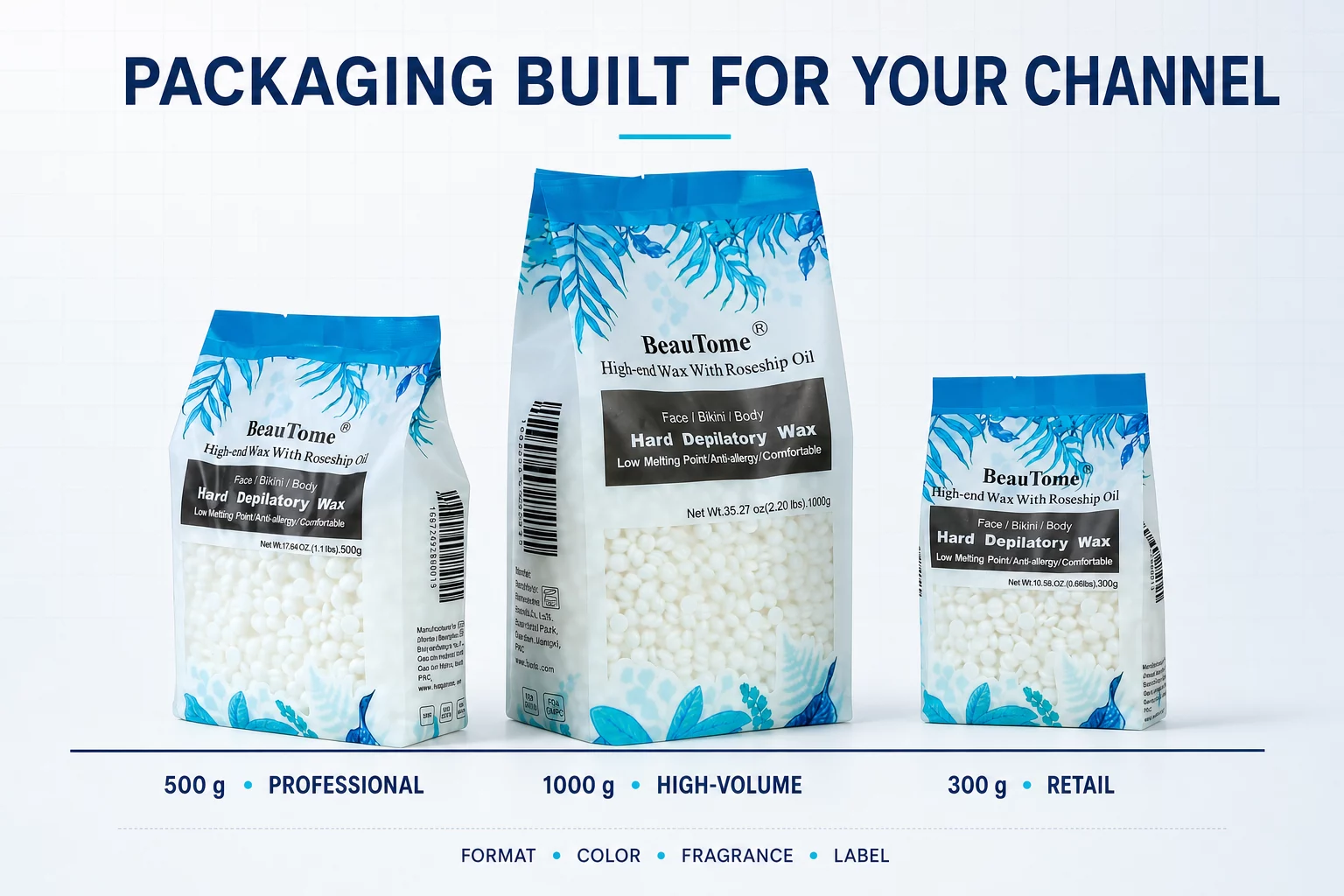
- Pack format: retail pouches, jars, professional bags, or bulk supply.
- Fill weight: consumer, salon, and distributor sizes based on market economics.
- Brand presentation: artwork, label language, instructions, cartons, and shipping cases.
Every customization can affect cost, MOQ, lead time, testing, and documentation. A new fragrance or active is not merely an artwork change; it may require compatibility, stability, labeling, and safety-review work.
Quality Documentation Beauty Brands Should Request
The required file depends on the market and the buyer’s role, but a professional supplier discussion commonly includes:
- Complete INCI or ingredient information appropriate to the project stage
- Safety Data Sheet where applicable
- Certificate of Analysis or batch-release specification
- Physical and chemical specifications
- Stability and packaging-compatibility evidence
- Microbiological assessment where relevant to formula type and market requirements
- Manufacturing quality-system information
- Label and claim-support information
- Traceability, retained-sample, and complaint-handling procedures
Documents should match the actual product, formulation, manufacturer, and batch. A generic certificate or an unrelated test report is not a substitute for product-specific evidence.
Regulatory and Claims Considerations
United States
Cosmetics are regulated by the FDA, but cosmetic products and ingredients—other than color additives—generally do not receive FDA premarket approval. Brands should avoid presenting registration or facility-related documents as “FDA approval.” Claims and labeling must be truthful and supported.
European Union
Under Regulation (EC) No 1223/2009, the responsible person must ensure that the product undergoes a safety assessment and that a Cosmetic Product Safety Report is prepared before the cosmetic is placed on the market. The Product Information File also includes information such as manufacturing method, GMP compliance, and—where justified—proof of the claimed effect.
Other markets have their own responsible-party, notification, ingredient, labeling, language, and claim requirements. Confirm the destination markets before freezing the formula and packaging.
Common Sourcing Mistakes
- Choosing by the lowest unit price: a cheaper wax that breaks, leaves residue, or creates complaints can cost more after launch.
- Approving only color and fragrance: visual preferences should not replace performance testing.
- Using one temperature claim for every formula: publish directions based on product-specific testing.
- Calling every rosin-free wax hypoallergenic: rosin-free removes one ingredient category; it does not prove that no user can react to the finished formula.
- Skipping heater compatibility: evaluate wax with the equipment and pot size your customers are likely to use.
- Changing the formula after sample approval: lock the formula version, specification, and retained standard.
- Leaving compliance until after packaging: market requirements can affect formula, claims, warnings, and label layout.
Questions to Ask a Rosin-Free Hard Wax Manufacturer
- Is the formula free from colophony and the rosin derivatives covered by our specification?
- Which performance characteristics can be customized?
- What are the recommended melting and working instructions for this exact formula?
- How are viscosity, elasticity, set time, color, and batch consistency controlled?
- What stability and packaging-compatibility work is available?
- Which documents are supplied for our target market?
- What are the sample, pilot, and production approval stages?
- What are the MOQ and lead-time implications of formula and packaging changes?
- How are formula revisions and batch traceability managed?
- Can the manufacturer support both retail packs and professional or bulk formats?
Rosin-Free Hard Wax FAQ
Is rosin-free hard wax automatically hypoallergenic?
No. Rosin-free confirms the absence of rosin according to the product specification, but the finished product contains other ingredients. Any hypoallergenic or sensitive-skin claim needs appropriate assessment and substantiation for the market.
Does rosin-free hard wax require strips?
Hard wax is normally designed to set into a removable film and is pulled without a nonwoven or paper strip. Follow the instructions for the specific formula.
Is every rosin-free wax low temperature?
No. “Rosin-free” identifies an ingredient-system choice, while working temperature depends on the complete formula. Request product-specific directions and test the wax with the intended heater.
Can one formula work for face, bikini, underarm, and body?
A versatile formula may cover several areas, but the brand should validate grip, application control, and removal behavior for each intended use. Specialist formulas may perform better for a narrow customer need.
What determines private-label hard wax cost?
Cost is affected by resin and polymer system, specialty ingredients, fragrance and pigment choices, pack material, fill weight, order quantity, testing, documentation, artwork, cartons, and logistics.
What should be approved before mass production?
Approve the formula version, retained reference sample, written specification, application directions, pack components, artwork, claims, required documentation, inspection criteria, and golden packaging sample.
Build the Formula Around the Brand Promise
The best rosin-free hard wax is not the one with the longest claim list. It is the formula whose working behavior, documentation, packaging, and positioning fit the brand’s actual customer.
BeauTome develops and manufactures rosin-free hard wax for private-label and professional beauty brands, with options for formula performance, fragrance, color, pack size, and branded packaging. Share your target market, channel, price position, and service requirements to begin with the right sample rather than a generic formula.
About the Author
Teco is an OEM/ODM manufacturing and product-development specialist with more than a decade of experience in beauty products, salon equipment, engineering, quality control, and international supply chains. He writes practical guides for brand founders, distributors, and product managers evaluating beauty-product formulas and manufacturers. Connect with Teco on LinkedIn.
References
- U.S. FDA: Cosmetics Safety Q&A—Hypoallergenic
- U.S. FDA: Cosmetics Are FDA-Regulated, Not FDA-Approved
- Regulation (EC) No 1223/2009 on Cosmetic Products
Planning to replace an existing salon formula? Use our rosin-free hard wax salon trial guide and blank evaluation record to compare service conditions, operator learning and consumption before rollout.
Evaluating a low-melting formula for facial or bikini-area services? Read our A1 rosin-free hard wax guide for the 48–50°C melting specification, temperature distinctions and product documentation to review.