-
Any Questions teco.beautome@gmail.com
最后更新:
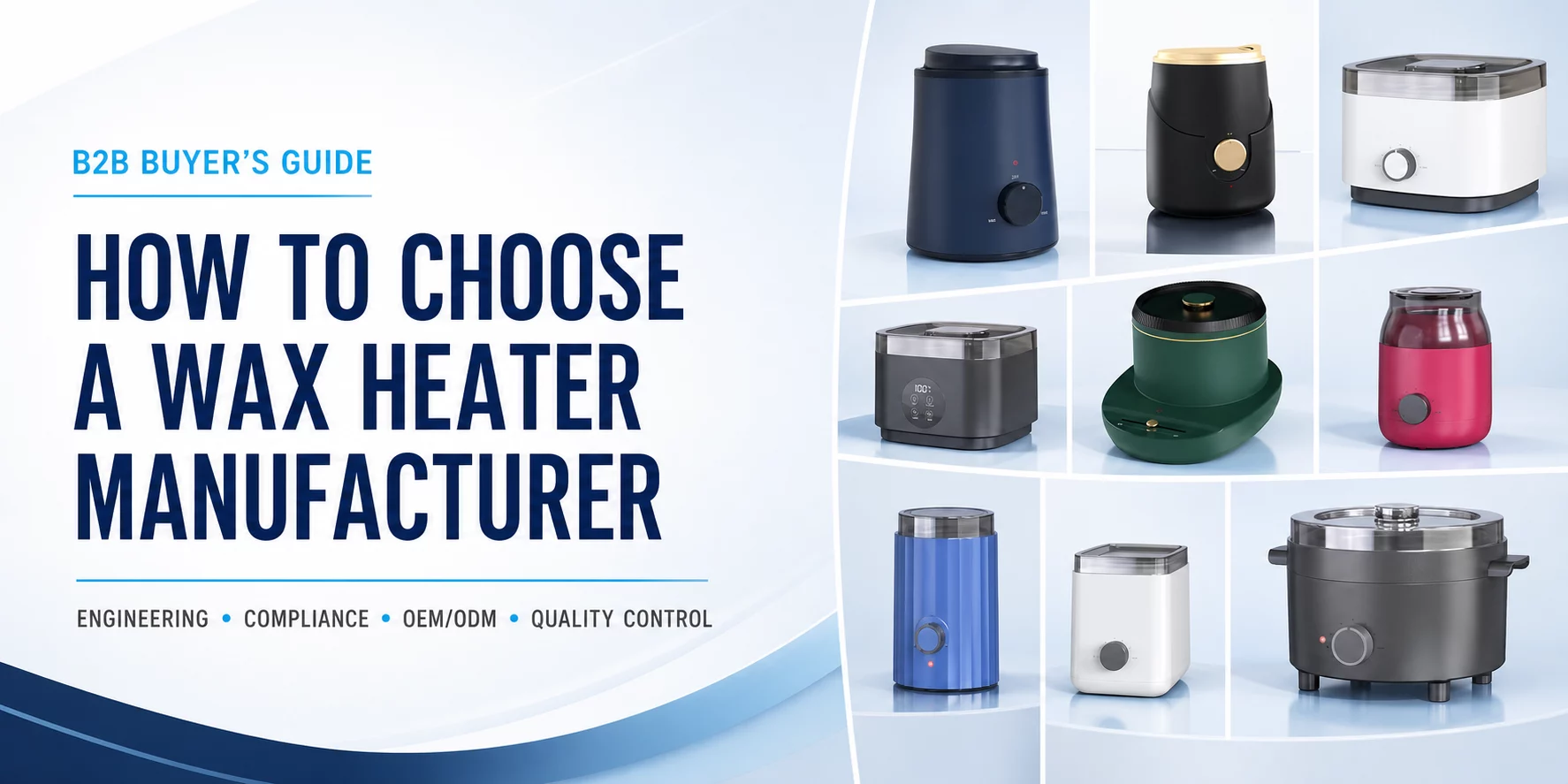
How to Choose a Wax Heater Manufacturer: Engineering, Compliance, OEM/ODM & Quality Control
A practical B2B guide to evaluating wax heater manufacturers through engineering evidence, market compliance, OEM/ODM control, sample testing, quality systems, and total sourcing risk.
 ByTeco
Last updated: August 31, 2026.
A reliable wax heater manufacturer should prove four things before you place a production order: stable engineering, market-appropriate compliance documentation, controlled OEM/ODM changes, and repeatable quality control. Do not select a supplier by unit price, wattage, or a logo sheet alone. Evaluate the physical sample, its bill of materials, the applicable test records, and the production-control plan as one package.
This guide is written for beauty brand owners, importers, distributors, procurement teams, and salon-equipment companies sourcing a professional wax warmer or private-label wax heater. It explains what to test, which documents to request, how to compare OEM and ODM options, and what to lock before mass production.
What should you look for in a wax heater manufacturer?
The best wax heater manufacturer for your project is not necessarily the factory with the lowest quotation or the longest catalog. It is the supplier that can translate your target market into a controlled product specification, demonstrate the design with evidence, and reproduce the approved sample consistently at scale.
| Evaluation area | Evidence to request | Common warning sign |
|---|---|---|
| Heating engineering | Temperature curve, distribution test, recovery behavior, control logic | Only a maximum-temperature claim |
| Electrical construction | BOM, wiring review, insulation approach, safety components | Components change without approval |
| Compliance | Applicable reports, declarations, labels and model identification | Certificates do not match the ordered model |
| OEM/ODM control | Change list, tooling ownership, approved drawings, firmware version | “Customization” is not documented |
| Quality control | Incoming, in-process and final inspection criteria | Inspection relies only on appearance |
| After-sales readiness | Warranty terms, failure analysis, spare-parts plan | No defined process for field failures |
1. Start with the market, user, and product position
Before comparing factories, define where and how the wax heater will be sold. A home-use warmer, a mobile-technician unit, and a high-throughput salon heater have different priorities. The specification should identify the target country, voltage and plug, wax format, expected fill volume, control type, cleaning method, packaging channel, and intended price tier.
Ask the manufacturer to respond to a written product brief rather than a broad request for “your best wax heater.” A good response should identify unclear requirements, explain relevant trade-offs, and separate standard options from changes that require new tooling, electronics, firmware, or testing.
Information to include in the initial brief
- Target country or countries and sales channel
- Home, salon, mobile, or professional back-bar use
- Required capacity and compatible wax container
- Analog, digital, or touchscreen control preference
- Target voltage, frequency, plug and detachable-cord requirement
- Logo, color, finish, packaging, manual, and language requirements
- Expected order volume and launch timing
- Required market documentation and third-party inspection plan
2. Evaluate heating performance—not just wattage
Wattage describes electrical input, not the complete heating result. Melt time and working stability also depend on heater geometry, pot material, thermal coupling, sensor location, control logic, insulation, ambient conditions, wax mass, and starting temperature. Two heaters with the same rated wattage can behave differently under the same load.
For a deeper explanation, see Wax Heater Engineering: Temperature Stability, Sensor Accuracy, and Heat Distribution.
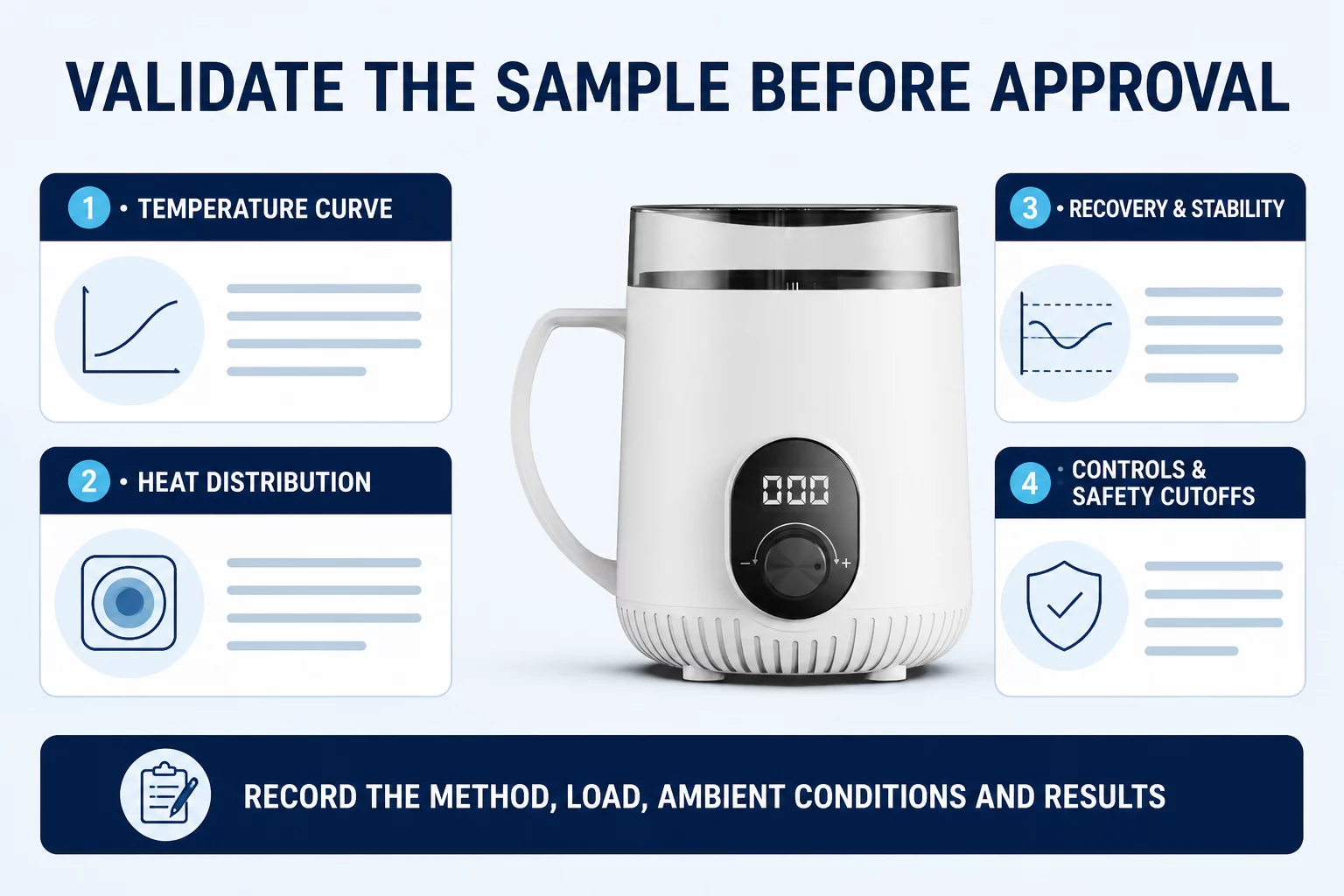
Ask for a temperature curve
A useful temperature curve shows how the measured location changes over time from startup to steady operation. The report should state the test load, probe location, ambient conditions, setpoint, sampling interval, and measurement equipment. Without those details, a graph is difficult to compare or reproduce.
Check heat distribution
One center measurement cannot reveal the full thermal pattern. Compare multiple defined locations in the pot or representative wax load. The objective is not to demand a universal “perfect” temperature; it is to identify excessive local variation, understand where the sensor reads, and confirm that the behavior suits the intended wax and workflow.
Measure recovery and stability
A salon heater may be opened, stirred, refilled, or operated repeatedly. Record how the system responds after a disturbance and whether the control repeatedly overshoots or cycles too widely. Always distinguish the control setpoint, the heater or pot measurement, and the actual wax temperature.
3. Inspect the electrical and mechanical design
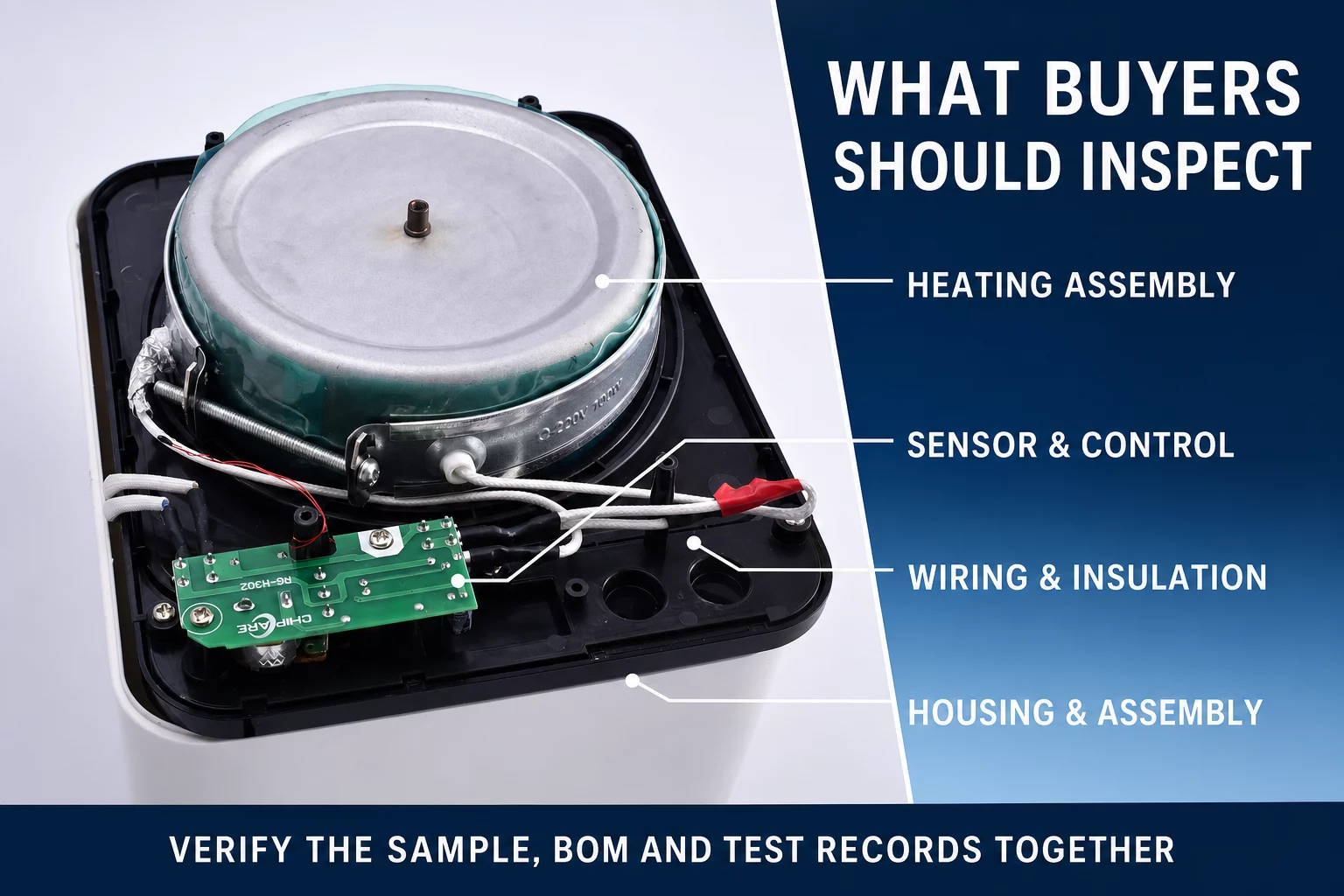
A wax heater is a heat-producing electrical appliance. Supplier evaluation should therefore cover more than the visible housing. Review the heating assembly, sensor and control components, wire routing, insulation, strain relief, connectors, thermal protection, pot support, housing material, lid, feet, and service access.
Ask whether safety-critical or performance-critical components can be substituted during production. If alternatives are allowed, define the approval process. An attractive golden sample has limited value when the production BOM can change without written authorization.
Questions for the engineering review
- Where is temperature measured, and what does the displayed value represent?
- Which component provides temperature control, and which provides independent over-temperature protection?
- How are high-temperature wires, connectors, and insulating materials specified?
- How is the pot supported and thermally coupled to the heater?
- Which plastics or finishes are close to heat, wax, or cleaning agents?
- Which BOM items are locked, and what triggers revalidation?
4. Match compliance evidence to the exact product and market
There is no single universal “wax heater certificate.” Applicable obligations depend on product architecture, target country, electrical configuration, and the economic operator placing it on the market. Ask a qualified laboratory or compliance specialist to confirm the path for your exact SKU.
For the European Union, CE marking is a manufacturer declaration that the product meets applicable EU rules; the manufacturer must complete the conformity assessment, technical documentation, and EU Declaration of Conformity. The European Commission’s CE-marking guidance explains these responsibilities. CE is not simply a certificate purchased once for every future variation.
Electrical and electronic equipment sold in the EU may also fall within restrictions on hazardous substances. The European Commission’s RoHS page explains the scope and restricted substances. For the United States, some digital or radio-frequency devices are subject to FCC equipment-authorization rules; the required route may be certification or Supplier’s Declaration of Conformity depending on the device. Review the FCC Equipment Authorization resources for the current framework.
An ISO 9001 certificate concerns an organization’s quality-management system; it is not proof that a specific wax heater passed product requirements. ISO’s official explanation of ISO 9001 makes that distinction clear.
Compliance-document checklist
- Exact manufacturer and applicant names
- Model number matching the quotation, sample, label, manual, and report
- Rated voltage, frequency, power, plug, and electrical configuration
- Applicable standards and report dates
- Complete report or declaration—not only a logo or first-page screenshot
- Laboratory identity and a method for verifying authenticity
- Technical file, labeling, warnings, and responsible-party requirements
- Reassessment plan when the design, BOM, firmware, or market changes
5. Understand OEM and ODM before requesting customization
OEM wax heater projects normally customize an existing platform through approved options such as color, logo, packaging, manual, plug, or selected components. ODM wax heater projects involve deeper product development, potentially including industrial design, mechanical structure, tooling, electronics, firmware, and a new validation plan.
| Customization level | Typical scope | What buyers should lock |
|---|---|---|
| Private label | Logo, artwork, packaging, manual | Print files, color standards, placement, carton specification |
| Configured OEM | Color, controls, cord, plug, selected features | Option list, BOM, labels, sample, test applicability |
| Cosmetic ODM | New housing or interface using an existing technical platform | Drawings, tooling ownership, materials, finish, change impact |
| Full ODM | New mechanics, electronics, firmware, tooling | Requirements, milestones, IP, validation, compliance and change control |
Every customization can affect cost, lead time, manufacturability, documentation, and compliance. A color change may be simple; a new housing material, heater, control board, wireless function, or power configuration may require further engineering and testing. Ask the supplier to issue a written change-impact assessment.
6. Audit the quality-control plan
Quality control should prevent variation, detect defects, and preserve traceability. Request the actual inspection plan for your model rather than a generic factory presentation. The plan should define the characteristic, method, equipment, frequency, sample size, acceptance limit, record, and reaction when a result fails.
Incoming quality control
Incoming checks may cover heaters, sensors, control boards, cords, plugs, plastics, pots, fasteners, packaging, and printed materials. Buyers should identify which characteristics are safety-critical, performance-critical, or cosmetic and how supplier lots are traced.
In-process quality control
Assembly controls can include wire routing, torque or fastening checks, connector seating, insulation placement, grounding where applicable, functional testing, and firmware verification. Photos of an assembly line are not a substitute for controlled work instructions and recorded results.
Final inspection and reliability testing
Final checks commonly include appearance, operation, control response, electrical safety tests where applicable, labeling, accessories, packaging, and carton verification. Reliability or aging tests should have a written method and acceptance criteria. Avoid accepting a vague statement such as “24-hour aging” without knowing the load, cycle, sample quantity, failure definition, and resulting action.
7. Use a staged supplier-approval process
A controlled sourcing project moves from requirements to evidence, then to a pilot and repeatable production. Do not jump directly from a visually acceptable sample to a full purchase order.
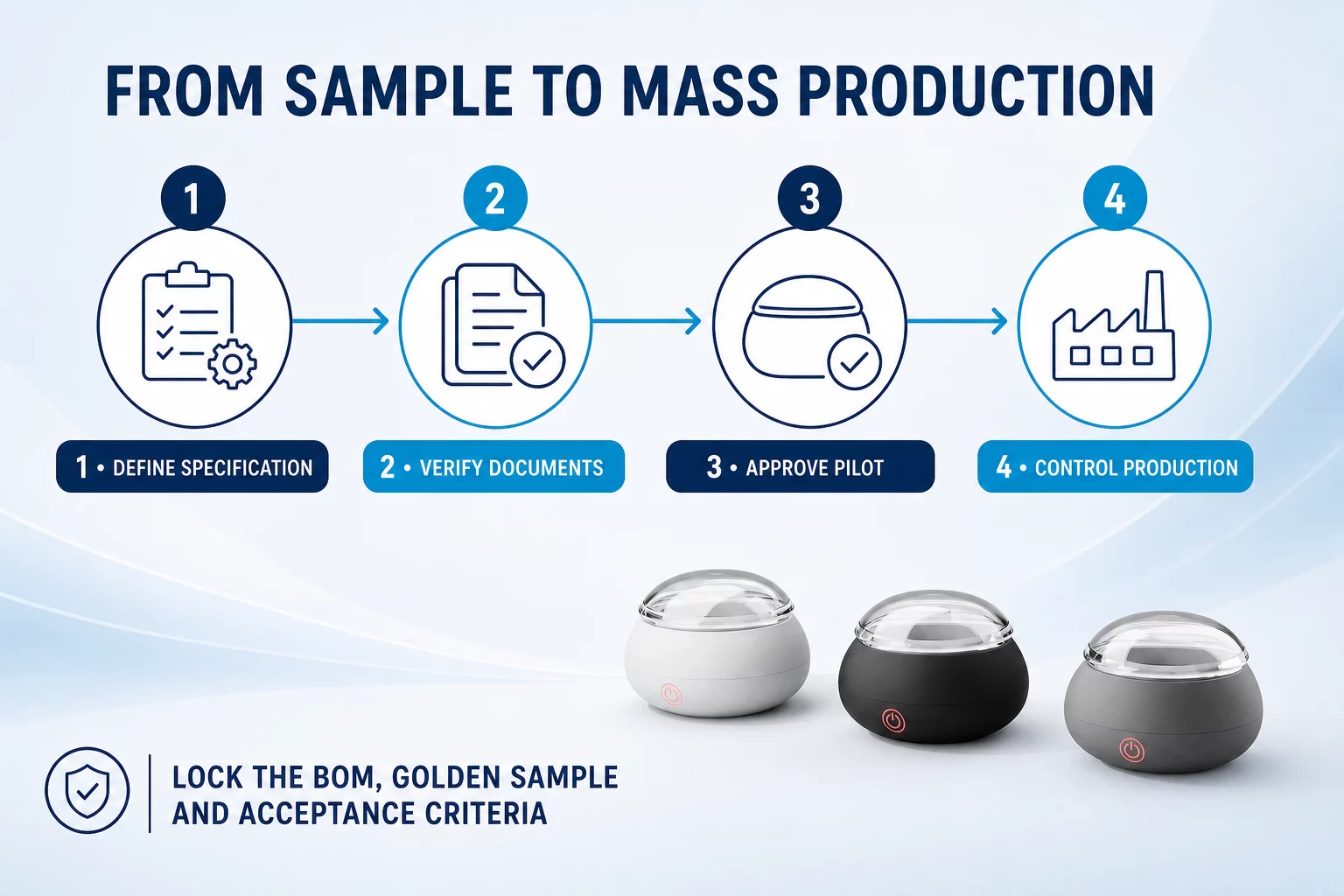
- Define the specification: agree on market, use case, electrical rating, functions, materials, appearance, packaging, documentation, and acceptance criteria.
- Verify documents: review drawings, BOM, test evidence, declarations, labels, manuals, quality plan, and change-control rules.
- Approve a pilot: confirm that a small production run matches the approved design and that inspection records are complete.
- Control mass production: use the golden sample, locked documents, batch records, pre-shipment inspection, and corrective-action process.
8. Compare total landed risk—not only unit price
A low quotation can become expensive through rework, delayed documentation, inconsistent components, packaging damage, returns, warranty replacements, or compliance changes. Compare suppliers with a total-risk model that includes product cost, tooling, testing, inspection, packaging, logistics, duties, spare units, warranty reserve, and the internal cost of managing failures.
MOQ and lead time should also be tied to the customization level. A standard color and logo project is different from a new mold or control system. Ask which materials or components create the minimum order, which deposits are non-refundable, and what must be reapproved before repeat orders.
9. Wax heater manufacturer RFQ checklist
A strong request for quotation makes supplier responses easier to compare. Include the following:
- Target market, channel, and intended user
- Capacity, wax format, controls, operating modes, and required accessories
- Voltage, frequency, plug, cord, labeling, and manual languages
- Housing color, finish, logo, packaging, and carton requirements
- Required drawings, BOM visibility, firmware control, and tooling ownership
- Applicable compliance target and required evidence
- Sample quantity, pilot quantity, forecast, and desired production schedule
- Inspection standard, acceptance criteria, traceability, and change notification
- Warranty, spare parts, failure analysis, and corrective-action expectations
- Quotation validity, payment terms, Incoterm, and shipping assumptions
Frequently asked questions
How do I verify a wax heater manufacturer?
Verify the legal factory identity, manufacturing capability, engineering contact, quality system, model-specific evidence, sample performance, and production-control plan. Use independent document checks, a factory audit when justified, reproducible sample tests, and a pilot order. Do not rely only on marketplace status, catalog size, or certificate images.
What is the difference between an OEM wax heater and an ODM wax heater?
OEM normally uses an existing technical platform with controlled branding or configuration changes. ODM involves deeper design and development, such as new housing, tooling, electronics, firmware, or user experience. ODM creates more differentiation but requires clearer ownership, validation, change control, cost, and schedule management.
Does a digital display guarantee accurate wax temperature?
No. A display may show a setpoint or a sensor reading taken away from the wax. Accuracy depends on sensor location, calibration, control logic, pot construction, wax load, and test method. Compare the displayed value with independently measured temperatures at defined locations and operating conditions.
Which certifications does a wax heater need?
The required conformity route depends on the target market and the exact product configuration. Buyers should identify applicable electrical-safety, electromagnetic-compatibility, substance-restriction, labeling, and responsible-party obligations with a qualified specialist. Require documents that match the ordered model instead of requesting a generic “CE/FCC/RoHS certificate.”
What should be approved before mass production?
Approve the written specification, drawings, BOM, firmware version where relevant, artwork, labels, packaging, test plan, acceptance criteria, compliance evidence, and golden sample. Also define which components cannot change without written approval and how deviations, failures, and corrective actions will be handled.
Final recommendation
Choose a wax heater manufacturer by evidence, not by promises. The supplier should be able to explain the design, reproduce the test method, connect every document to the exact model, control customization, and show how production will remain consistent after the sample is approved.
Explore BeauTome’s wax heater and wax warmer manufacturing options, review the Wax Heater FAQ, or contact BeauTome with your target market, product brief, expected quantity, and customization requirements for an OEM/ODM assessment.