
-
Any Questions teco.beautome@gmail.com
最后更新:2026-09-28
Switching to Rosin-Free Hard Wax: A Salon Trial Guide for Beauty Brands
Plan a controlled rosin-free hard wax salon trial. Compare handling, consumption and training needs with a practical scorecard and downloadable trial record.
 ByTeco
Updated September 28, 2026 · A practical trial framework for salon owners, educators and private-label beauty brands.
Before switching to rosin-free hard wax, run a controlled salon trial against your current formula. Confirm the candidate’s ingredient documentation, follow each wax’s validated heating instructions, record application and removal under comparable service conditions, and compare consumption and training needs. Approve the change only when the results are repeatable and the purchasing specification is clear.
This guide focuses on the decision to change an established salon workflow. For formulation background, start with our complete guide to rosin-free hard wax. The worksheet below is a suggested evaluation method, not a published BeauTome performance study or a universal industry acceptance standard.
What does rosin-free hard wax tell a buyer?
Rosin-free identifies a formulation direction: the wax is intended to exclude rosin, also called colophony, and the rosin-derived ingredients covered by the supplier’s declaration. Ask exactly what that declaration covers and match it to the current formula. The phrase alone does not establish application temperature, hair-removal performance, fragrance status or suitability for every client.
Do not turn a composition statement into a promise of allergy-free waxing. The US FDA explains that “hypoallergenic” has no federal standard or definition. That does not make rosin-free and hypoallergenic interchangeable. Review the complete product, its instructions and the evidence behind each proposed claim. See FDA guidance on hypoallergenic cosmetics.
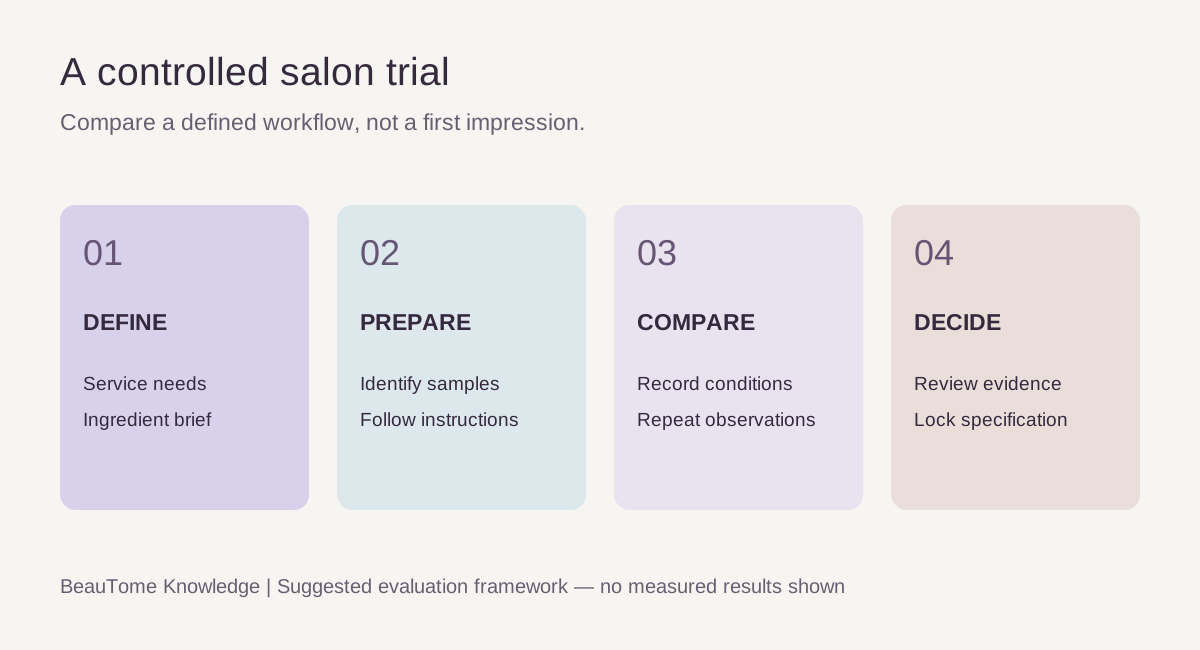
1. Define why your salon wants to switch
Choose a service problem or purchasing requirement before opening the samples. Otherwise, a different color, fragrance or demonstration technique can dominate the decision.
| Reason for the trial | Question to answer | Evidence to retain |
|---|---|---|
| A defined rosin-free range | Does the documented formula meet our ingredient brief? | Formula version, ingredient declaration and supplier clarification |
| Inconsistent film removal | Can trained operators obtain repeatable film integrity? | Film thickness notes, working conditions and tearing observations |
| Too much product waste | What changes in consumption and discarded material? | Wax issued, unused usable balance and classified waste |
| A new service or retail channel | Does the formula suit the intended user and workflow? | Service scope, training needs, instructions and pack requirements |
Keep these objectives separate. A formula can satisfy the ingredient brief while requiring different application timing. Another can feel familiar to technicians but lack the documentation your retail brand needs.
2. Check documents and prepare each formula correctly
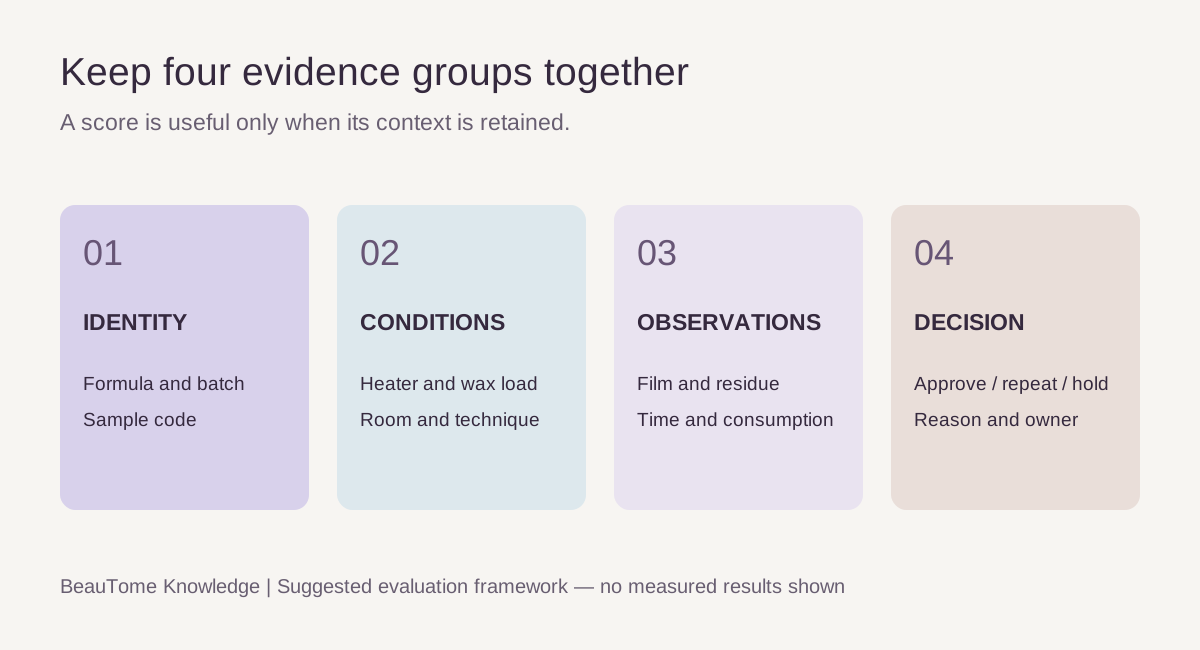
Assign a sample code and record the supplier, product name, batch, formula version where available, receipt date and packaging condition. Obtain the current ingredient declaration, instructions for use, storage guidance and relevant product specification. Ask what evidence supports any claims your salon or brand intends to repeat.
Do not assume the same heater setting is a fair comparison. Two formulas may have different validated preparation instructions. Prepare each within its own instructions, then document the conditions so the comparison is interpretable. A heater display and the wax temperature are not necessarily the same measurement.
- Record heater model, pot or liner, wax load, room conditions, stirring and hold procedure.
- Use an appropriate temperature measurement method and record the measurement location.
- Keep formulas identifiable and separate. Do not mix the candidate with residual wax from the incumbent.
- Use controlled training practice before involving clients. Any service trial must follow product instructions, practitioner qualifications, screening, consent and local hygiene requirements.
This article does not set a universal application temperature or authorize testing on a client who should not receive the service. For equipment variables, consult our wax heater engineering guide.
3. Compare comparable services and operators
Test the proposed workflow across the operators and treatment types it is intended to serve. A small facial application and a large body strip are different tasks; keep their records separate. Note relevant differences in hair, treatment area, application thickness and operator experience rather than attributing every outcome to the formula.
Where practical, rotate the order of the products between sessions and use sample codes on record sheets. Complete blinding may be impossible when formulas look or smell different. Record that limitation instead of calling the exercise a blinded study.
Agree on the number of sessions and operators before beginning, based on the variation you need to understand. This framework does not prescribe a statistically validated sample size. A single successful demonstration is insufficient to establish repeatability across a salon team.
4. Use an anchored trial scorecard
Describe observations before assigning a score. A simple internal scale can use 1 = below the agreed requirement, 3 = meets it and 5 = exceeds it under the recorded conditions. Define the anchors in advance; a total score must not compensate for a safety concern or missing essential documentation.
| Evaluation area | What to record | Keep the interpretation narrow |
|---|---|---|
| Spread and edge formation | Control, thickness, usable edge and corrective work | Compare similar application areas |
| Working window | Application-to-removal timing and operator observations | Record room conditions and thickness |
| Film integrity | Tearing, cracking, fragments and edge failure | Separate technique changes from formula changes |
| Removal and residue | Observed remaining hair, residue and additional work | Do not promise one-pass removal for every client |
| Operator learning | Coaching needed, handling errors and repeatability | Distinguish first-use learning from settled performance |
| Client-reported experience | Consented feedback and any concern requiring escalation | Feedback is not proof of hypoallergenicity or clinical safety |
Download the blank salon trial record (CSV). It contains no assumed results or pass limits. Set your own operational requirements with the responsible trained personnel before using it.
5. Compare cost per completed service
A price per kilogram cannot tell you the complete service cost. Use measured wax consumption, disposable supplies, service time and waste. Keep the wax-only calculation separate from labor and overhead so the team can see what actually changed.
Wax material cost per service = wax consumed in grams × delivered wax cost per gram.
Calculate delivered cost from the actual purchase and relevant freight or other allocated charges, using a consistent basis for both products. Do not count unused wax remaining in a service pot as consumed merely because it was initially loaded. Separately record discarded material, preparation losses and any unusable stock.
When service lengths or treatment areas differ, compare like-for-like groups. A formula’s higher unit price may or may not be offset by changes in consumption or workflow; only your records can establish that. Do not sacrifice hygiene to improve the waste figure.
6. Decide whether to approve, retrain or hold
Make the decision against the original brief. If results vary by operator, review technique and instructions before blaming the product. If a problem persists under controlled conditions, send the supplier the sample identity and records. Pause a trial when an unexpected safety concern arises and follow the appropriate professional and local reporting process.
- Approve: the documented formula and repeated observations meet the agreed requirements, with a workable training and purchasing plan.
- Retrain and repeat: the remaining issue appears linked to a correctable technique or instruction gap; record the change before another trial.
- Hold: essential documentation is missing, results remain inconsistent, or a concern requires investigation.
Before a wider rollout, lock the approved product and packaging specification, batch identification, instructions, storage conditions and supplier change-notification arrangements. For a private-label program, retain a production-representative reference sample and define how future deliveries will be checked. A successful trial is a starting point for ongoing quality control.
Questions salon owners and beauty brands ask
Can we use our existing wax heater?
Possibly, but confirm compatibility with the wax instructions, pot configuration, operating range and preparation method. Record the actual setup used during the trial rather than assuming every heater behaves the same way.
Should rosin-free wax be compared with another rosin-free formula only?
No. If the decision is whether to replace your current wax, that incumbent is the useful operational reference. Evaluate the rosin-free ingredient requirement separately from service performance and cost.
Does a good salon trial support a sensitive-skin claim?
Not by itself. Routine service observations do not establish a general safety or allergy claim. Any such wording needs appropriate finished-product evidence and review for the target market.
What should we send a manufacturer before requesting samples?
Share the intended treatment areas, user skill level, current workflow, ingredient exclusions, fragrance preference, pack format, target market and the specific problem you want to resolve. Explain how you plan to evaluate the sample.
Plan your rosin-free hard wax trial with BeauTome
Review our rosin-free hard wax product overview and hard wax range, then send your market, service requirements and sample evaluation brief. We can discuss a sample plan and the documents to confirm before your team begins. Final formula, packaging and commercial terms should be agreed for your project.
Sources and method notes
This is an editorial trial framework, not a clinical study, certification protocol or report of measured BeauTome product results. The scorecard and decision stages are suggested working tools. Product-specific instructions and local professional requirements take precedence.
- US FDA: “Hypoallergenic” Cosmetics — interpretation of the term in the United States.
- NSW Health: Waxing — a jurisdiction-specific hygiene reference; check the rules applying to your own location.
- BeauTome: Rosin-Free Hard Wax Formulation and Polymers — related formulation background.
Developing wax under your own brand? Use our private-label hard wax development guide and editable product brief to define formula changes, packaging, sample approval and quotation requirements.