-
Any Questions teco.beautome@gmail.com
最后更新:
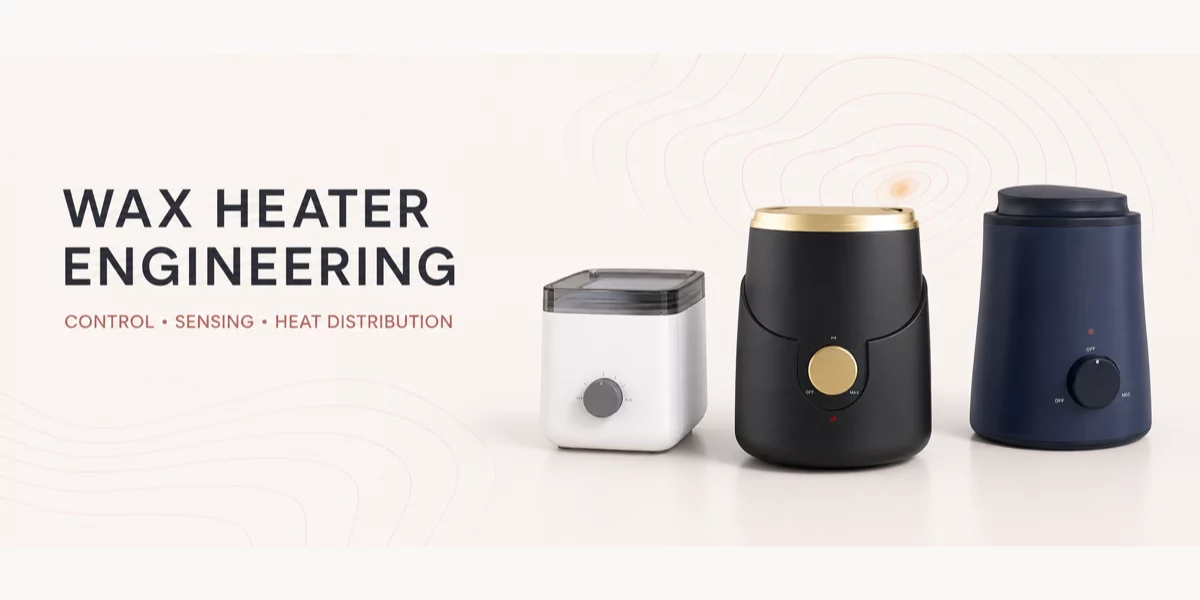
Wax Heater Engineering: Temperature Stability, Sensor Accuracy, and Heat Distribution
A practical wax heater engineering guide for beauty brands covering temperature stability, sensor placement, control logic, heat distribution, validation testing, safety architecture, and OEM sourcing questions.
 ByTeco
A wax heater may look simple from the outside, but its performance depends on an entire thermal system: the heating element, sensor, controller, pot, insulation, wax load, and safety architecture. For beauty brands sourcing an OEM or private-label wax warmer, the important question is not whether the display shows a precise number. It is whether the product can heat a defined wax load predictably, maintain a usable condition, recover during service, and respond safely when something goes wrong.
This guide explains the engineering decisions behind temperature stability, sensor accuracy, and heat distribution. It also gives purchasing teams a practical framework for comparing suppliers without relying on isolated specifications.
What Determines Wax Heater Performance?
A professional wax heater has two jobs. First, it must supply enough heat to melt the intended wax within a reasonable workflow. Second, it must regulate that heat so the wax remains consistent enough for application. Those jobs involve different design trade-offs.
- Heating power influences warm-up speed, but more wattage does not automatically mean better control.
- Sensor type and placement determine what temperature the controller actually “sees.”
- Control logic determines when power is switched or modulated.
- Pot geometry and material influence how heat spreads into the wax.
- Insulation and housing design affect heat loss, external surface temperature, and recovery.
- Wax chemistry and load change melt time, viscosity, and thermal response.
Because these variables interact, a single number—maximum temperature, rated power, or display resolution—cannot describe overall wax warmer performance.
Understanding the Complete Thermal System
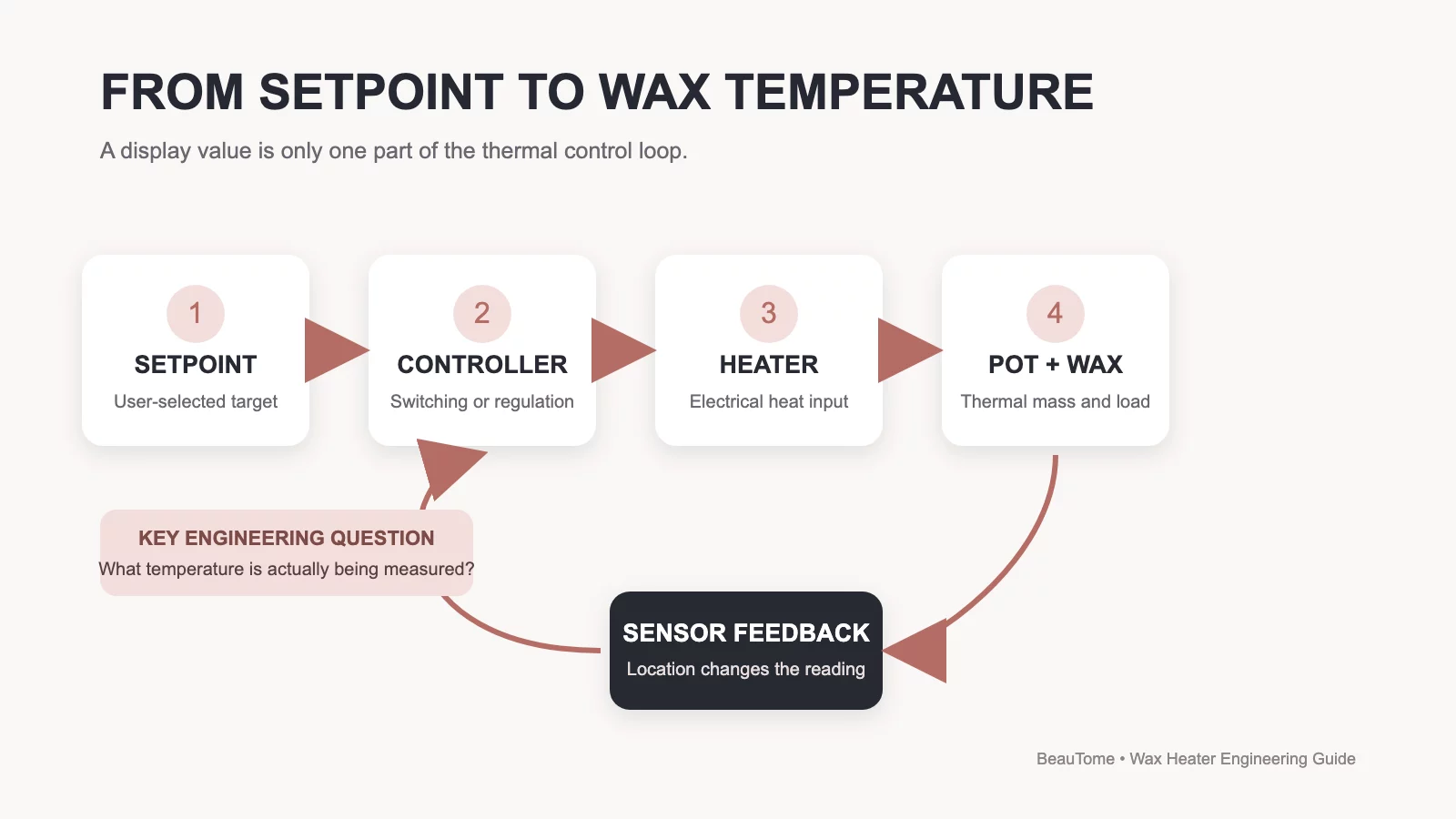
The user selects a target using a knob or digital interface. The controller compares that command with feedback from a sensor, then turns the heating element on, off, or partially on. Heat travels through the plate and removable pot before reaching the wax. Meanwhile, energy is lost through the lid, housing, and surrounding air.
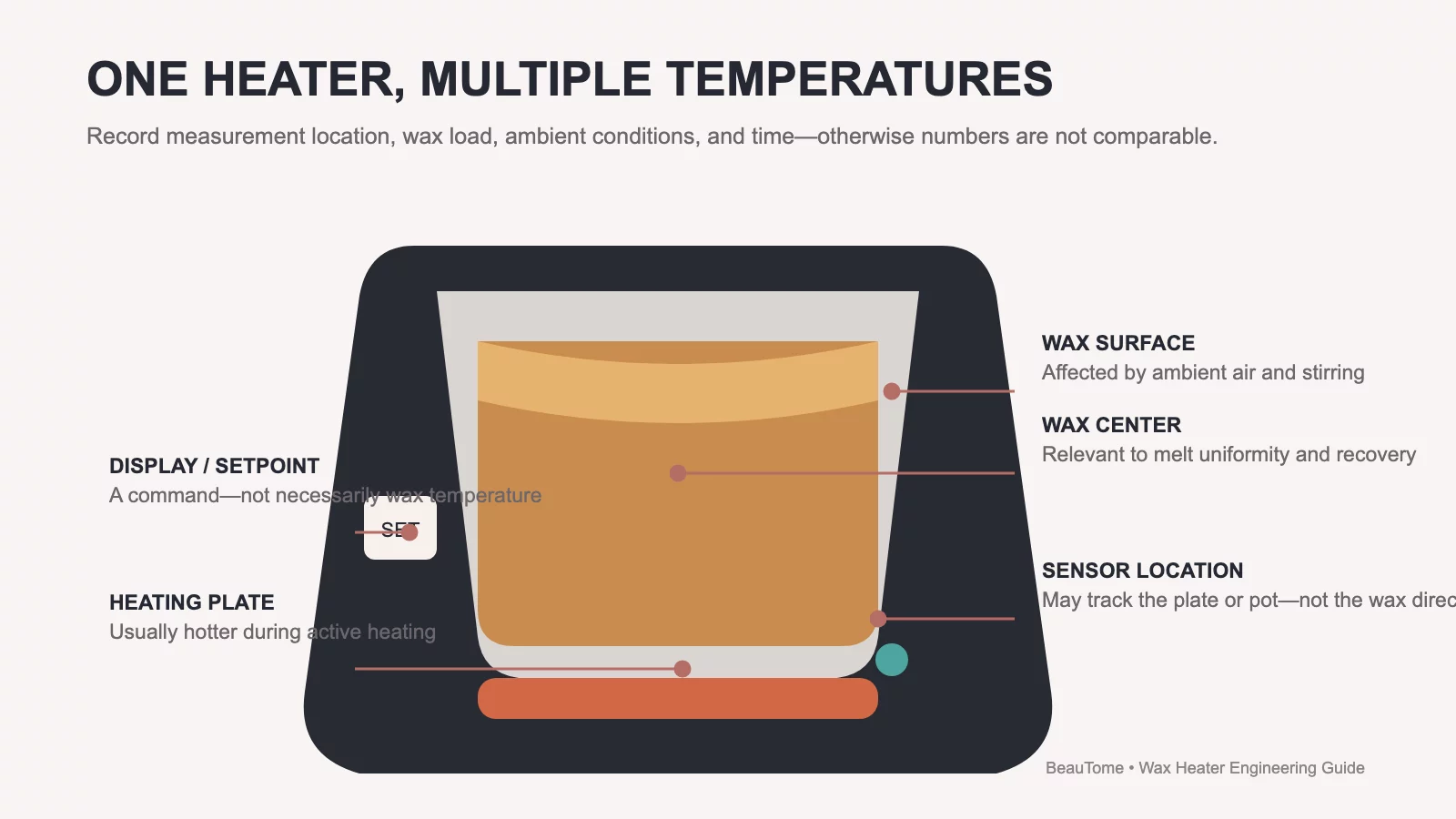
This creates several temperatures at the same moment: the selected setpoint, the sensor reading, the heating plate temperature, the pot-wall temperature, the temperature near the bottom of the wax, and the temperature at the surface. They are related, but they are not identical.
Engineering principle: a temperature claim is meaningful only when the measurement location, wax load, test method, ambient conditions, and acceptance limit are defined.
Temperature Stability: What Should Actually Be Measured?
Temperature stability describes how the system behaves after approaching its target condition. A heater that repeatedly overshoots and cools may show a familiar average temperature while producing large cycles in the pot. A better evaluation records temperature over time and looks at four behaviors.
- Overshoot: the peak reached after the initial heating phase.
- Steady-state cycling: the recurring variation once the system has settled.
- Recovery: how the heater responds after the lid is opened, wax is stirred, or material is removed.
- Repeatability: whether multiple units and repeated cycles behave within the agreed tolerance.
For sourcing, do not request “stable temperature” as a vague feature. Define a test load and target condition, then agree on an acceptable overshoot, cycling band, recovery method, and sampling interval. The tolerance should come from the product requirement and risk assessment—not from a universal marketing number.
Sensor Type, Placement, and Calibration
Wax heaters commonly use a thermistor, thermostat, or another temperature-sensing arrangement, depending on the control concept and price segment. The sensor’s nominal accuracy matters, but its placement and thermal contact often matter just as much.
A sensor mounted near the heating plate can react quickly to the element, yet it may not represent the wax center. A sensor coupled to the pot may track the vessel more directly, but the response depends on contact pressure, interface material, and assembly consistency. If the sensor is too far from the heat source, delayed feedback can contribute to overshoot.
Calibration is a system check
Calibration should compare the heater’s control response with traceable measurement equipment under a defined load. It should not be reduced to matching a digital display at one point. Purchasing teams should ask how the factory controls sensor tolerances, assembly position, thermal contact, firmware parameters, and end-of-line verification.
Sensor feedback also should not be treated as the only safety layer. Independent over-temperature protection may be required by the product architecture, applicable standard, and risk assessment.
Analog, Digital, and Closed-Loop Control
“Analog” and “digital” primarily describe the user interface and control implementation; they do not automatically tell a buyer how accurately the wax is regulated. A basic dial unit can be appropriate for a simple, cost-sensitive product. A digital model can offer clearer settings, timers, memory functions, or additional interface options. Neither format guarantees uniform heating.
Likewise, a digital display does not prove that a product uses PID control. On/off control with hysteresis, proportional control, and PID are different strategies. Each can be engineered well or poorly for a given thermal mass. Buyers should ask for the control method, test data, and user behavior—not infer the algorithm from the interface.
For a segment-by-segment comparison, see our guide to digital vs. analog wax heaters.
Heat Distribution: Element, Pot, Insulation, and Wax Load
Heat distribution is the result of the entire mechanical stack. Element shape affects where heat enters the plate. Plate flatness and contact influence conduction. Pot wall thickness and material influence lateral spreading. The gap between the pot and heater, lid design, insulation, and housing ventilation all change the thermal map.
The wax itself is part of the system. A small load warms differently from a full pot. Hard wax pellets, canned wax, and sugar paste can differ in thermal behavior and working viscosity. During melting, natural convection and manual stirring redistribute heat, so a test with an empty pot or water is not automatically representative of the intended material.
How to assess uniformity
Use multiple measurement points at defined depths, or combine contact probes with thermal imaging where appropriate. Compare center and perimeter, upper and lower layers, and behavior before and after stirring. Record the time at each stage. An infrared image can help locate hot zones on visible surfaces, but emissivity and reflective metal can affect readings; it should be interpreted alongside contact measurements.
Maximum Setpoint vs. Actual Wax Working Condition
A high maximum setting can accelerate initial melting or support multiple material types, but the number on the dial is not a recommended application temperature. Actual wax handling should follow the wax manufacturer’s instructions and be checked before skin contact. Brands should avoid turning a maximum setpoint into a universal safety or performance claim.
If rapid melting is a product requirement, define the wax type, mass, starting temperature, supply voltage, lid condition, stirring procedure, and target state. “Fast melt” without a method is not comparable between suppliers. Our separate guide explains the design variables behind fast melting in wax heaters.
How to Validate a Wax Heater
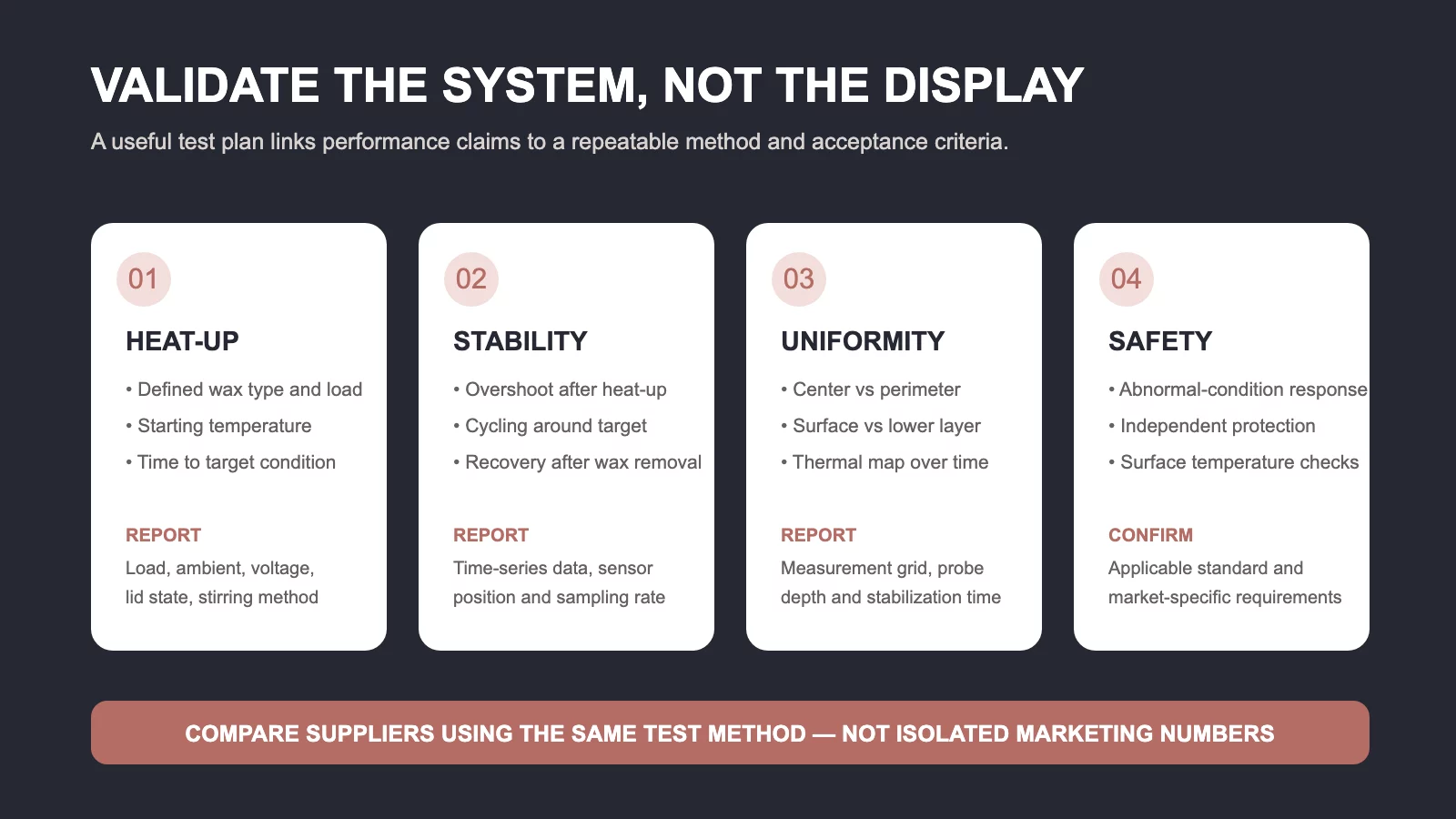
A useful validation plan converts brand requirements into repeatable tests. The following matrix is a starting point; the final plan should match the intended wax, capacity, market, user, and electrical design.
| Test area | Define before testing | Useful output |
|---|---|---|
| Heat-up | Wax type, load, starting condition, voltage, lid and stirring method | Time-temperature curve and time to defined target state |
| Stability | Target, sensor position, sampling rate and stabilization period | Overshoot, cycle range and recovery behavior |
| Uniformity | Measurement grid, probe depth, load and stirring status | Maximum spatial difference and thermal map |
| Unit consistency | Sample size and production stage | Variation between samples and pass rate |
| Abnormal conditions | Fault scenarios based on risk assessment | Protective response and post-test condition |
Factory quality control may include incoming component inspection, PCBA checks, functional testing, temperature verification, aging or endurance testing, dielectric-strength and earth-continuity checks where applicable, and final visual inspection. The exact sequence should be tied to the approved design and control plan.
Safety Architecture and Market Compliance
Compliance is market- and product-specific. CE marking applies to products covered by relevant European Union harmonisation legislation; it is not a general-purpose global certificate. For mains-powered equipment in the EU, the design may fall within the scope of the Low Voltage Directive and other applicable rules. The EU’s official CE marking guidance explains the manufacturer’s responsibilities.
In the United States, FCC equipment authorization requirements depend on whether the electronics are an intentional, unintentional, or incidental radiator and on the applicable rules; a blanket “FCC certificate required for every heater” statement is not accurate. The FCC’s equipment authorization overview provides the regulatory framework.
IEC 60335-2-15 covers particular requirements for appliances for heating liquids. Whether it is the correct particular standard for a specific wax heater should be confirmed with the testing laboratory based on product construction and intended use. Brands should establish the target markets first, then have a qualified compliance partner confirm the standards, national deviations, plug, voltage, labeling, and documentation requirements.
OEM Specification Checklist for Beauty Brands
- Use case: salon, retail home use, mobile technician, or multi-material platform.
- Wax system: intended wax types, container format, minimum and maximum load.
- Thermal targets: defined heat-up test, stability band, overshoot and recovery behavior.
- Capacity and pot: usable volume, removable or integrated pot, material and cleaning method.
- Control interface: dial or digital display, timer, presets, memory and user feedback.
- Safety: primary regulation, independent protection, surface-temperature and abnormal-condition strategy.
- Electrical: target voltage, frequency, plug, cord construction and market requirements.
- Customization: housing color, finish, logo, packaging, instructions and accessory scope.
- Quality plan: critical components, sample size, production tests, traceability and change control.
Explore BeauTome’s wax heater manufacturing and customization options to compare platform formats before defining a project brief.
Questions to Ask a Wax Heater Manufacturer
- What temperature does the sensor measure, and where is it mounted?
- What control method is used, and what are the switching or regulation parameters?
- How are heat-up, overshoot, cycling, recovery, and uniformity tested?
- Which wax type and load were used for the reported results?
- How is sensor contact and calibration controlled in production?
- What independent protective devices are included?
- Which standards and market requirements has the laboratory confirmed for this design?
- Which components or firmware parameters may change after approval, and how are changes communicated?
- Can the supplier provide pilot samples and a mutually agreed validation report?
- How are logo, color, packaging, voltage, and interface options managed across MOQ levels?
Wax Heater Engineering FAQ
Does a digital wax heater control temperature better than an analog model?
Not necessarily. A digital interface can provide clearer settings and features, but actual control depends on the sensor, placement, algorithm, heating element, pot, thermal mass, and validation.
Does a precise display mean the wax is at that exact temperature?
No. The display may show a setpoint or a sensor reading from another location. Wax temperature can vary by depth, position, load, and time.
Is a higher maximum temperature always better?
No. Maximum setpoint, melting speed, regulation, working condition, and user safety are separate considerations. The best specification is the one validated for the intended material and market.
How should brands compare wax heater samples?
Use the same wax, load, starting temperature, voltage, lid state, stirring method, measurement points, and acceptance criteria. Record the full time-temperature behavior rather than one reading.
For more practical questions, visit the Wax Heater FAQ.
Build a wax heater specification your suppliers can actually validate
Share your target market, wax format, capacity, control interface, customization scope, and testing priorities. BeauTome can help translate the brief into an OEM/ODM wax heater development discussion.