-
Any Questions teco.beautome@gmail.com
最后更新:
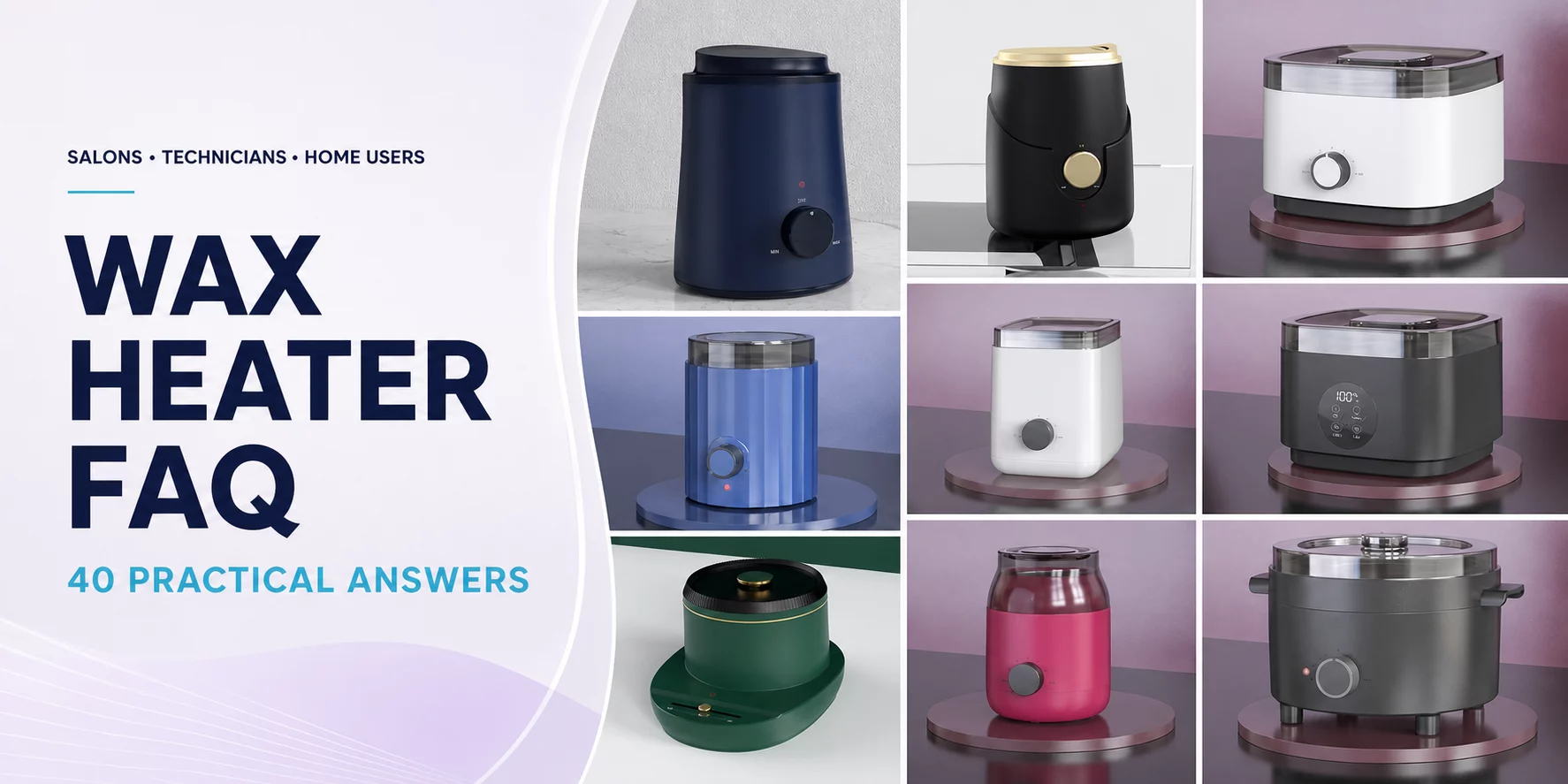
Wax Heater FAQ: 40 Questions Answered for Salons, Technicians, and Home Users
Forty practical wax heater questions answered for salons, technicians, home users, distributors, and beauty brands—from temperature control to OEM buying.
 ByTeco
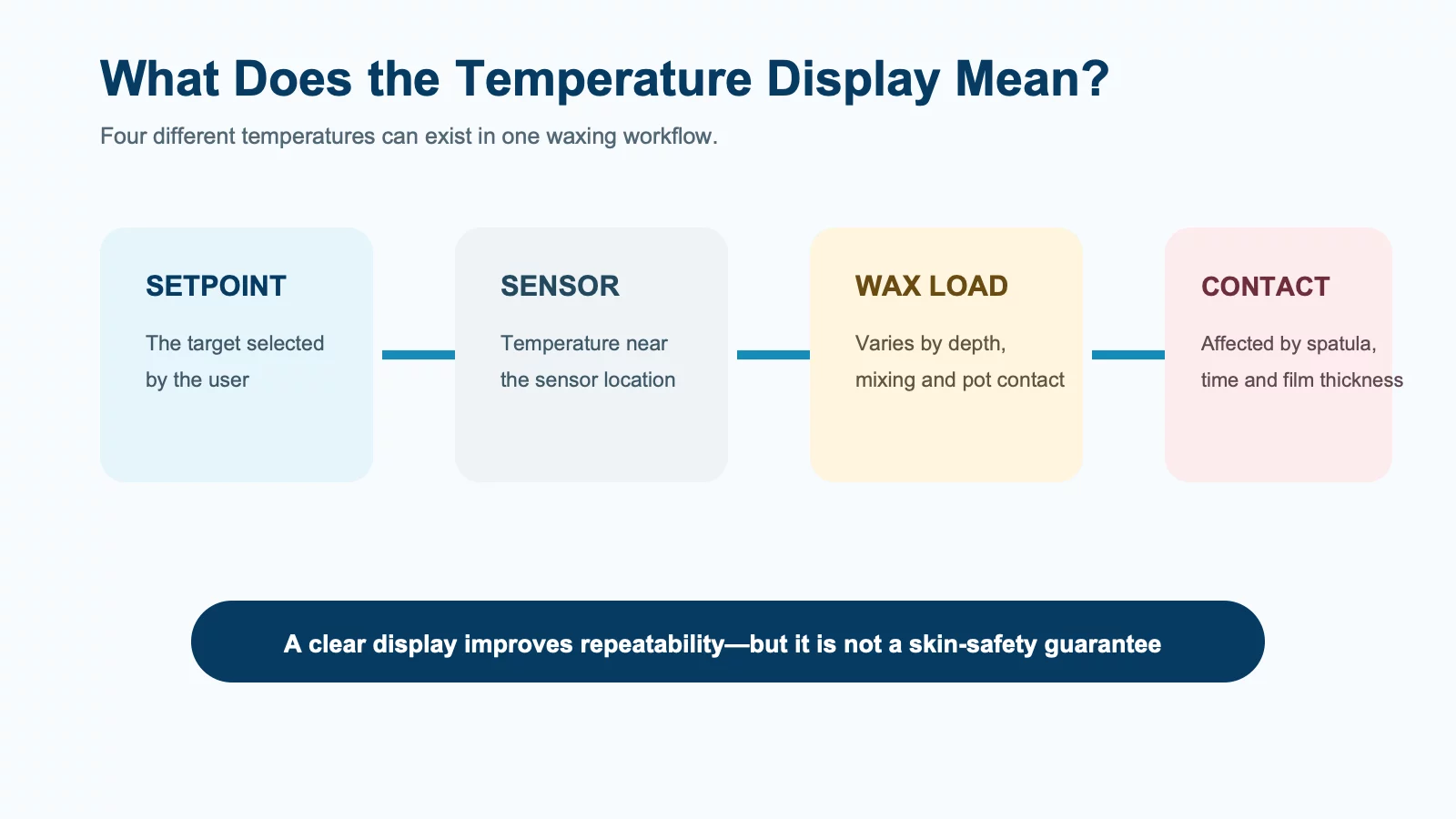
A wax heater influences preparation time, wax consistency, workflow, and user control, but the heater display is only one part of the thermal system. Wax type, load size, pot geometry, sensor location, room conditions, and operator technique all affect the result.
This wax heater FAQ answers 40 practical questions for salons, mobile technicians, home users, distributors, and private-label beauty brands. Where performance depends on a specific model, the answer explains what to verify instead of assuming a universal specification.
Heating Performance and Temperature Control
1. What makes one wax heater melt wax faster than another?
Useful melt speed depends on heater power, pot contact, thermal mass, insulation, lid use, starting wax temperature, and load size. Compare models with the same wax, load, room conditions, and endpoint rather than relying only on rated wattage.
2. What is the ideal temperature for hard wax?
There is no universal number. Follow the wax manufacturer’s instructions, melt the product fully, mix it, and reduce heat until it forms a smooth, controllable ribbon. Confirm application temperature before contact with skin.
3. Does a higher maximum heater setting mean faster melting?
Not necessarily. A higher setpoint can increase heat input, but melt speed is limited by power, heat transfer, control logic, and load. Excessive settings can overheat wax near the pot wall before the center has melted.
4. Why does a heater cycle on and off?
Most heaters cycle to maintain a target range. On/off behavior is normal; large or slow oscillations may indicate controller tuning, sensor placement, load, or hardware issues. Evaluate the wax temperature trend, not only the indicator light.
5. Why does wax sometimes become stringy?
Stringing can result from formulation, temperature, incomplete melting, mixing, contamination, or cooling during application. Test the wax in a verified working range before concluding that the heater is the cause.
Sensors, Displays, and Thermal Accuracy
6. Why is temperature stability important?
Stable conditions help technicians maintain predictable viscosity, spread, set time, and film thickness. Stability does not replace mixing or an application check, because temperature can vary within the pot.
7. What is an NTC sensor?
An NTC thermistor is a temperature-sensitive component whose electrical resistance decreases as temperature rises. Its presence does not prove system accuracy; sensor tolerance, placement, calibration, controller design, and assembly all matter.
8. Is a digital wax heater more accurate than an analog model?
A digital interface can offer finer settings and clearer repeatability, but display resolution is not the same as measurement accuracy. A well-designed analog heater may control temperature more consistently than a poorly calibrated digital one.
9. Does the display show the actual wax temperature?
Often it shows a setpoint or a sensor reading from the heater assembly, not a direct measurement of the entire wax load. Buyers should ask what the display represents and how the device is calibrated.
10. How should temperature accuracy be tested?
Use a defined wax or test medium, load, lid condition, room temperature, stabilization time, measurement position, and calibrated reference instrument. Record overshoot, steady-state variation, and repeatability across several units.
Safety and User Comfort
11. Can a wax heater prevent burns?
No heater can eliminate risk. Protective devices can limit abnormal conditions, but users must follow instructions, keep the unit stable, mix the wax, and verify application temperature before use.
12. Should the outer shell stay completely cool?
Accessible surfaces may become warm. The acceptable temperature depends on material, location, intended contact, and applicable safety requirements. “Cool-touch” should be supported by a defined test, not assumed from plastic type alone.
13. Is low-temperature waxing automatically safe for sensitive skin?
A lower working temperature may improve comfort, but skin response also depends on wax formulation, technique, repeated passes, treatment area, and individual sensitivity. It is not a guarantee against irritation.
14. Do all wax heaters have automatic shutoff?
No. Some include over-temperature protection, a thermal fuse, timer-based standby, or auto-off; others do not. Ask for the exact protection architecture and test evidence for the model being purchased.
15. Is waxing during pregnancy safe?
Pregnancy is a medical context, and a heater specification cannot answer it. Users should follow product instructions and seek advice from a qualified healthcare professional when they have concerns or skin changes.
Wax and Container Compatibility
16. Can one heater melt both hard wax beads and soft wax?
Many can, but compatibility depends on the removable pot, can diameter, temperature range, and manufacturer instructions. Never assume a standard can fits without checking dimensions.
17. What capacity should a salon choose?
Choose for peak service demand, wax type, changeover frequency, and workstation space. A larger pot holds more wax but generally has greater thermal mass; a smaller unit may suit facial services or mobile technicians. Compare the SW6B dual-pot salon wax warmer with the PW8 compact wax warmer, then check your intended wax and container fit against the selected model.
18. Can a standard wax heater warm sugar paste?
Only if the sugar-paste supplier permits it and the heater can control the required lower range. Excess heat can change consistency. Use a dedicated container and avoid water contamination.
19. Can it handle low-temperature hard wax?
It can if the control range and stability match the formula’s working window. Validate with the intended wax rather than checking only the minimum number printed on the control.
20. Can silicone liners be used?
Use only a liner compatible with the heater and wax. A liner changes thermal contact and may increase melt time or alter controller behavior. It must sit flat and remain within the device manufacturer’s instructions.
Salon Workflow and Home Use
21. How long should a wax heater take to melt wax?
There is no meaningful answer without load and endpoint. A supplier’s melt-time claim should state wax type, grams, starting temperature, lid position, heater setting, and the definition of “ready.”
22. Is a lid important?
A lid can reduce convective heat loss and protect the pot during storage, but it should be used only as instructed. Condensation and contamination risks differ by product and environment.
23. What makes a heater suitable for high-volume salons?
Prioritize repeatable temperature control, durable controls, stable feet, cleanable geometry, replaceable pots, clear instructions, serviceability, and validated duty-cycle performance—not maximum temperature alone.
24. What should mobile technicians look for?
Consider size, cord storage, lid security during transport, voltage compatibility, setup stability, heat-up time at the intended load, and cooling time before packing. Never transport hot liquid wax.
25. What features help home users?
Clear controls, readable instructions, stable placement, manageable capacity, easy cleaning, and a forgiving temperature range are more useful than numerous modes that are not explained.
Cleaning and Maintenance
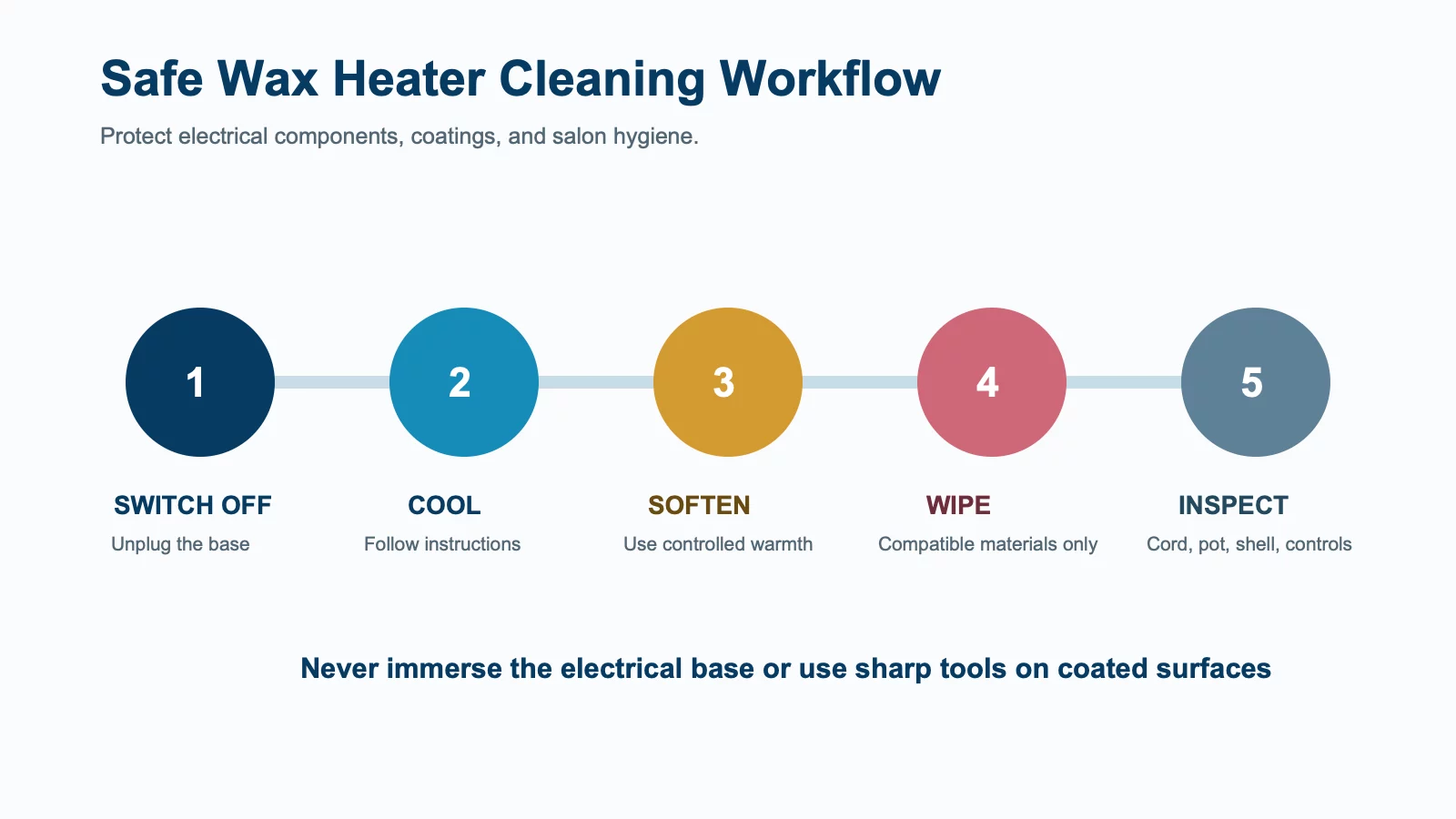
26. Should the heater be unplugged before cleaning?
Yes. Switch off, unplug, and follow the cooling and cleaning instructions. Never immerse the electrical base or allow liquid into controls, vents, connectors, or sensor areas.
27. How should hardened wax be removed?
Follow the wax and heater instructions. Typically, controlled warming softens residue so it can be wiped with compatible materials. Do not use sharp tools that can damage coatings or electrical components.
28. Should the pot be cleaned after every client?
Salons need a documented hygiene protocol based on local rules, service method, applicator policy, and product instructions. Never double-dip a used applicator into shared wax.
29. What damages a wax pot?
Abrasive tools, incompatible solvents, overheating, impacts, bent rims, and residue around electrical contact surfaces can reduce life. Inspect removable pots and coatings regularly.
30. What routine maintenance is needed?
Check the cord, plug, pot seating, controls, lid, feet, and visible housing condition. Stop using a unit with damaged insulation, loose parts, unusual odor, arcing, or repeated unexplained shutdowns.
Quality, Compliance, and OEM Purchasing
31. Does housing material determine quality?
No. Resin grade, heat aging, wall design, flame behavior where applicable, molding quality, assembly, and accessible-surface temperature all matter. “New material” is not a substitute for test evidence.
32. How long should a wax heater last?
Life depends on duty cycle, components, thermal stress, contamination, handling, and maintenance. Buyers should request an aging-test method, failure criteria, warranty terms, and spare-part strategy.
33. Does CE or RoHS prove overall product quality?
No. CE marking relates to applicable EU legislation, while RoHS addresses restricted substances in electrical equipment. Buyers must identify applicable requirements for the exact product and market and review the supporting technical documentation.
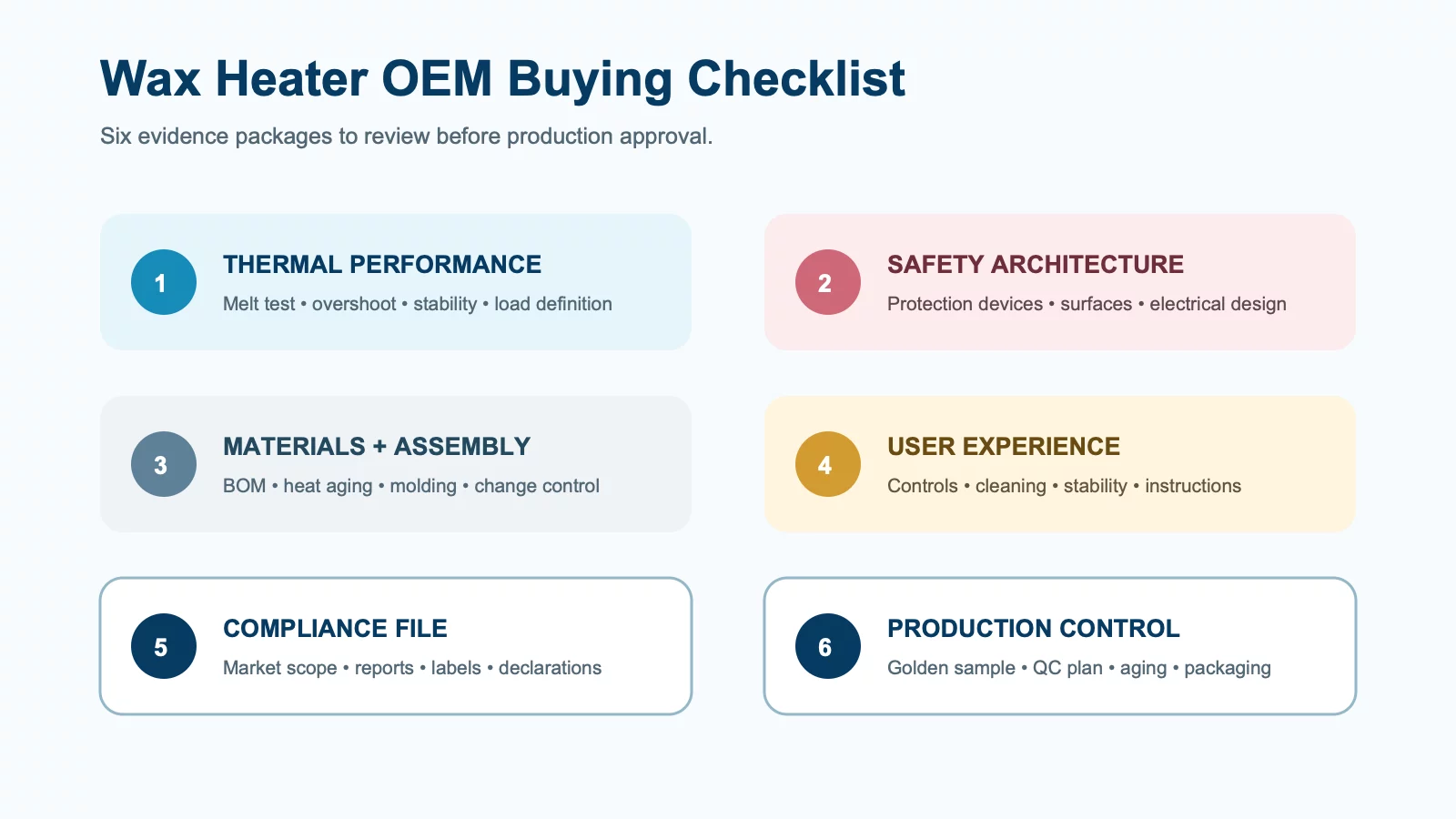
34. What factory tests should a brand request?
Typical controls may include electrical safety checks, functional tests, temperature calibration or verification, power checks, aging, visual inspection, and packaging tests. The plan must match the model and destination market.
35. What should be locked before mass production?
Lock the approved sample, BOM, firmware where applicable, appearance standard, temperature-control criteria, labels, manual, packaging, inspection plan, and change-control process.
Troubleshooting
36. Why is the wax not melting evenly?
Possible causes include a large load, compacted pellets, poor pot seating, no lid, inadequate mixing, cold room conditions, or a heater fault. Reduce variables one at a time and follow the manual.
37. Why does the heater keep turning off?
Normal thermostat cycling, timer standby, poor ventilation, unstable power, a loose pot, or protective shutdown are possibilities. If behavior differs from the manual or repeats after cooling, stop use and contact the supplier.
38. Why is the wax too thick?
The wax may be below its working range, incompletely melted, insufficiently mixed, aged, or contaminated. Increase heat only within the product instructions and verify consistency gradually.
39. Why is the wax too thin or runny?
The wax may be too hot or the formula may not suit the technique. Reduce the setting, mix, allow stabilization, and test again. Do not apply wax until its temperature and consistency are appropriate.
40. Why does the heater make a clicking sound?
A soft click can be a relay or thermostat switching normally. Loud, irregular, sparking, buzzing, or burning-odor symptoms require immediate shutdown and supplier inspection.
Choosing the Right Wax Heater
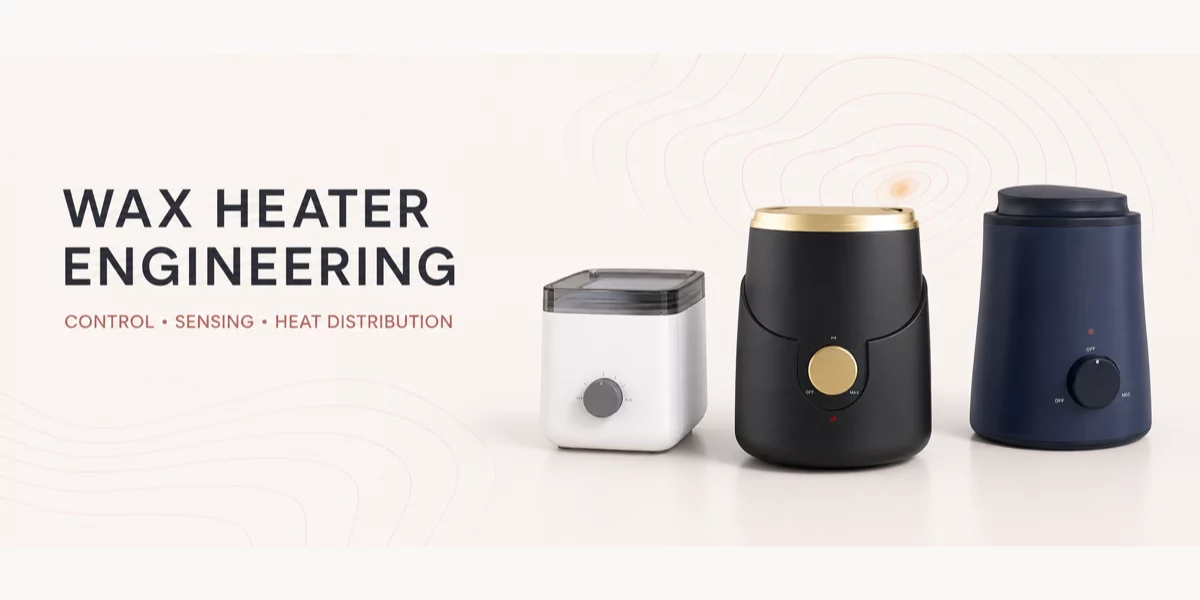
Start with the intended wax, load, user, service volume, destination market, and cleaning method. Then compare control behavior, safety architecture, materials, documentation, usability, and production consistency. BeauTome’s wax heater range provides a starting point for OEM/ODM discussions, while the wax heater engineering guide explains the thermal system in greater depth.
Need a Wax Heater Specification for Your Brand?
Tell BeauTome your target market, capacity, interface, wax type, packaging, and compliance requirements. We can help define the sample and production-validation plan before you commit to tooling or mass production.