-
Any Questions teco.beautome@gmail.com
最后更新:
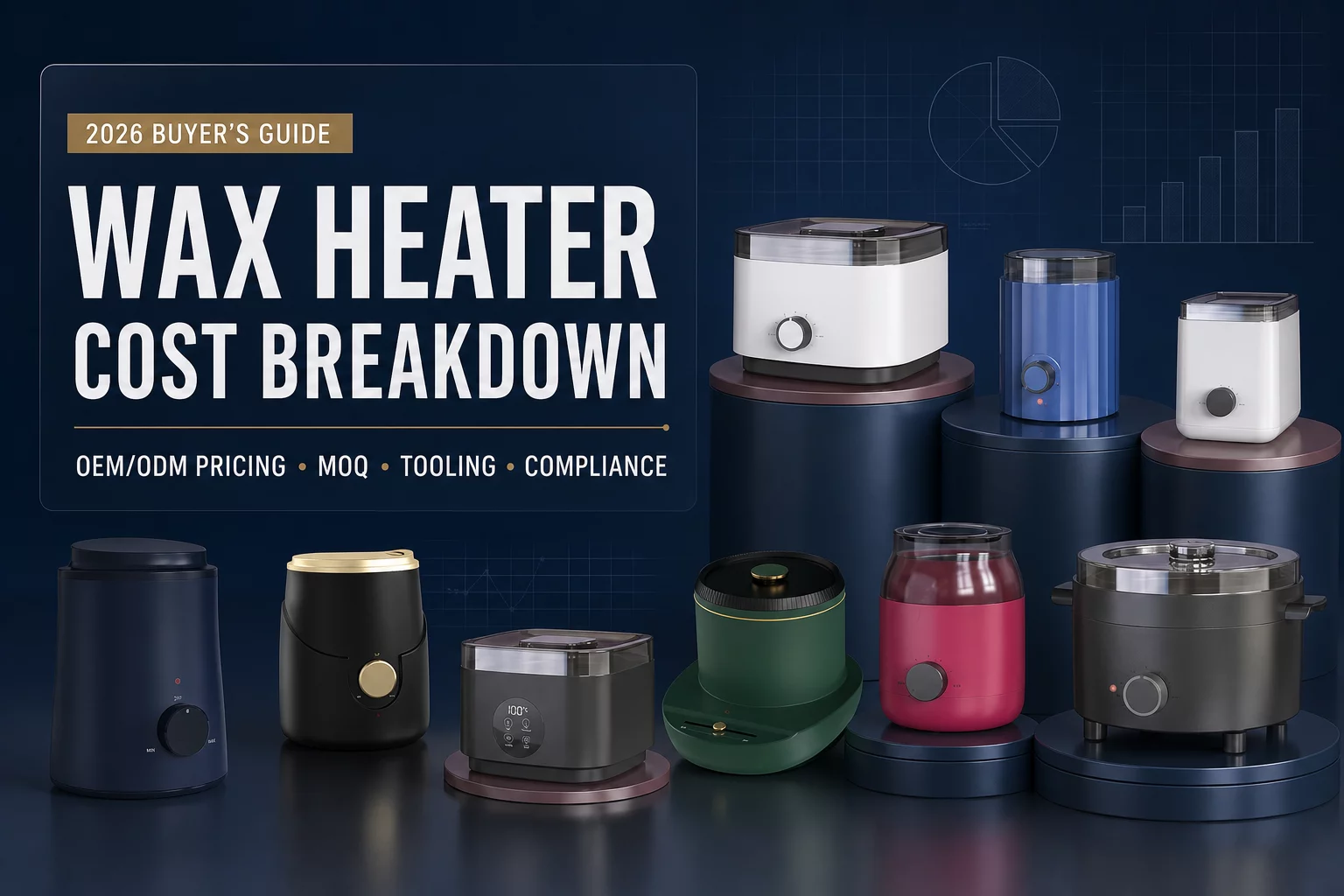
Wax Heater Cost Breakdown: OEM/ODM Pricing, MOQ, Tooling and Compliance in 2026
A practical 2026 guide to wax heater OEM/ODM pricing, covering hardware, MOQ, tooling, compliance, packaging, landed cost and supplier quote comparison.
 ByTeco
Last updated: September 1, 2026.
Wax heater pricing is determined by more than the heater’s size or control panel. The main cost drivers are the heating system, electronics, housing, safety components, assembly, quality control, packaging, customization, order quantity, compliance work, and logistics. For OEM/ODM buyers, the useful comparison is a normalized landed-cost model—not the lowest factory quote.
This guide explains how beauty brands, distributors, importers, and professional-channel buyers can evaluate a wax heater cost breakdown without relying on a misleading universal price list. It complements our guide to choosing a wax heater manufacturer and the BeauTome wax heater product range.
Wax heater cost breakdown at a glance
| Cost layer | What it can include | What buyers should confirm |
|---|---|---|
| Core hardware | Heating element, pot, housing, lid, insulation and controls | Approved specification and bill of materials |
| Electrical and safety design | PCB, sensor or thermostat, wiring, fuse and protection components | Construction, component ratings and applicable test evidence |
| Manufacturing | Labor, assembly, calibration, inspection and yield loss | Inspection plan, sampling level and failure handling |
| Customization | Color, logo, interface, packaging, tooling, electronics or firmware | One-time versus recurring charges |
| Compliance | Technical documentation, testing, declarations, labels and market-specific work | Exact model, target market and responsible economic operator |
| Commercial and logistics | MOQ, cartons, freight, insurance, duty, brokerage and inventory carrying | Incoterm, carton data and landed-cost assumptions |
The proportions of these layers vary by design and order. A simple analog platform may concentrate cost in mechanical construction and the heating assembly. A digital or customized unit adds electronics, software, validation, and change-control work. That is why two heaters with a similar exterior can have different quotations—and why a low quote may not represent the same product.
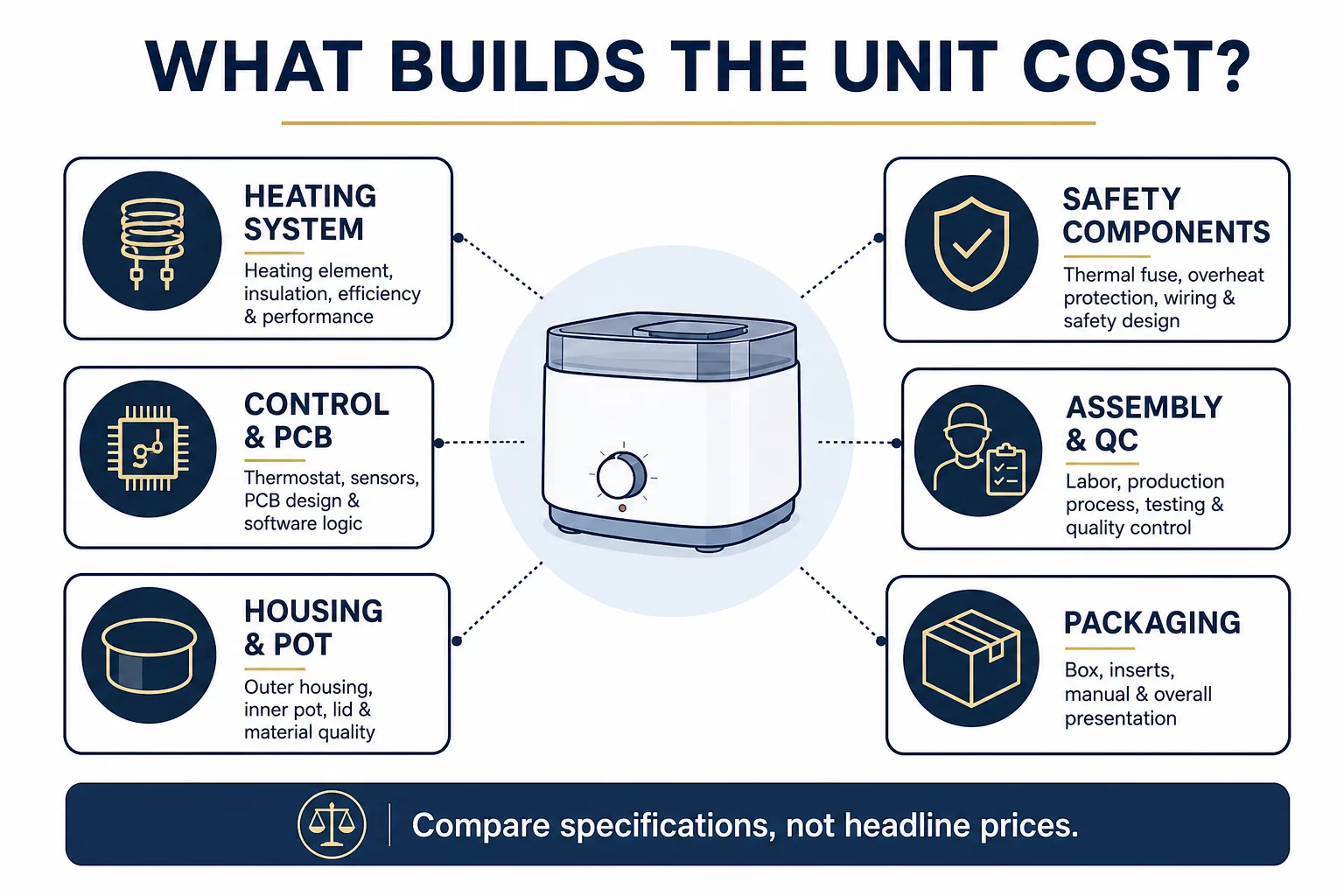
1. What builds the wax heater unit cost?
The recurring unit cost begins with a defined product specification. If two suppliers quote different materials, controls, cord sets, packaging, tests, or inspection levels, their prices are not comparable. Lock the intended configuration before using unit price as a decision metric.
Heating system and thermal construction
The heating element, heat-transfer path, pot geometry, insulation, sensor or thermostat position, and control logic influence both the bill of materials and the validation workload. A headline wattage or maximum dial marking does not describe temperature uniformity, control cycling, recovery after wax is added, or protection behavior.
Ask the supplier to identify the heating architecture and provide a repeatable test method. Useful evidence includes temperature-versus-time curves, test locations, load conditions, stabilization criteria, and results from more than one sample. Our article on wax heater temperature stability and heat distribution explains how to evaluate those results.
Controls, PCB and user interface
An analog thermostat, digital display, touch interface, timer, memory function, or detachable control base changes component count and assembly complexity. The cost difference is not only the visible interface: PCB design, firmware, sensor selection, electromagnetic compatibility work, calibration, and replacement-part planning may also change.
Buyers should request the approved control specification, display behavior, tolerance criteria, component substitution rules, and firmware version where applicable. If a supplier can change a PCB or sensor without written approval, a stable quotation does not guarantee a stable product.
Housing, inner pot and lid
Housing material, wall thickness, finish, color process, internal supports, lid construction, removable pot design, and tooling condition all affect cost. Larger capacity does not create a simple linear price increase because it can require different tooling, heater geometry, structure, packaging, and shipping volume.
For comparison, document the material specification, finished weight where relevant, surface standard, fit tolerances, cleaning requirements, and approved appearance sample. Photographs alone are not sufficient to confirm polymer grade, heat resistance, metal specification, or durability.
Safety components and market configuration
Voltage, frequency, plug, cord, thermal fuse, grounding or insulation strategy, strain relief, and protective components must match the intended market and product design. These choices can change the BOM and required evidence. They should never be removed merely to reach a target price.
Compliance language must also be precise. In the European Union, CE marking is the manufacturer’s declaration that applicable EU requirements have been met; it is not a generic quality certificate sold independently of a defined product. The EU’s official CE marking guidance explains the manufacturer’s responsibilities. The RoHS Directive restricts specified hazardous substances in electrical and electronic equipment, while applicable FCC requirements in the United States depend on the device and authorization route described by the FCC Equipment Authorization program.
Assembly, calibration and quality control
Labor cost depends on the number of parts, fastening method, wiring steps, sealing or insulation work, calibration requirements, test time, rework, and expected yield. A quotation that includes only a visual final inspection is not equivalent to one that includes incoming component checks, in-process controls, electrical safety tests, functional tests, and documented final inspection.
Request the inspection plan before approving the price. It should state what is checked, the method, sample size or inspection level, acceptance criteria, records, and response to failure. ISO explains that ISO 9001 addresses a quality management system; it does not certify that a particular wax heater model meets a product safety standard.
Packaging and accessories
Retail box construction, molded pulp or foam inserts, manual languages, labels, barcode work, master carton strength, spare pots, spatulas, and power-cord packaging can materially alter the quote. Packaging also affects volumetric freight, damage rates, retailer acceptance, and customer experience.
Ask for a packaging BOM, dieline, print specification, assembled carton dimensions, gross weight, pack-out photographs, and transport-test plan where required. Confirm whether artwork setup and samples are included or charged separately.
2. Analog, digital and touchscreen pricing are not directly interchangeable
| Control type | Typical cost considerations | Questions for the supplier |
|---|---|---|
| Analog | Thermostat or controller, knob, markings, mechanical tolerance and calibration | How are dial positions verified? What controls temperature cycling? |
| Digital | Display, PCB, buttons or encoder, sensors, firmware and calibration | What is displayed: setpoint, measured value, or operating mode? |
| Touchscreen | Touch panel, display assembly, UI, firmware, EMC work and replacement support | Who owns the interface files and firmware? How are revisions controlled? |
A more complex interface is not automatically the better commercial choice. The appropriate design depends on the customer segment, retail price position, service environment, usability requirements, and after-sales capability. Compare the full platform rather than assuming the control type alone determines value.
3. How capacity changes cost
Capacity affects more than the quantity of metal or plastic. Moving from a compact heater to a larger pot or a multi-pot salon configuration may change the heating load, housing structure, mold set, electrical design, carton volume, gross weight, and intended duty cycle. The price effect therefore depends on the complete architecture.
When comparing capacities, keep the wax format, target melt workflow, voltage, control strategy, pot construction, accessories, and test method consistent. A nominal volume alone cannot predict melt time, thermal stability, or professional suitability.
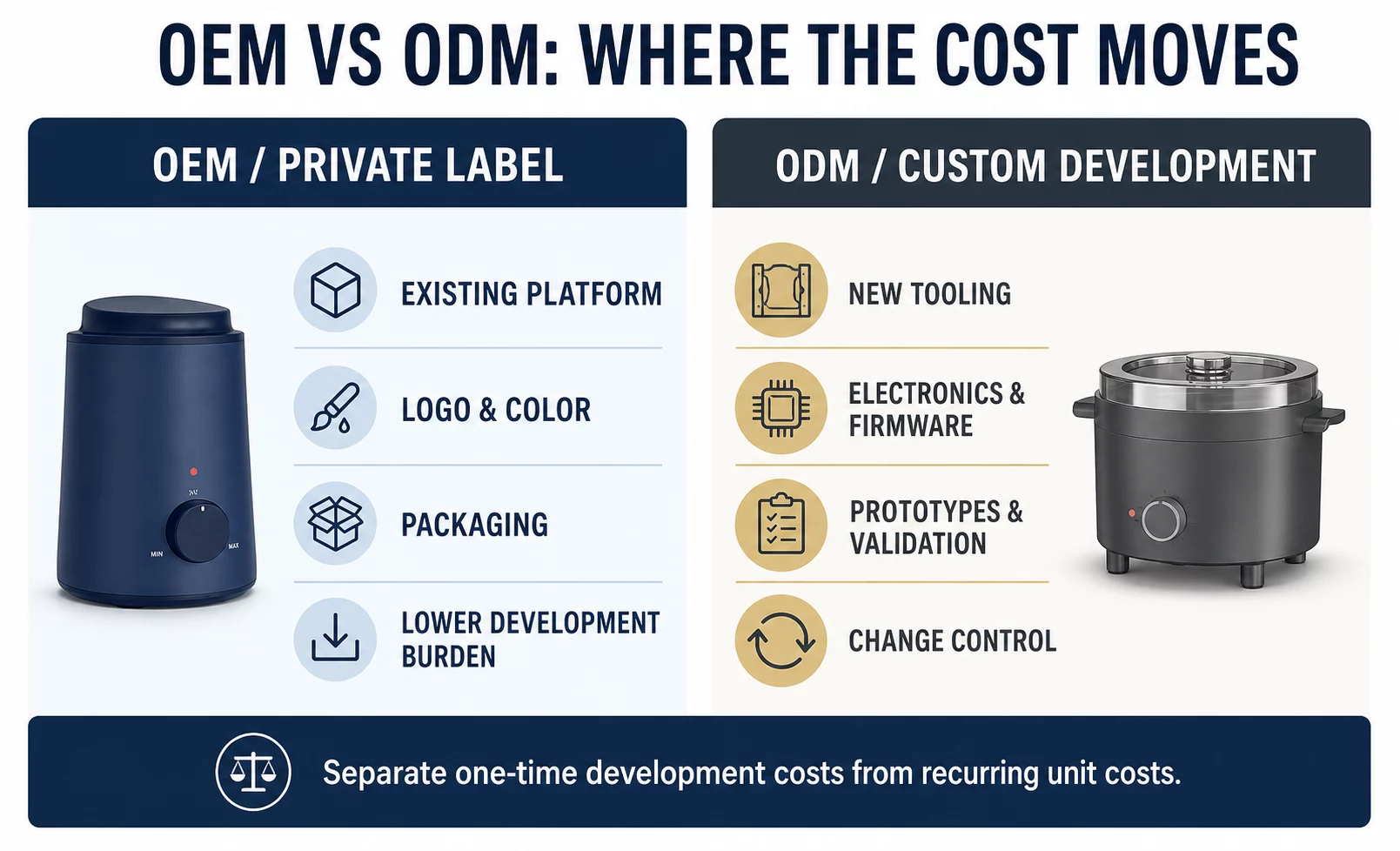
4. OEM versus ODM: separate recurring and one-time costs
OEM or private-label projects generally start from an existing platform, while ODM projects introduce deeper product changes. The commercial difference should be expressed as a change list: what remains standard, what is modified, who owns each deliverable, and which charges recur on every order.
| Cost type | Examples | How to document it |
|---|---|---|
| Recurring unit cost | Components, assembly, testing, packaging and routine QC | Unit quotation tied to approved specification and quantity tier |
| Non-recurring engineering (NRE) | Engineering work, drawings, prototypes, firmware or validation setup | Milestones, deliverables, revision limits and payment schedule |
| Tooling | Molds, fixtures, gauges, printing plates or dedicated test tools | Ownership, maintenance, storage, lifespan and transfer rights |
| Compliance and testing | Laboratory work, samples, documentation and market-specific review | Applicant, model scope, standard edition and report ownership |
| Artwork and packaging setup | Dielines, proofs, plates, color matching and samples | Approved artwork, color standard and included revision count |
Do not amortize one-time costs into the unit price until projected volume and ownership are clear. A low unit quote paired with supplier-owned tooling, limited documentation, or expensive future changes can create a higher lifetime cost.
5. How MOQ affects wax heater pricing
MOQ affects price because factories and upstream suppliers have setup quantities, packaging runs, color batches, component pack sizes, line-change time, and inspection overhead. However, there is no universal wax heater MOQ. It depends on whether the buyer chooses a standard model, custom color, printed packaging, modified electronics, new tooling, or multiple market configurations.
Ask for a quantity-break explanation
- Which cost changes at each quantity tier?
- Is the MOQ driven by assembly, components, color, printing, or packaging?
- Can standard units and custom packaging use different minimums?
- Can multiple colors share a production run, and under what conditions?
- Are spare parts, samples, and replacement units priced separately?
A lower MOQ can reduce inventory exposure but increase unit cost. A higher MOQ can reduce certain setup costs per unit while increasing cash, storage, forecast, and obsolescence risk. Evaluate the economic order quantity for the business rather than treating the factory’s lowest unit-price tier as the default.
6. Compliance is a project scope, not a logo on a quotation
The compliance budget depends on the destination market, product construction, standards considered applicable, existing evidence, changes from the tested model, and the party responsible for the product. A report for a similar-looking heater does not automatically cover the ordered configuration.
Before accepting a compliance charge or claim, verify:
- The exact model name and configuration shown in the documents
- The applicant, manufacturer and factory identities
- The target market and applicable legal framework
- The standard and edition used for testing
- Whether plug, cord, PCB, heater, housing or firmware changes affect scope
- Who owns and can use the reports, technical file and declaration
- Which labels, manuals, warnings and traceability marks are required
Compliance costs should be quoted as a transparent work package. Buyers remain responsible for confirming requirements with qualified laboratories, compliance specialists, and legal advisers for their markets.
7. Calculate landed cost, not only ex-factory price
A usable landed-cost model brings every supplier to the same commercial basis. It should state currency, payment terms, Incoterm, shipping origin, carton dimensions, units per carton, gross weight, freight mode, insurance, brokerage, duty assumptions, warehousing, inspection, and expected defect or warranty exposure.
Basic landed-cost framework:
Product cost + allocated NRE/tooling + packaging + inspection + freight + insurance + duty/tax where applicable + brokerage + inland delivery + inventory carrying + expected quality and warranty cost.
Tax and duty treatment varies by country and importer circumstances, so the calculation should be reviewed with the buyer’s customs broker or tax adviser. The goal is not to predict every future charge perfectly; it is to prevent unlike quotes from appearing equivalent.
8. A five-step method for comparing supplier quotations
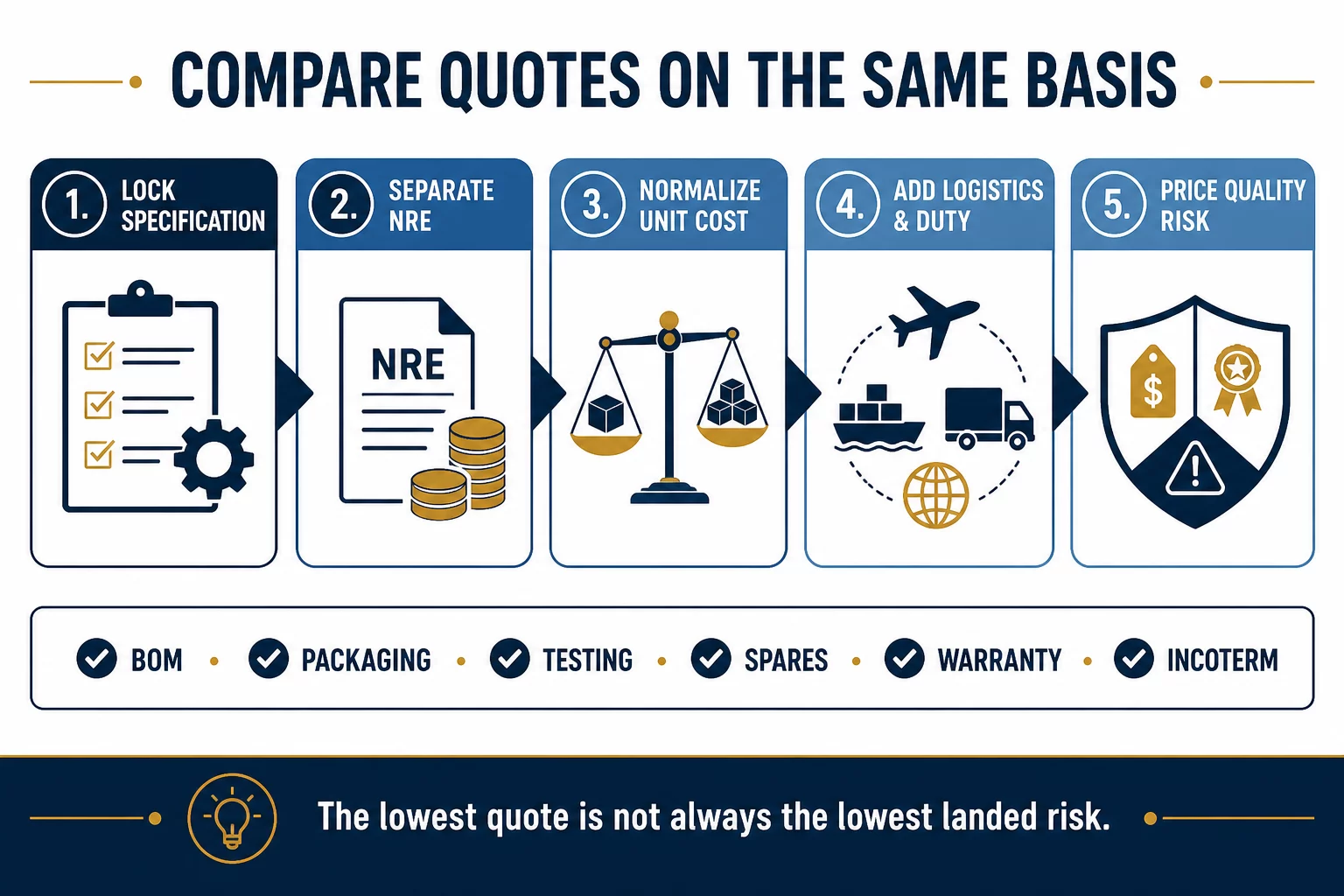
- Lock one specification. Use the same product brief, drawings, BOM requirements, packaging, tests and quality criteria.
- Separate non-recurring costs. List engineering, tooling, samples, compliance and artwork setup outside recurring unit cost.
- Normalize the unit quotation. Compare the same quantity, currency, Incoterm, accessories, spare parts, warranty and inspection scope.
- Add logistics and import assumptions. Use confirmed carton data rather than estimates based on product photos.
- Price the quality risk. Consider audit findings, sample variation, change control, response time, documentation, repairability and field-failure handling.
The Wax Heater FAQ can help product teams align technical questions with the needs of salons, technicians, and home users before the RFQ is finalized.
9. RFQ checklist for a comparable wax heater quote
- Target countries, voltage, frequency, plug and cord requirements
- Product capacity, pot, lid, housing and control specification
- Heating and temperature-validation method
- Safety construction and required market documentation
- Color, finish, logo, artwork and packaging scope
- Accessories, spare parts and replacement-unit policy
- Sample stages and approval criteria
- MOQ and quantity price breaks with their cost drivers
- NRE, tooling, testing and artwork charges listed separately
- Tooling ownership, maintenance and transfer conditions
- Inspection plan, acceptance criteria and records
- Production lead-time definition and change-control process
- Incoterm, port, carton dimensions, gross weight and units per carton
- Payment terms, quote validity and currency
- Warranty, failure analysis and corrective-action process
Frequently asked questions
How much does an OEM wax heater cost?
There is no reliable universal OEM wax heater price. Cost depends on the approved platform, heating and control system, housing, safety components, packaging, quantity, quality plan, market configuration and Incoterm. Request a quotation tied to one written specification and separate recurring unit cost from tooling, engineering, testing and artwork charges.
Why do similar wax heaters have different wholesale prices?
Similar exteriors can contain different heaters, controls, sensors, wiring, protective components, materials and inspection scopes. Packaging, accessories, compliance evidence, component change control, warranty terms and order quantity also affect the quote. Compare BOM and acceptance criteria rather than appearance alone.
Does a higher MOQ always produce a lower total cost?
A higher quantity can spread setup costs and improve component purchasing, but it also increases cash commitment, storage, forecast and obsolescence risk. The best order size balances unit economics with realistic demand and inventory risk.
What is the difference between tooling cost and NRE?
Tooling cost generally covers physical production assets such as molds, fixtures, gauges or printing plates. Non-recurring engineering covers development work such as drawings, electronics, firmware, prototypes and validation setup. A contract should define deliverables, ownership, maintenance and future-change charges for both.
Should certification or compliance costs be included in the unit price?
They can be quoted separately or amortized, but the scope must remain visible. Confirm the exact model, market, applicant, standards, reports, technical documentation and effects of customization before allocating the expense. CE marking, RoHS obligations and FCC authorization are distinct concepts and should not be bundled under a vague “certification fee.”
Build a quotation your team can defend
A professional wax heater sourcing decision connects price to specification, evidence and risk. When every supplier quotes the same configuration and separates unit cost from development, tooling, compliance, packaging and logistics, buyers can make a commercially meaningful comparison.
Planning a private-label or custom wax heater line? Review BeauTome’s wax heater manufacturing options, then send your target market, control type, capacity, quantity and customization brief. We can help organize the product specification and quotation scope before sampling.