-
Any Questions teco.beautome@gmail.com
最后更新:
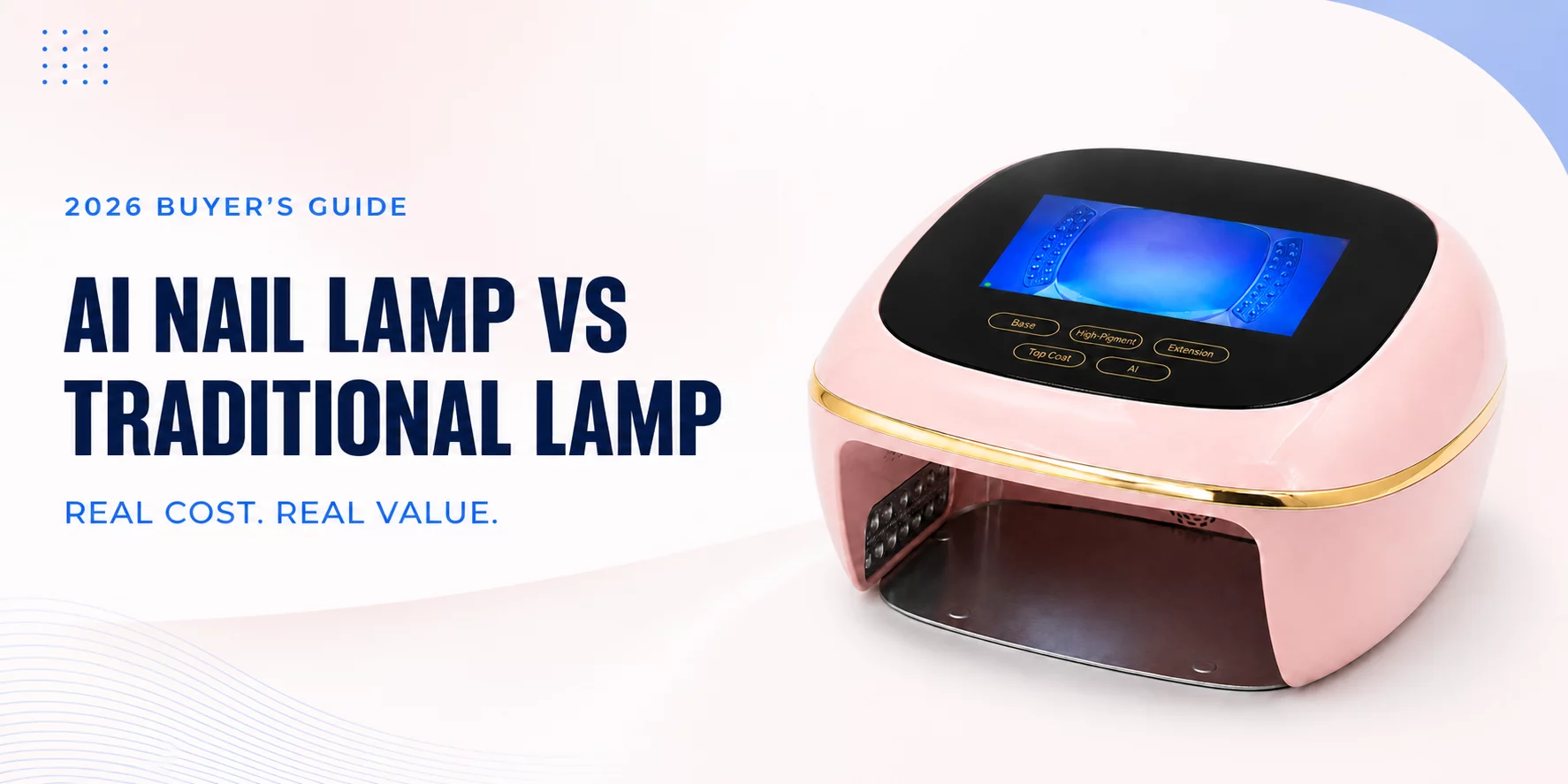
AI Nail Lamp vs Traditional Nail Lamp: Understanding the Real Cost and Value
Compare AI and traditional nail lamps by architecture, total cost and brand value, with confirmed 2026 BeauTome specifications and a practical OEM/ODM buyer checklist.
 ByTeco
An AI nail lamp and a traditional UV/LED nail lamp may perform the same basic job—curing gel—but they are not the same product with different price tags. A traditional lamp mainly combines LEDs, a timer, a power supply and simple controls. An AI model adds imaging, local computing, software, a display and coordinated LED control. For beauty brands, the right comparison is therefore not “Which lamp is cheaper?” but “Which product architecture supports the customer experience and market position we want?”
This 2026 buyer’s guide compares the cost, value and sourcing implications of both approaches. It also uses the current BeauTome AI Smart Nail Lamp as a concrete reference: 0.5 TOPS local AI computing, 136 dual-wavelength LEDs, a 29-language interface and a 24 × 24 × 11.5 cm enclosure.
AI nail lamp vs traditional nail lamp: the short answer
A traditional nail lamp is usually the better fit when a brand needs a familiar entry-level product, a low retail price and minimal user training. An AI nail lamp is better suited to a differentiated premium line where guided operation, visual feedback, localized software and a more distinctive salon experience can justify a higher landed cost.
| Decision factor | Traditional nail lamp | AI nail lamp |
|---|---|---|
| Core architecture | LED array, timer, sensor and basic control board | LED curing system plus camera, processor, display and software |
| User interaction | Preset buttons or automatic start | Visual interface, guided modes and on-screen feedback |
| Differentiation | Mainly power, shape, LED count and price | Hardware, software, interface and workflow |
| Localization | Printed labels or simple icons | Multi-language software interface |
| Development work | Primarily mechanical, electrical and optical | Mechanical, electrical, optical, software and algorithm validation |
| Best commercial role | Volume or entry-level range | Flagship, professional or innovation-led range |
What makes an AI nail lamp genuinely different?
The word “AI” should describe a real technical function, not a decorative label. In this product, a 2MP 1080p camera captures the hand position and a 0.5 TOPS on-device processor analyzes nail placement. The system can then coordinate LED zones around the detected area. Because the processing runs locally, the curing workflow does not depend on a cloud connection.
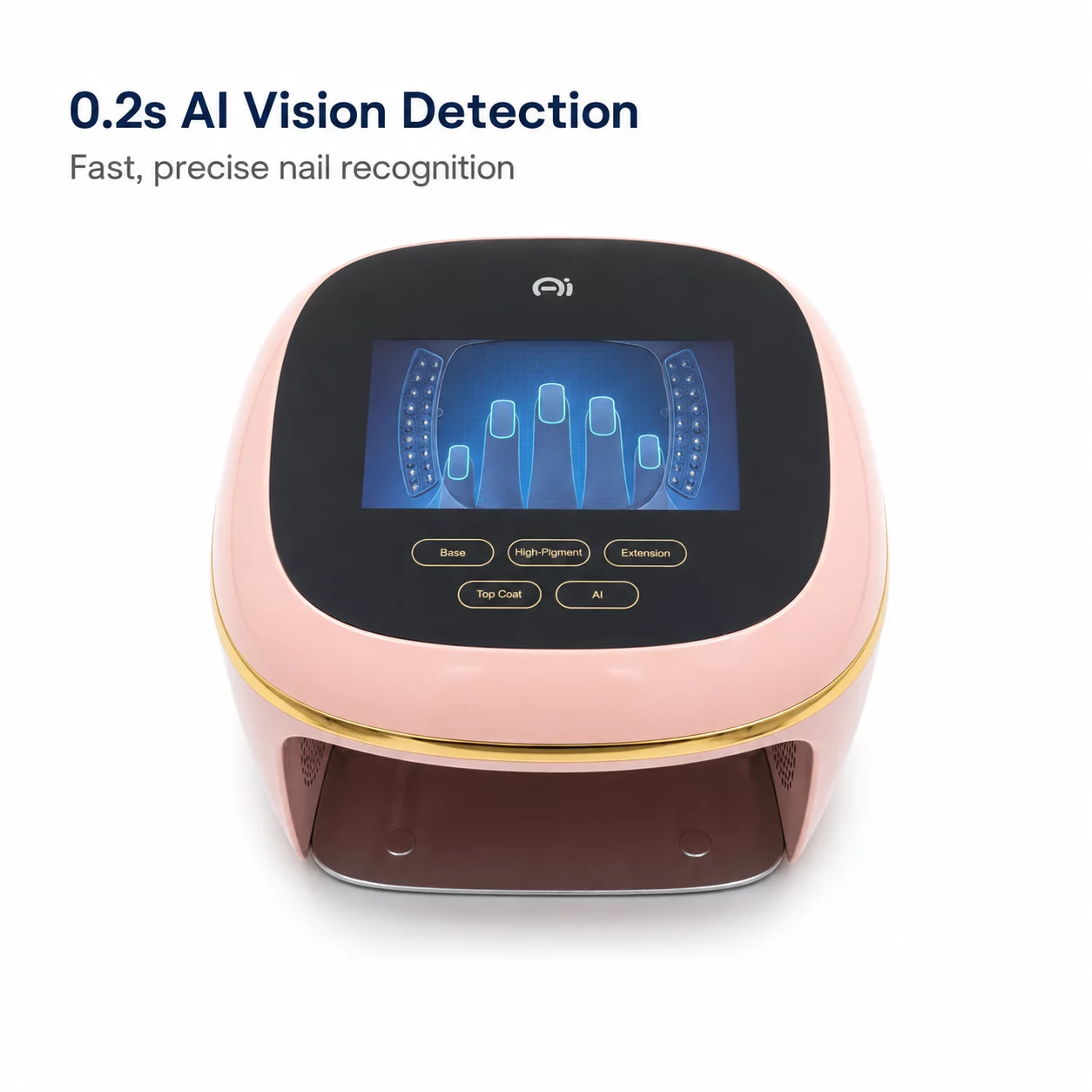
This architecture is more complex than adding a camera to a conventional lamp. The camera position, field of view, reflective interior, hand-rest geometry, LED map and control logic must work together. A brand evaluating an AI nail lamp should ask to see the recognition workflow under realistic salon conditions—not only a polished demonstration video.
Where the additional cost comes from
1. Imaging and local computing
A traditional lamp does not need a camera, image-processing pipeline or embedded operating system. The AI model adds a 1.2 GHz CPU, 128 MB RAM and 0.5 TOPS local computing capability. These components affect the bill of materials, PCB design, heat management, firmware work and quality-control process.
2. A larger controlled LED system
The current model uses 136 dual-wavelength LEDs spanning 365–370 nm and 395–400 nm. LED count alone does not prove better curing: irradiance distribution, gel compatibility, distance, timing and thermal behavior still matter. The commercial value comes from how the LEDs are arranged and controlled as a system, not from treating “136” as an isolated marketing number.
3. Touchscreen and interface development
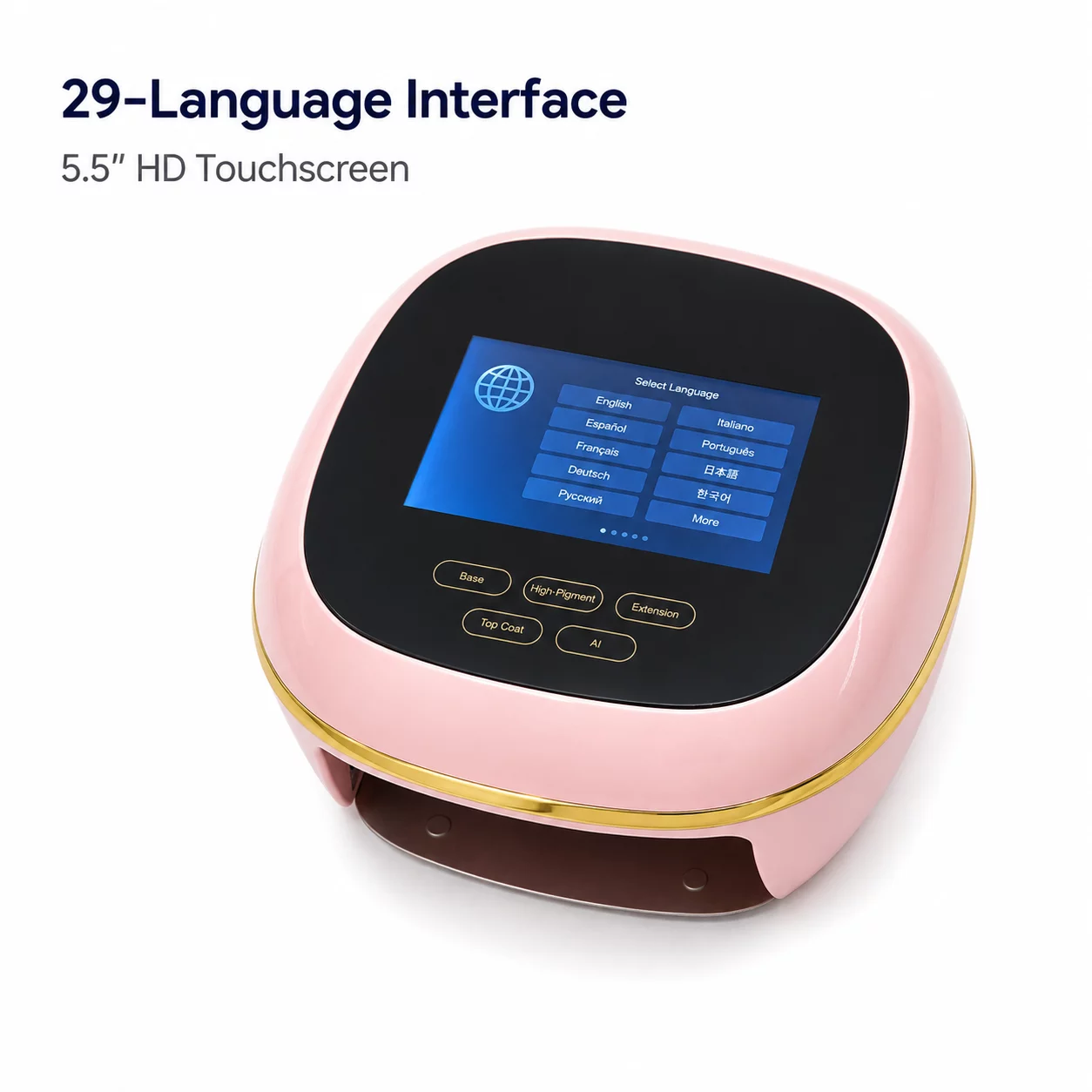
A 5.5-inch 1280 × 720 touchscreen creates a different interaction model from timer buttons. The interface includes 29 languages, which can reduce the need for market-specific printed panels and make one hardware platform easier to distribute internationally. However, brands should still review every translation, symbol, warning and workflow before approving production.
4. Software verification and after-sales support
Software creates value, but it also creates responsibilities. A buyer should clarify version control, update procedures, fault logging, language maintenance and support ownership. These items rarely appear in a simple unit-price comparison, yet they influence launch risk and the total cost of ownership.
Does AI improve curing consistency?
AI can improve process consistency by detecting hand position, selecting a mode and coordinating LED zones, but it cannot guarantee a perfect cure for every gel. Gel chemistry, layer thickness, pigmentation, application technique and exposure settings remain important. Brands should validate representative base coats, builder gels, high-pigment colors and top coats rather than relying on a single demonstration sample.
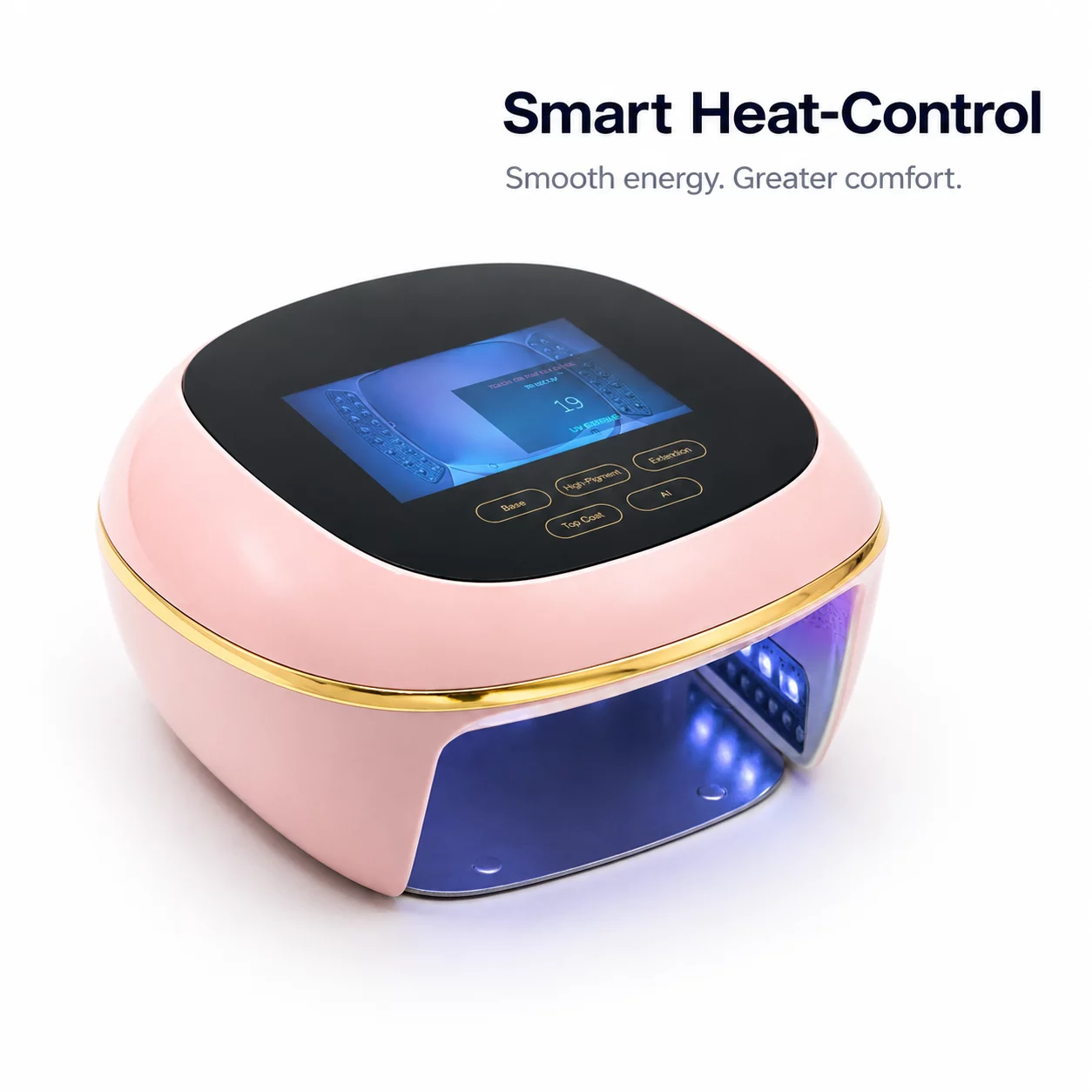
The smart heat-control algorithm is designed to modulate energy delivery for greater comfort. Treat that as a system feature to test, not as a medical or universal comfort claim. A robust validation plan records gel type, layer thickness, cure time, surface condition, hardness or adhesion method, and user feedback across repeated samples.
The 2026 BeauTome AI nail lamp specification snapshot
| AI computing | 0.5 TOPS on-device processing |
|---|---|
| Processor and memory | 1.2 GHz CPU, 128 MB RAM, Linux embedded OS |
| Camera | 2MP, 1080p |
| LED system | 136 dual-wavelength LEDs |
| Wavelengths | 365–370 nm and 395–400 nm |
| Display | 5.5-inch HD touchscreen, 1280 × 720 |
| Languages | 29 interface languages |
| Connectivity | 2.4 GHz and 5 GHz Wi-Fi |
| Dimensions | 24 × 24 × 11.5 cm |
| Battery | Optional 6000 mAh configuration |
These specifications describe the current platform; final OEM/ODM configurations, labeling, packaging and market documentation should be confirmed in the approved order specification.
How to compare total cost instead of unit price
For a traditional lamp, the unit price often dominates the business case. For an AI lamp, evaluate five cost layers:
- Product cost: processor, camera, display, LED system, enclosure, assembly and testing.
- Development cost: industrial design changes, UI branding, language work, firmware and validation.
- Launch cost: content, training, demonstrations and customer-support preparation.
- Service cost: spare units, diagnostics, software support and warranty assumptions.
- Commercial return: achievable retail price, margin, sell-through, repeat orders and brand differentiation.
A higher factory price can still support a stronger business case if the device occupies a clear premium position and gives distributors or salons a story customers can understand. Conversely, advanced hardware is a poor investment when a brand cannot demonstrate the workflow, support users or justify the price difference.
Buyer checklist before starting an OEM/ODM project
- Request a live demonstration of camera detection with different hand positions and lighting conditions.
- Test the exact gel families and colors intended for the launch market.
- Review the 29-language interface and decide which languages should ship by default.
- Confirm the approved LED map, wavelengths, modes and thermal-control behavior.
- Define who owns UI assets, translations, firmware versions and future changes.
- Check product-specific reports and market documentation; do not accept a certification logo as sufficient evidence.
- Model landed cost, warranty reserve, support workload and target retail margin.
- Approve a golden sample and written specification before mass production.
Which type should your brand choose?
Choose a traditional nail lamp when your priority is a proven, easy-to-explain product at an accessible price. Choose an AI nail lamp when your strategy depends on a flagship user experience, localized software and meaningful product differentiation—and when your team is prepared to validate and support a more sophisticated system.
The strongest portfolios may use both: a traditional model for reach and an AI model as the innovation anchor. The important point is to assign each product a clear role instead of comparing them only by wattage, LED count or factory price.
Evaluate the AI nail lamp for your market
Need a sample, interface review or OEM/ODM assessment? Explore the AI Smart Nail Lamp platform or contact BeauTome with your target market, gel system and launch requirements.