
-
Any Questions teco.beautome@gmail.com
最后更新:2026-10-13
How to Choose a Wax Heater for Low-Melting Rosin-Free Hard Wax
Match low-melting hard wax with the right heater capacity, controls and preparation routine. A practical sample-evaluation guide for beauty brands.
 ByTeco
Choose a heater for low-melting hard wax by matching the wax instructions, intended batch size, container and control behaviour. Then evaluate the proposed combination through melting, holding and refilling. A low melting point alone does not establish the correct heater setting or a safe application temperature.
For beauty brands and distributors, the useful purchasing question is: can the intended user prepare this formula consistently with this device and the supplied instructions? This guide provides a sample-review framework, using BeauTome A1 hard wax and PW2B as product examples. It does not report a completed compatibility test between them.
Separate melting point, heater setting and actual wax temperature
A melting specification describes the material. A control setting describes an instruction to the heater. The temperature of the wax is a condition to check during preparation. Treating these as the same number can lead to unclear instructions and unsuitable product claims.
| Term | What it tells a buyer | What still needs checking |
|---|---|---|
| Melting point or range | The supplier's reference for the formula becoming molten | The recommended preparation and application procedure |
| Heater setting | The selected knob position or digital setpoint | How that control relates to the actual wax under the stated conditions |
| Measured wax temperature | A reading at a defined location and time | Measurement method, mixing, fill level and variation during use |
BeauTome's A1 product specification lists approximately 48°C as its melting reference; the existing A1 product guide discusses a 48–50°C melting range. Neither figure should be printed as a universal heater setpoint. Confirm the specification and instructions supplied with the selected formula before preparing a branded manual.

Choose capacity around the service
Begin with the portions the user needs, the work area and the frequency of replenishment. A compact heater may suit smaller preparation amounts and local touch-ups. A larger service routine may require more capacity or a different workstation arrangement. Select these deliberately rather than assuming that the largest pot is the most useful.
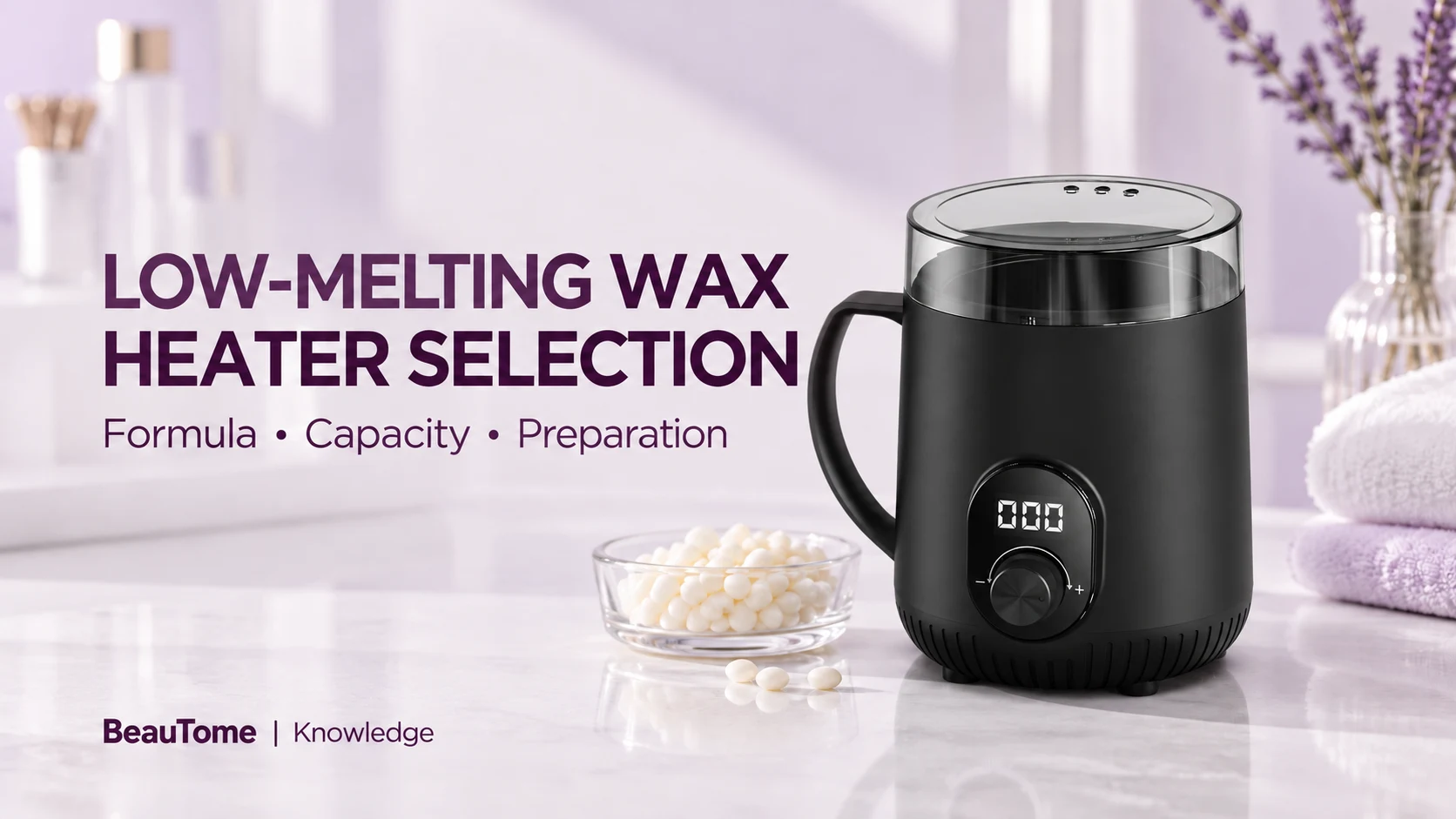
PW2B has a nominal 250 ml capacity, a nonstick pot, a see-through cover, an integrated grip handle and rotary adjustment with chip-based control. Its digital display shows the real-time temperature measured by the sensor. The sensor reading does not establish that all parts of the wax have the same temperature. A silicone bowl is optional and should be specified in the order. These are configuration facts, not evidence of a particular temperature tolerance or warm-up time. See the PW2B product page for the model context.
Do not convert 250 ml directly into a guaranteed wax weight or a number of treatments. The usable fill amount, wax form and operating instructions need to be considered separately. Record the sample's fill level and wax mass so another evaluator can reproduce the setup.
Compare controls through use, not appearance
A rotary control offers a simple adjustment interface. A digital model can make the selected setting easier to communicate, but the displayed number should still be interpreted according to the model documentation. Ask whether it represents a setpoint, a sensor reading or another value.
For either design, request an explanation of normal preparation, holding and adjustment. If temperature consistency is central to your product positioning, agree a measurement method and acceptance criteria before testing. Avoid purchasing against an unspecified claim such as “precision heating”. Our wax heater engineering guide explains the broader questions to raise with a supplier.
Use a repeatable preparation review
The following is a proposed buyer evaluation sequence, not a published standard or a set of BeauTome test results. Keep initial equipment checks off skin. Have qualified personnel define the temperature measurement procedure and conduct any subsequent application evaluation under the formula's instructions.
- Identify the setup. Record formula and batch, heater model, power configuration, container or liner, wax amount and room conditions.
- Follow the preparation instructions. Record control changes, lid position, stirring and the time at which the wax reaches the specified usable condition.
- Review holding behaviour. Use an agreed measurement location and schedule. Observe consistency and record adjustments rather than relying on an isolated reading.
- Review replenishment. Add the agreed quantity only as permitted by the instructions. Record the preparation steps needed before further use.
- Repeat the relevant scenarios. Evaluate the intended fill amounts and container configuration. Changing a liner or portion should be documented.
- Approve the instructions alongside the sample. Record the accepted configuration, remaining questions and responsibility for resolving them.

Keep formulation claims specific
A1 is a rosin-free, unscented hard wax developed for professional waxing. Those attributes describe its positioning; they do not remove the need to review individual suitability or application instructions. Rosin-free does not mean allergy-free, and a low melting point does not guarantee a burn-free service.
The American Academy of Dermatology advises following wax package directions and checking wax temperature before application. Its consumer guidance is useful background, but it does not validate a particular heater or replace the instructions for a hard-wax formula. Read the AAD guidance.
What should go into the quotation request?
Send the intended user, treatment areas, formula reference, preparation amount, expected replenishment routine, power and plug requirements, preferred container, required accessories and packaging languages. Ask the supplier to separate confirmed specifications from options requiring sample review.
Where the wax itself is changing, use our private-label hard wax development guide before approving the device combination. For a packaged offer, continue to the waxing kit specification guide.
Frequently asked questions
Can low-melting hard wax be used in any wax heater?
Do not assume universal compatibility. Check the formula and heater instructions, container, permitted fill amount and control behaviour, then review the proposed combination.
Does a digital display prove that the wax has the displayed temperature?
No. Confirm what the display represents and how the model measures temperature. Product claims about actual wax temperature require an appropriate measurement method.
What does the PW2B display show?
It shows the real-time temperature measured by the sensor. PW2B combines this digital display with rotary adjustment and chip-based control. Check the actual wax according to its instructions; a sensor reading does not prove uniform temperature throughout the pot.
Is 48°C the recommended heater setting for A1?
It is a listed melting reference, not a universal setting or guaranteed skin-contact temperature. Use the operating instructions supplied for the selected wax and heater.
Discuss your wax-and-heater sample plan
BeauTome supports B2B waxing product and equipment development. Share your formula, target market and service routine to discuss an appropriate model and a clearly scoped sample review.
Sources and product evidence
- American Academy of Dermatology: Hair removal—How to wax; temperature and instruction guidance only.
- BeauTome rosin-free hard wax and PW2B; manufacturer product specifications, not independent performance certification.
Product records and linked guidance reviewed on October 13, 2026. The review sequence is editorial procurement guidance; no measured performance results are asserted.