
-
Any Questions teco.beautome@gmail.com
最后更新:2026-10-13
Private-Label Waxing Kits: How to Specify the Wax, Heater and User Instructions
Build a private-label waxing kit brief covering wax, heater, accessories, packaging and instructions. Learn what to confirm before approving the complete sample.
 ByTeco
A private-label waxing kit brief should define the intended user, wax formula, heater, accessories, packaging and operating instructions as one coordinated offer. Approve the complete packed sample against that brief before treating individual component approvals as a launch decision.
For a brand or distributor, this turns a catalogue selection into a usable product specification. It also exposes omissions early: an optional bowl left out of the price, unclear plug requirements or instructions written for a different formula. This guide focuses on the kit as a whole; our hard wax development guide covers formula development in more detail.
Start with the person using the kit
Professional and home-use projects need separate briefs. A trained technician brings a different level of experience to preparation and application. Do not assume that smaller packaging makes a professional formula or procedure suitable for a first-time home user.
Record the intended treatment areas, experience level, work surface, storage constraints and expected preparation amount. Specify who will assess instructions and user suitability. If a home-use project is proposed, agree its evaluation and documentation requirements before adopting professional product copy.
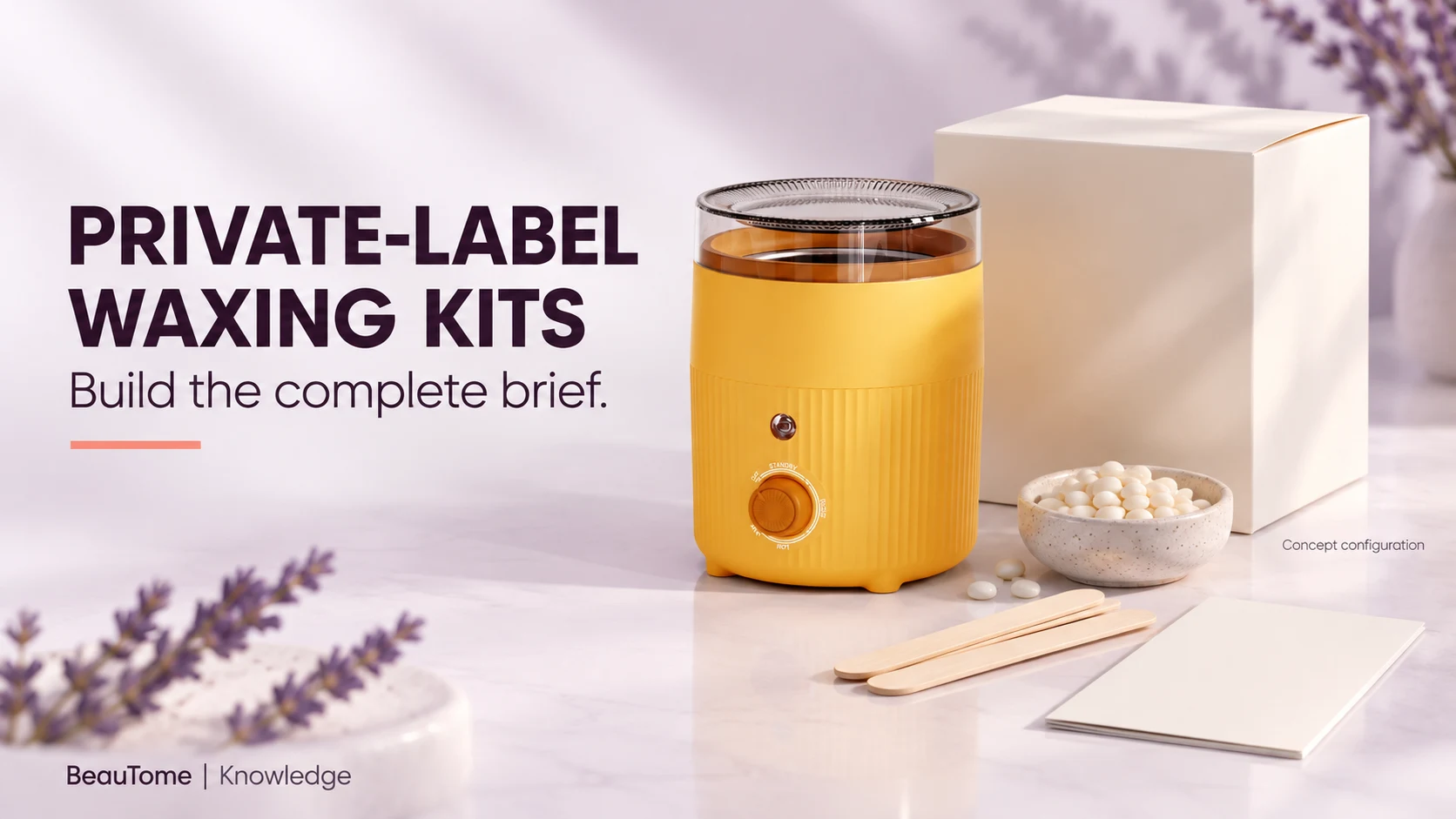
BeauTome A1 is a rosin-free, unscented option for a professional waxing range. PW8 is a compact 180 ml rotary-control heater that can be considered where smaller preparation portions are appropriate. Together they are potential development inputs, not a pre-validated retail kit.
Write a bill of materials that a buyer can check
List every item, including those that feel obvious. For each one, record its specification, quantity, supplier reference and whether it is included or optional. A photograph of accessories is not a substitute for an agreed contents list.
| Item | Define in the brief | Check on the packed sample |
|---|---|---|
| Wax | Formula reference, colour, scent profile and net weight | Correct variant, label and batch identification |
| Heater | Model, controls, power and plug configuration | Supplied unit matches the agreed configuration |
| Container or bowl | Fixed pot or compatible accessory; included or optional | Fit and use instructions for the selected model |
| Application accessories | Type, size, quantity and intended use | Actual contents and hygienic packaging |
| Instructions | Language, formula, equipment and user scope | Printed version matches the approved revision |
| Outer packaging | Dimensions, insert, artwork and market information | Fit, legibility, contents and handling assessment |

Keep wax pack weight separate from heater capacity
A refill pouch may contain more wax than the heater should hold in one preparation cycle. Packaging should not imply that the whole pouch belongs in the pot. State the preparation and replenishment method clearly, using the device's permitted fill amount and the formula instructions.
For PW8, the 180 ml specification is a nominal capacity, not a claim that a particular wax weight can be loaded at once. Its optional silicone bowl must be named explicitly if the kit includes it. Evaluate the chosen container configuration rather than assuming that results from a different pot or liner transfer unchanged. The low-melting wax heater guide provides a preparation review framework.
Make the instructions part of product development
Draft the manual while choosing the components. It should explain how the user identifies the correct contents, prepares the equipment, follows wax-specific heating directions, checks readiness and temperature, and cleans and stores the equipment according to its instructions.
Give product-specific warnings and suitability information the space they require. Do not replace them with broad phrases such as “gentle for everyone”. AAD consumer guidance reinforces the importance of package directions and temperature checks, but its general procedure should not be copied wholesale into a manual for a different wax system. See the AAD source.
Ask an evaluator representative of the intended user to work through the preparation instructions under appropriate supervision. Record unclear steps, missing illustrations and differences between the written sequence and the supplied equipment. Resolve those issues before translating the final version. This is a proposed usability review, not a substitute for required product testing.
Use claims that match the selected formula
For A1, rosin-free and unscented are specific product attributes. They should not become allergy-free, pain-free or universally suitable claims on a kit box. Low melting point is a formulation reference, not a guarantee about skin-contact temperature.
The FDA explains that the term “hypoallergenic” has no federal standard or definition in the United States. That makes it a poor substitute for clearly supported formulation information. Review the exact claims and their evidence for the intended market. Read the FDA explanation.
Review market requirements by component
A kit combines different items. Ask the responsible market adviser or testing provider to identify the requirements applicable to the cosmetic, electrical appliance, accessories and packaging in the destination market. A document concerning one component does not automatically establish the status of the entire set.
Request model-specific records, the intended power and plug configuration, current formula and label information, traceability details and the required language versions. Confirm who owns each review and what remains outstanding. Avoid printing approval logos or certification statements before their scope and permitted use are checked.
Approve the complete packed sample
Use a single approval record with separate decisions for contents, operation, artwork and packaging. For example, a heater can match its specification while the supplied leaflet still shows a different control. That discrepancy should remain open until the leaflet is corrected and checked.
- Compare every physical item with the bill of materials.
- Review preparation and cleaning using the exact supplied components.
- Compare labels, leaflet and box against the approved formula and model.
- Assess the packaging fit and agree any handling or transport evaluation needed.
- Record approved revisions, unresolved items and the conditions for production release.

Request quantity, pricing and timing for that exact configuration. Standard-stock terms do not automatically apply to custom colours, printed packaging or formula changes. If a component changes after approval, agree which instructions, artwork and tests need review.
Frequently asked questions
What should a private-label waxing kit include?
The contents depend on the intended user and use. Define the wax, heater, required application accessories, instructions and packaging, then identify optional items separately.
Is the PW8 silicone bowl included automatically?
No. It is optional. Specify it in the quotation and the final kit contents if required.
Can a professional wax kit be sold as a home-use kit without changes?
Do not assume that it can. Review intended use, suitability, instructions and destination-market requirements for the proposed home-use configuration.
Does private label only mean adding a logo?
A project can be limited to branding, but a complete kit brief also needs to control contents, formula and device identity, packaging, instructions and the approved sample revision.
Build your kit brief with BeauTome
BeauTome supports OEM/ODM discussions for waxing products and equipment. Send your target market, intended user, treatment areas and proposed contents to discuss a scoped sample plan. We will confirm available options and project-specific requirements rather than assuming a universal kit configuration.
Sources and product evidence
- AAD: Hair removal—How to wax; general user precautions.
- FDA: Cosmetics Safety Q&A—Hypoallergenic; United States terminology context.
- BeauTome A1 and PW8; manufacturer specifications.
Reviewed October 13, 2026. The cover is a concept configuration. The planning and approval checklists are editorial tools, not evidence of a tested or certified kit.