-
Any Questions teco.beautome@gmail.com
最后更新:
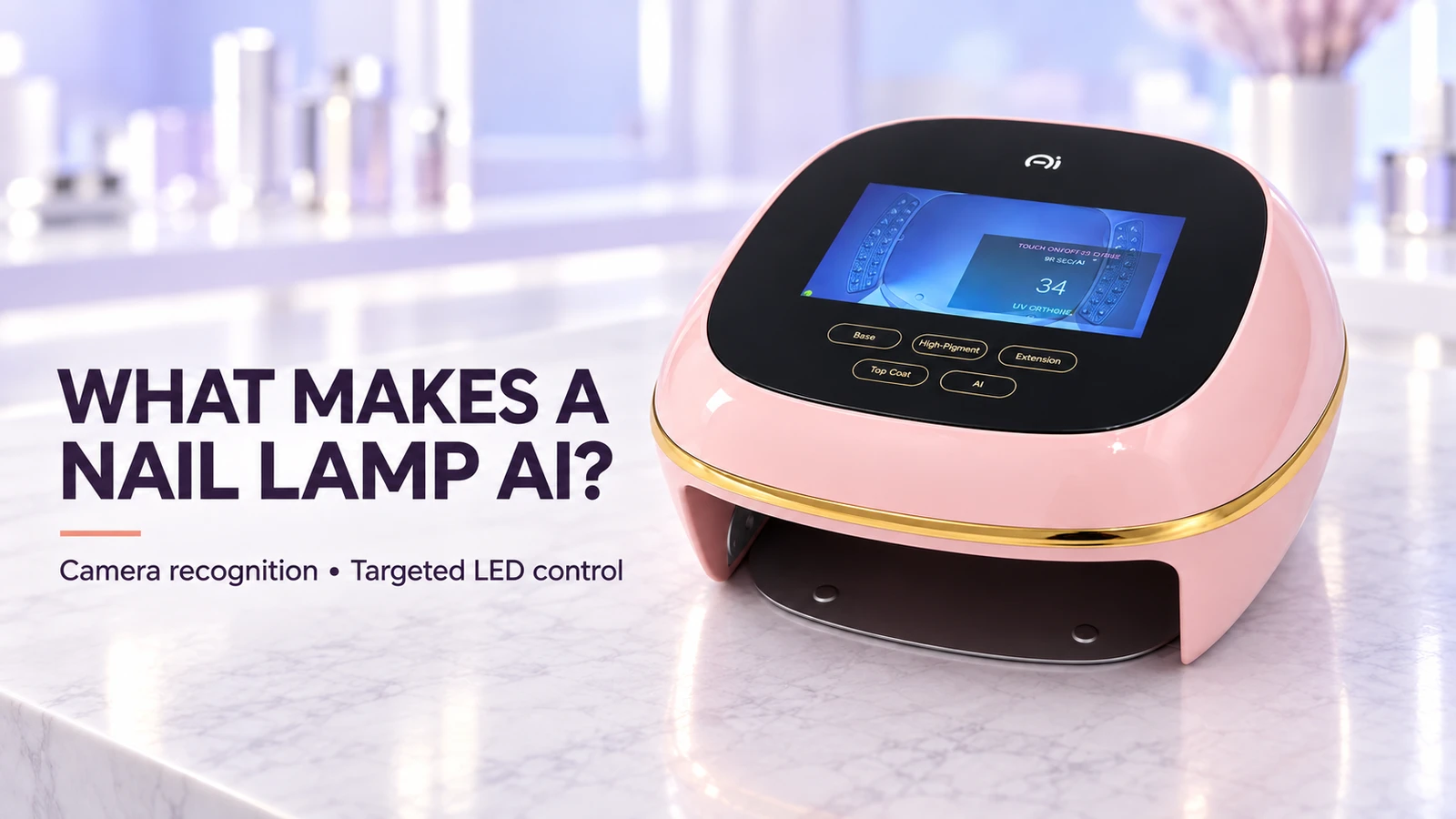
What Makes a Nail Lamp AI? Camera Recognition, Position Detection and LED Control Explained
A technical guide to how camera-guided AI nail lamps detect hand entry, locate nails, map positions to LED zones, and what beauty brands should validate before sourcing.
 ByTeco
Last updated: September 26, 2026
An AI nail lamp is not simply a UV/LED lamp with an automatic start function, touchscreen or premium-looking interface. A genuine AI workflow uses a camera to capture the hand, processes that image to locate the nails, maps the detected nail positions to corresponding LED zones, and then controls those zones during curing.
In the current BeauTome AI Smart Nail Lamp workflow, the camera also detects that the hand has entered the curing area and starts the system. It does not depend on an infrared hand sensor for activation.
For beauty brands and distributors, that distinction matters. It separates a meaningful recognition-and-control architecture from ordinary automation marketed with an “AI” label.
AI nail lamp definition: the short answer
An AI nail lamp combines four functional layers:
- Visual input: a camera captures the hand inside the curing area.
- Position recognition: an on-device algorithm identifies the location and approximate contour of the nails.
- Spatial mapping: the detected nail coordinates are matched to defined UV/LED zones inside the lamp.
- Controlled output: the system activates the corresponding LED zones according to the selected curing mode.
The word “AI” describes this recognition-and-control loop. A timer, proximity sensor or preset heat mode may be useful, but none of those features alone demonstrates artificial intelligence.
How a camera-guided AI nail lamp works
The mechanism can be summarized as:
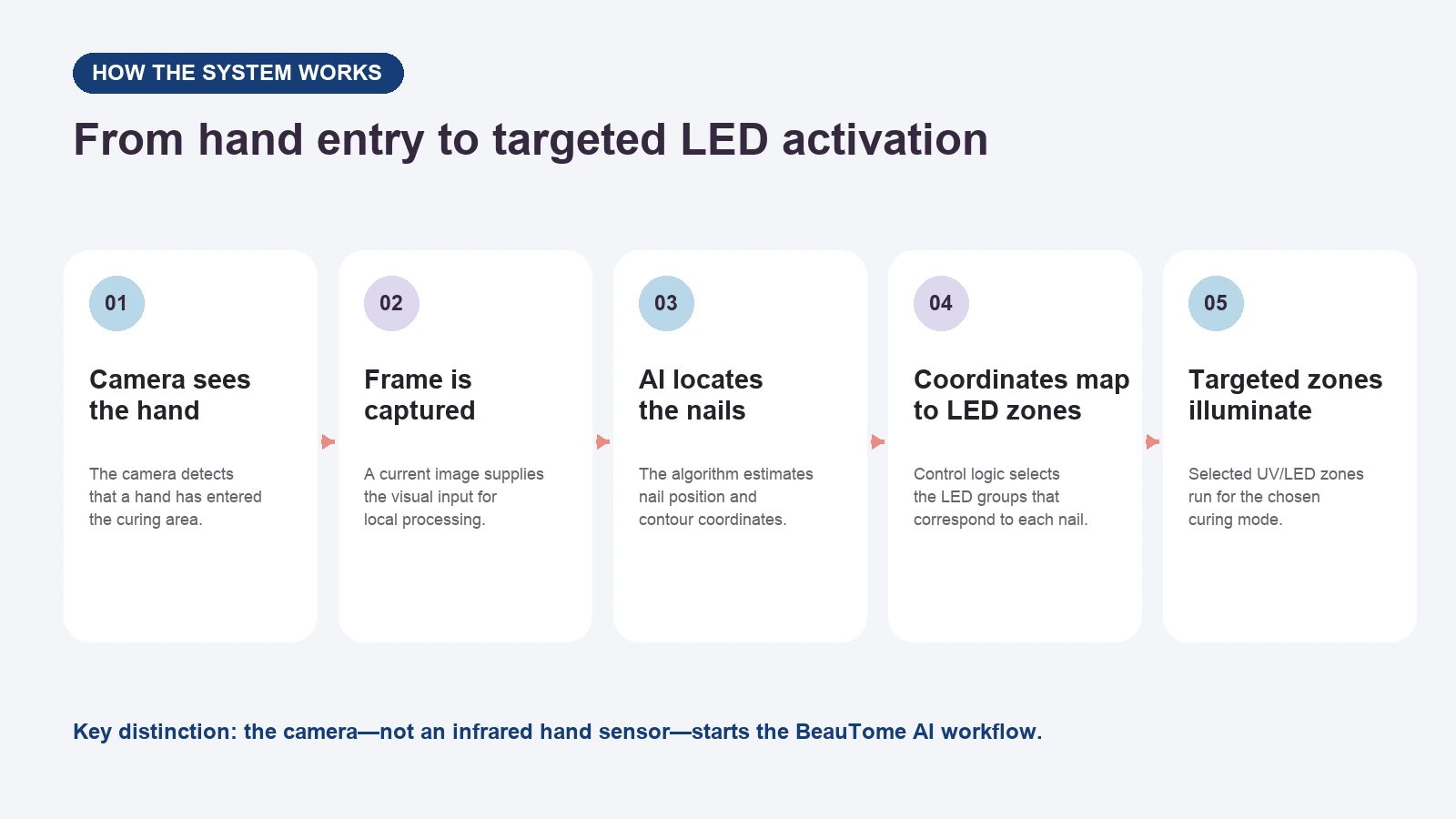
Camera detects hand entry → camera captures the hand image → local AI locates the nails → coordinates map to LED zones → selected UV/LED zones illuminate.
Step 1: the camera detects that a hand has entered
In a conventional automatic nail lamp, a separate infrared or proximity sensor often detects the hand and starts a timer. The BeauTome AI platform uses the camera to recognize that the hand has entered the curing area. The same imaging system then supplies the frame used for nail-position analysis.
This design links activation and recognition into one visual workflow. Buyers should still test how reliably the system responds to partial insertion, unusual hand angles and repositioning.
Step 2: the system captures a current hand image
The camera provides a live view of the curing area. The image is not valuable by itself; camera position, field of view, lighting, reflective surfaces and hand-rest geometry must allow the nails to remain visible enough for processing.
A high-resolution camera does not automatically prove accurate recognition. Resolution is one input. The complete imaging environment determines whether the algorithm receives a usable frame.
Step 3: the on-device algorithm locates the nails
The processor evaluates the captured image and estimates the position and contour of each visible nail. The current BeauTome 2026 specification lists a 2 MP 1080p camera, 0.5 TOPS of local AI computing and a listed recognition response of 0.2 seconds.
TOPS describes theoretical AI-computing throughput. It does not measure curing quality, optical output or recognition accuracy. Buyers should judge the system by repeatable detection results, not by processor terminology alone.
Step 4: nail coordinates are mapped to LED zones
The detected coordinates must correspond to a known LED layout. Control software translates the nail positions into commands for the relevant LED groups.
This is where imaging, software and optical engineering meet. If the camera view, coordinate system and physical LED map are misaligned, the screen can appear to recognize a nail while the wrong area is illuminated.
Step 5: the selected zones illuminate
The system activates the LED zones associated with the detected nail positions and applies the chosen curing mode. This targeted architecture is intended to avoid running every diode across the entire hand area when only specific zones are required.
That does not create a universal safety or curing guarantee. Exposure, gel compatibility, irradiance distribution, time, layer thickness and technician technique still require product-specific validation.
AI nail lamp vs infrared sensor nail lamp
An infrared sensor lamp automates a trigger. A camera-guided AI lamp interprets visual information and uses the result to control spatially defined LED zones.
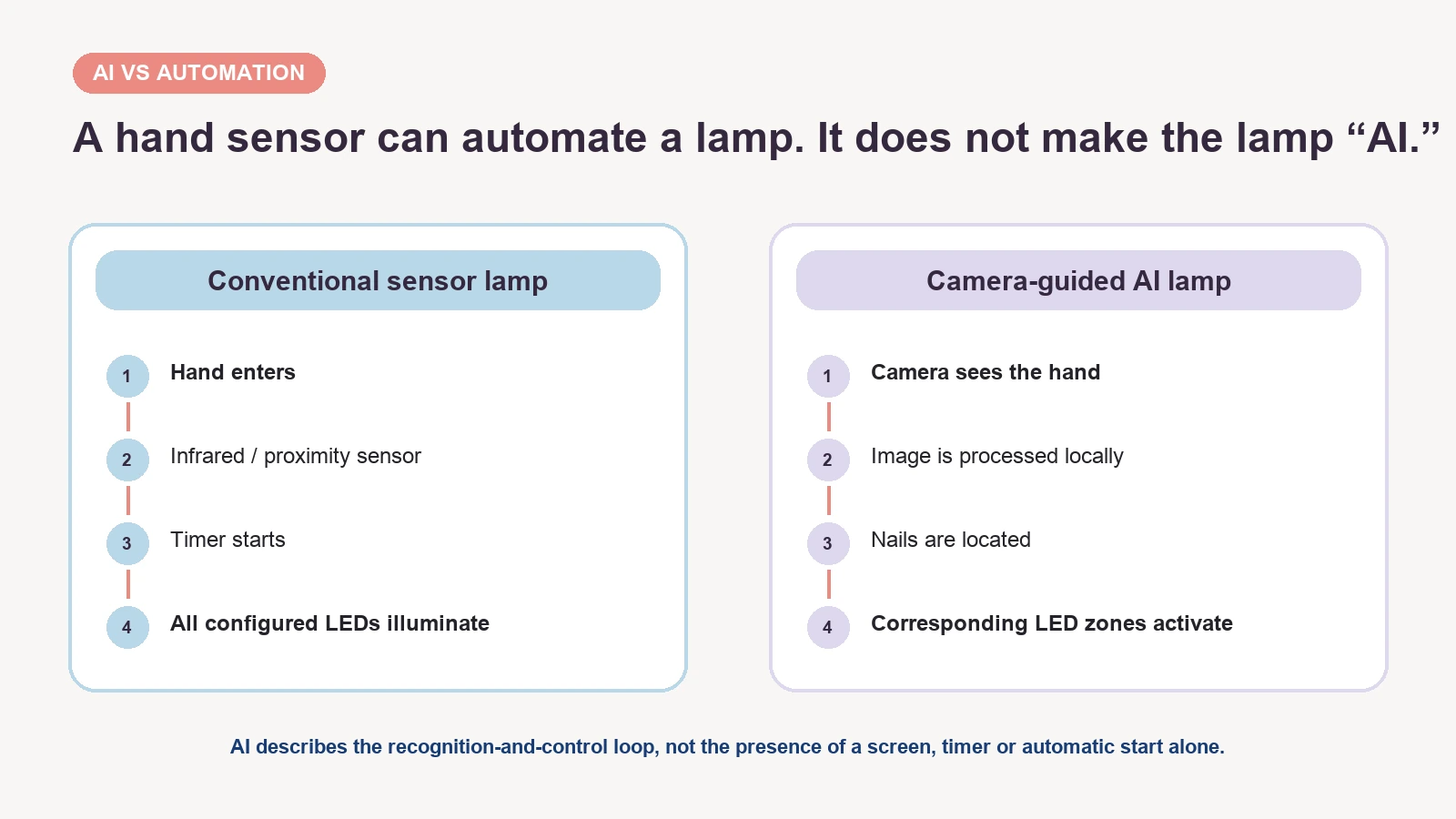
| Decision point | Conventional sensor nail lamp | Camera-guided AI nail lamp |
|---|---|---|
| Hand-entry trigger | Usually infrared or proximity sensor | Camera recognizes the hand entering the curing area |
| Input data | Presence or absence of an object | Current image of the hand and nails |
| Processing | Simple trigger and timer logic | Image processing and nail-position recognition |
| LED behavior | Runs the configured LED array or preset mode | Maps detected nails to corresponding LED zones |
| User feedback | Timer, buttons or indicator display | Recognition view, interface prompts and controlled modes |
| Main buyer validation | Trigger range, timing and full-field curing | Trigger, recognition, coordinate mapping, zone control and curing |
The comparison is not “smart versus unsmart.” A well-designed sensor lamp can be reliable and commercially appropriate. The question is whether the product performs a genuine visual-recognition task and whether that extra complexity supports the brand’s intended positioning.
Which features do not prove that a nail lamp uses AI?
The following features may appear on an advanced nail lamp but do not independently prove an AI function:
- An automatic hand-entry start
- A touchscreen
- Multiple curing timers
- Heat-control modes
- A large number of LEDs
- Dual-wavelength LEDs
- Wi-Fi connectivity
- A camera that only displays video
- Preset gel modes
To substantiate an AI positioning, the supplier should demonstrate how image input changes the lamp’s control behavior. The most direct evidence is a repeatable test showing nail detection and the resulting LED-zone selection under defined conditions.
Where the AI function ends—and curing science begins
AI determines where the control system should direct its output. It does not change the underlying photopolymerization chemistry.
Gel curing still depends on the relationship among:
- The gel’s photoinitiator system
- The lamp’s wavelength bands
- Irradiance at the nail surface
- Exposure time
- Layer thickness and pigmentation
- Distance and angle between the gel and LEDs
- Thermal behavior during repeated cycles
For that reason, a correctly detected nail can still be under-cured if the gel, optical output or exposure protocol is unsuitable. Conversely, a conventional lamp can cure a compatible gel successfully without AI. The value of AI lies in the controlled workflow and product differentiation, not in replacing compatibility testing.
The BeauTome 2026 AI nail lamp architecture
The current platform combines camera-guided recognition with a controlled UV/LED system and multilingual interface.
| Specification area | Current 2026 platform specification |
|---|---|
| Camera | 2 MP, 1080p |
| AI processing | 0.5 TOPS on-device processing |
| Listed recognition response | 0.2 seconds |
| LED system | 136 dual-wavelength LEDs |
| Wavelength bands | 365–370 nm and 395–400 nm |
| Display | 5.5-inch HD touchscreen, 1280 × 720 |
| Interface | 29 languages |
| Dimensions | 24 × 24 × 11.5 cm |
| Weight | 1.85 kg listed in the current specification |
| Battery | Optional 6000 mAh configuration |
These figures describe the current product platform. Final hardware, adapter, firmware, battery, labeling and market documentation must be confirmed in the approved OEM/ODM order specification. View the BeauTome AI Smart Nail Lamp V2 for the product overview.
How brands should test the AI function
A polished demonstration is useful for orientation, but it is not an acceptance test. Buyers should challenge the complete camera-to-LED loop.
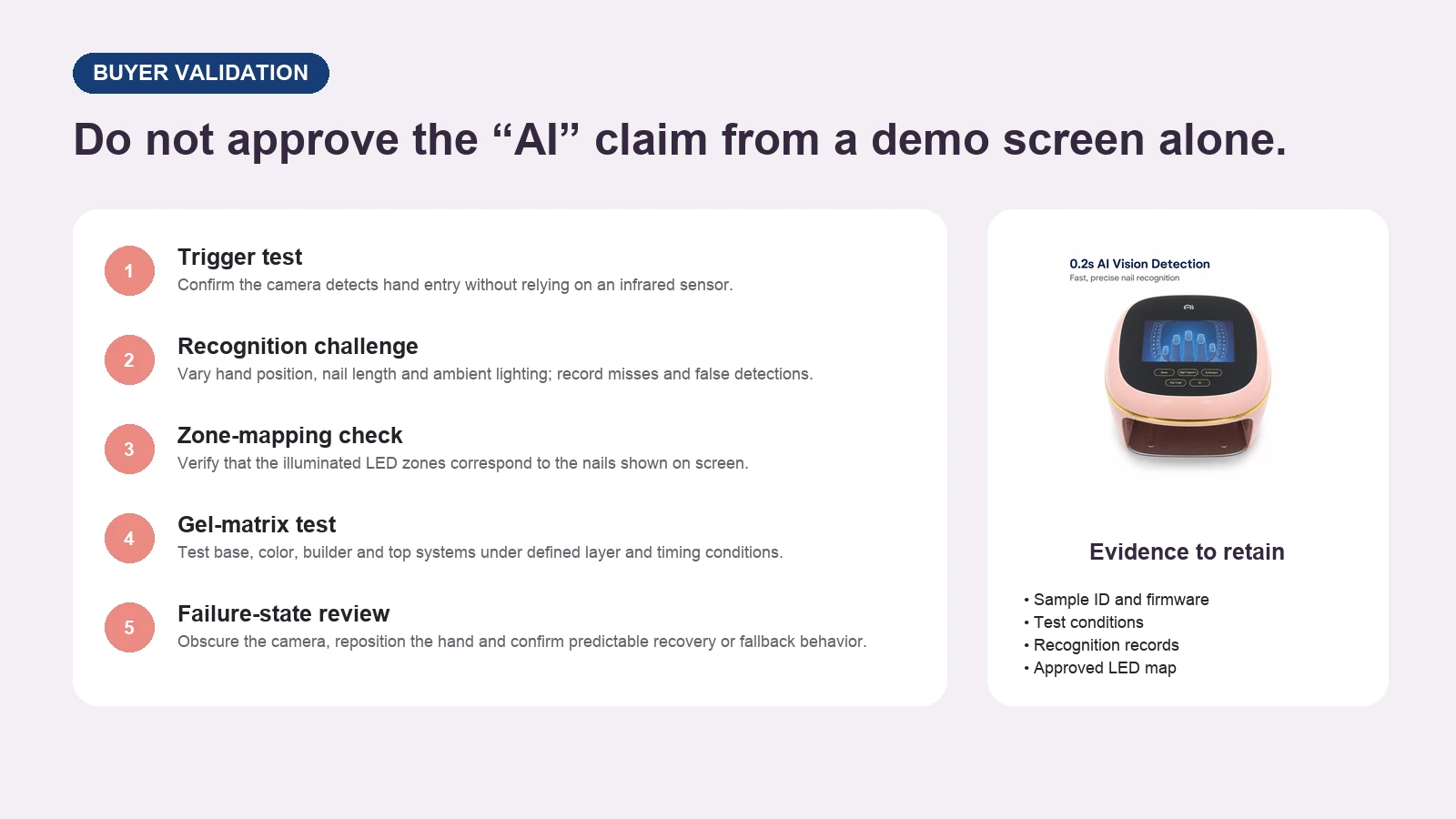
1. Freeze the sample configuration
Record the model, hardware revision, firmware version, camera specification, adapter, LED layout and interface version. Keep the same identification throughout testing.
2. Test camera-based hand entry
Confirm that placing the hand in the curing area starts the workflow through the camera. Test full insertion, partial insertion, slow entry, quick entry and removal followed by re-entry.
3. Challenge nail recognition
Vary hand placement, finger spacing, nail length and ambient lighting. Record missed nails, false detections, detection delay and recovery after the hand is repositioned. Include the representative users and service conditions of the intended market.
4. Verify the LED map
Do not stop at the screen overlay. Observe whether the illuminated LED zones correspond to the nails the interface has identified. Challenge the thumb, side walls and off-center placements.
5. Run a defined gel matrix
Test the brand’s intended base coat, color gels, high-pigment shades, builder or extension products and top coat. Define layer thickness, timing and evaluation method before the trial.
6. Review failure behavior
Temporarily obscure the camera, insert the hand outside the expected position and interrupt a cycle. The system should respond predictably, communicate the problem and recover without creating a confusing workflow.
7. Retain evidence
Keep sample IDs, test conditions, photos or videos, recognition records, gel results and the approved LED-zone map. These records make supplier comparisons and later change control much more reliable.
OEM/ODM questions to ask the manufacturer
Before approving an AI nail lamp program, ask:
- What visual event starts the system, and does the design use any separate infrared sensor?
- Which functions run locally, and which require Wi-Fi or external services?
- How are camera coordinates calibrated against the physical LED layout?
- What happens when one or more nails are not recognized?
- Can the buyer review recognition logs or controlled demonstration records?
- How are firmware versions, language files and LED-control changes managed?
- Which parts of the interface, modes and language package can be customized?
- How are software changes linked to sample approval and production traceability?
- Which product-specific test reports and declarations match the final configuration?
- What acceptance criteria will be written into the golden-sample approval?
These questions shift the sourcing discussion from a marketing label to an auditable product system.
Frequently asked questions
Does automatic start mean a nail lamp uses AI?
No. Many conventional lamps use an infrared or proximity sensor to start a timer. AI requires a recognition function in which visual input is processed and affects control decisions.
Does the BeauTome AI nail lamp use an infrared sensor to start?
No. In the current workflow, the camera detects that the hand has entered the curing area and initiates the process. The camera image is then used to locate the nails and select corresponding LED zones.
Is a camera enough to call a nail lamp AI?
No. A camera may simply display or record an image. The buyer should verify that the image is processed to recognize nail positions and that recognition changes LED-zone behavior.
Does 0.5 TOPS indicate how well the gel cures?
No. TOPS is a computing-throughput specification. Curing performance depends on the optical system, gel chemistry, exposure protocol and application conditions.
Does targeted LED control guarantee less skin exposure?
It is designed to avoid illuminating zones that are not selected, but the actual exposure pattern must be measured and validated. Avoid turning an architectural feature into an absolute safety claim.
Can one AI nail lamp cure every gel?
No universal compatibility should be assumed. Brands should test every intended gel family, shade and application thickness under a defined protocol.
A better way to evaluate the “AI” label
The most useful question is not “Does this nail lamp have AI?” It is:
What visual information does the system interpret, what decision does it make, and how does that decision change the curing hardware?
For the BeauTome platform, the answer is concrete: the camera detects the hand, captures the image, the local algorithm locates the nails, and the control system activates the corresponding UV/LED zones. That mechanism gives brands a technical story customers can understand—and a workflow buyers can test.
If you are evaluating a private-label or OEM/ODM AI nail lamp, review the AI Nail Lamp vs Traditional Nail Lamp comparison and the Complete Guide to AI Nail Lamps for Beauty Brands and Distributors. Then contact BeauTome with your target market, gel portfolio, interface languages and sample-validation requirements.
Evidence notes
- Current product specifications:
AI SMART NAIL LAMP 2026.xlsx, BeauTome internal product record. - Product mechanism: camera-based hand-entry detection, image capture, nail-position recognition and corresponding LED-zone activation, confirmed by the product owner.
- Product overview: BeauTome AI Smart Nail Lamp V2.
- Specifications and marketing statements should be confirmed against the approved sample, final order specification and product-specific compliance documentation before market use.