
-
Any Questions teco.beautome@gmail.com
最后更新:2026-10-13
How to Evaluate an AI Nail Lamp for Your Gel Polish System
Evaluate an AI nail lamp with your gel system: review specifications, hand-position recognition, curing procedures, maintenance and sample approval evidence.
 ByTeco
Evaluate an AI nail lamp by defining the intended gel system and application procedure, reviewing the lamp's optical and control specifications, and agreeing a compatibility assessment with the gel supplier and qualified evaluators. Camera recognition, wattage and wavelength specifications alone do not prove that a gel is fully cured.
For nail brands and distributors, this means bringing the gel into the sample brief from the beginning. The useful output is a documented decision about a particular lamp configuration, gel range and procedure—not an unsupported promise to cure every product.
Start with the gel system and its instructions
Record the exact base, colour, top coat and any enhancement products included in the proposed range. Obtain their application and curing instructions, including the permitted layer thickness or application method, lamp requirements and cycle. If those requirements are unclear, ask the gel supplier before attempting to choose an alternative lamp.
Nailberry provides a practical example of system-specific instructions: its BioGlow lamp page specifies one-minute cycles for base and colour layers and a two-minute cycle for the top coat. These are instructions for that brand's products, not transferable settings for BeauTome V2 or another gel range. See Nailberry's official BioGlow instructions.
Use that example to ask a procurement question: who will define and support the procedure for your own combination? A supplier demonstration with an unidentified gel is not an approval record for your product range.
Separate specifications, control functions and curing evidence
| Information | What it helps evaluate | What it does not establish alone |
|---|---|---|
| Wavelength bands | Comparison with the gel supplier's optical requirements | Compatibility or complete cure across all products |
| LED count and arrangement | Device configuration and areas to inspect | Uniform exposure at every nail position |
| Camera recognition | Detection and response to hand and nail position | A measurement of gel cure completion |
| Progressive output | The selected energy-delivery control approach | Pain-free curing or suitability for every gel |
| Maintenance alerts | Prompts for equipment checks | Proof that a particular application has cured correctly |

What BeauTome V2 brings to an evaluation
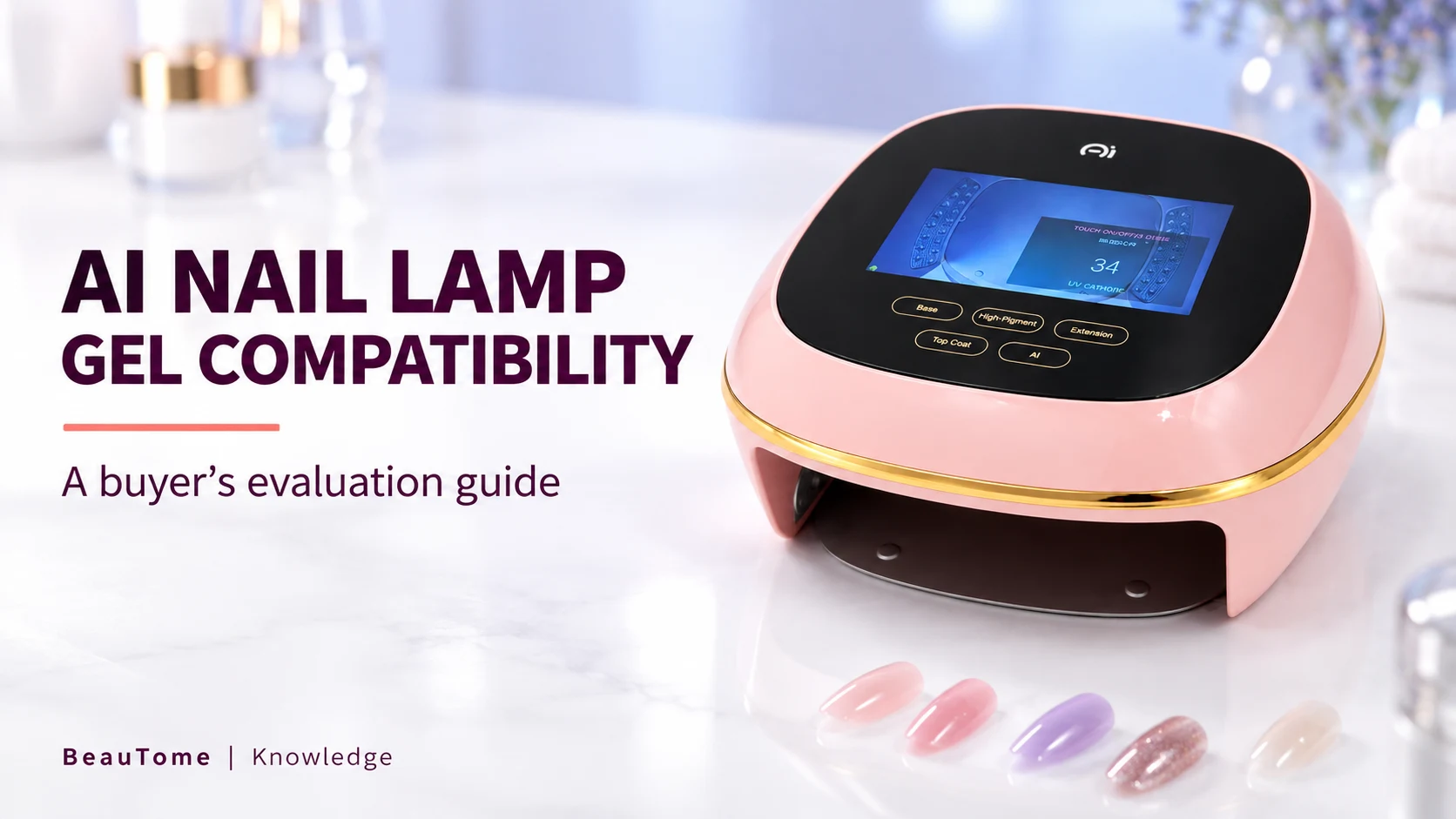
The BeauTome AI Smart Nail Lamp V2 product specification describes a 2 MP camera that detects hand position and nail contours, with processing used to control active LED zones. It lists 136 LEDs with wavelength bands of 365–370 nm and 395–400 nm, progressive output, light-decay alerts and a 5.5-inch multilingual touchscreen.
These are manufacturer specifications and features to assess on the supplied sample. They are not independent evidence that every gel, hand position or application thickness produces the same result. Confirm the hardware and software configuration, available modes and instructions for the unit under review.
The listed recognition response is a detection reference. It must not be described as a curing time. For more on the control sequence, read how camera recognition and LED zone control work.
Build a sample matrix before running demonstrations
Agree the evaluation scope with the gel supplier and the people responsible for validation. Identify the products and application conditions that need separate assessment rather than testing one convenient colour and extending the result to the entire range.
- Gel identity: manufacturer, product name, variant, batch and relevant instructions.
- Application: substrate, preparation, layer method and thickness controls defined by the evaluator.
- Lamp identity: model, sample identifier, hardware or firmware revision and selected mode.
- Position: the hand and thumb placements allowed by the operating instructions.
- Procedure: the cycle and output mode agreed for evaluation.
- Evidence: the test method, acceptance criteria and person responsible for interpreting results.
Do not select a new curing time by trial and error on a customer. Have the responsible technical parties establish an appropriate procedure. Visual appearance, a dry-looking surface or a successful camera response should not serve as the sole evidence for complete curing.
Review recognition as a distinct operational test
Check how the camera and active zones respond to the permitted placements and nail shapes in your intended workflow. Record the setup, observed response and any interruption or repositioning. If a position produces inconsistent detection, resolve it with the supplier and document the supported operating method.
This review answers whether the control behaves as specified in the observed conditions. Keep it separate from gel performance assessment. A recognition pass should never automatically mark a curing result as passed.
Evaluate output modes and maintenance instructions
V2's progressive-output feature changes how output is delivered during a cycle. Include the selected mode in the gel compatibility assessment instead of treating it as a cosmetic interface option. Ask the supplier to explain the mode's intended use and relevant operating limitations.
For light-decay alerts, confirm the trigger, user message and required response for the supplied configuration. An alert should lead to a defined maintenance action. It is not a direct reading of the chemical state of a gel layer. Also review cleaning instructions, inspection routines and the language versions required by the salon team.

Make the approval decision narrow enough to be useful
An approval should name the gel products, lamp revision, operating mode, application instructions and evidence reviewed. Record exclusions and unresolved questions. If the gel formulation, lamp configuration or procedure changes, decide what must be reassessed before reusing the earlier approval.
This approach also improves commercial discussions. Brands can request a specific configuration, relevant documentation, interface languages, packaging and a sample plan. Distributors can explain which use cases have been assessed rather than relying on a high wattage figure or a generic AI label. Our AI nail lamp buyer guide covers wider sourcing considerations.
Frequently asked questions
Can an AI nail lamp detect whether gel is fully cured?
Do not assume so. BeauTome V2's camera function detects position and nail contours for LED-zone control. It is not specified as a measurement of gel cure completion.
Do two wavelength bands establish compatibility with every gel?
No. Optical specifications are inputs to evaluation. Compatibility needs evidence for the intended gel and application procedure.
Can I use another brand's published curing times?
Only where the responsible suppliers support that exact combination and procedure. Times published for a named product system should not be transferred to a different lamp and gel without validation.
What should I send when requesting a V2 sample?
Send the target market, intended gel range and instructions, relevant application conditions, required interface languages and the questions your evaluation needs to resolve.
Plan a relevant sample evaluation
BeauTome works with beauty brands and professional equipment buyers on OEM/ODM projects. Share your gel system and intended workflow to discuss V2 configuration and an evaluation scope. Product documentation and sample review should precede broad compatibility claims.
Sources and product evidence
- Nailberry: BioGlow LED Lamp and application instructions; used only as an example of product-specific procedures, not as a comparative performance test.
- BeauTome AI Smart Nail Lamp V2; manufacturer specifications and operating-feature context.
Reviewed October 13, 2026. The evaluation framework is editorial procurement guidance. This article reports no laboratory results, universal compatibility finding or certification of a gel-and-lamp system.