
-
Any Questions teco.beautome@gmail.com
最后更新:2026-11-06
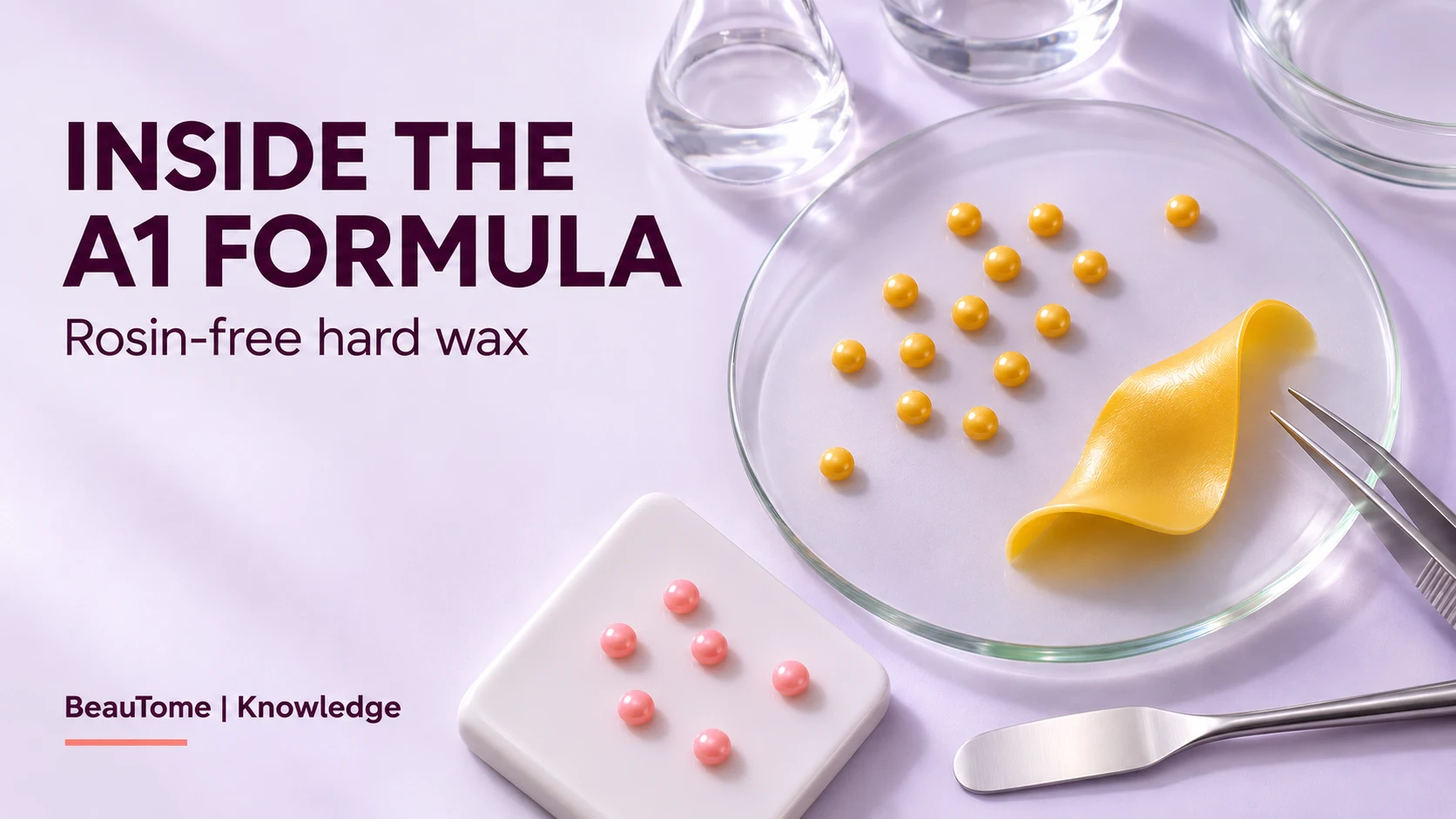
How BeauTome A1 Rosin-Free Hard Wax Is Formulated: Low Melting Point, Film Flexibility and Skin Comfort
Explore BeauTome A1’s resin, polymer, wax and emollient system, its stated 48°C melting point, and the evidence behind rosin-free and skin-comfort claims.
 ByTeco
BeauTome A1 combines a synthetic resin, a film-forming polymer, a wax blend and emollient ingredients. This combination helps explain the formulation approach behind its stated 48°C melting point and stripless application. Its rosin-free positioning addresses a specific ingredient concern. Skin comfort, however, depends on the finished formula, actual wax temperature, removal technique and the individual’s skin.
For beauty brands and salon buyers, three questions deserve separate answers: how does the wax soften and flow, how does the film hold together during removal, and which ingredients might cause an unwanted skin reaction?
This article explains A1 using BeauTome’s October 2026 ingredient declarations and current product specifications. Ingredient roles are formulation interpretations, not clinical results from testing A1. Exact percentages and raw-material grades are not disclosed here.
What is in A1?
A1 Golden and Pink share an ingredient declaration. A1 Jade (Clear) uses the same declared base ingredients and omits the four listed colourants. Sharing an ingredient list does not establish identical ingredient percentages.
| Ingredient or group | Formulation role to consider | What this does not establish |
|---|---|---|
| Hydrogenated Polydicyclopentadiene | Synthetic resin component of the adhesive and film system | Guaranteed freedom from allergic reactions |
| Ethylene/VA Copolymer | Polymer component contributing to film structure and flexibility | A measured reduction in pain or skin adhesion |
| Cera Microcristallina and Paraffin | Wax blend contributing to consistency, softening and setting behaviour | The finished product’s melting point from the names alone |
| Rice bran oil, shea butter, coconut oil and petrolatum | Emollient components that can modify texture and plasticity | Clinically demonstrated soothing or skin-barrier repair after waxing |
| Rosa Rugosa Flower Oil | A declared botanical oil that must be included in ingredient and sensitivity review | A fragrance-free formula or an anti-allergy treatment |
| CI 77891, CI 77019, CI 77491 and CI 47000 | Colourant system declared for Golden and Pink | Better or worse skin tolerance than Jade without comparative testing |

The important feature is the balance of the system. A wax must spread, surround hair, set into a usable film and remain cohesive during removal. Changing one ingredient can affect several of these properties at once.
How does the formula support a low melting point?
A1’s current product specification states a melting point of 48°C. That is a manufacturer specification; the ingredient list alone cannot independently verify the value.
The formulation explanation lies in the combined resin, polymer, wax and emollient system. Wax grades influence softening and consistency. The polymer contributes to film behaviour, while oils and other softening components can modify how the blend flows and flexes. Their proportions and compatibility matter as much as their names.
It would therefore be misleading to say that coconut oil alone “makes A1 melt at 48°C,” or that every rosin-free wax has the same melting point. The finished blend must be measured using a defined method.
Published formulation research supports treating these materials as a system. For example, patent CN110075009B describes a different depilatory-wax formulation in which polymers, waxes and other additives are balanced to obtain low-temperature film performance. It illustrates a formulation principle; it is not A1’s recipe, evidence of BeauTome patent ownership, or proof of A1’s performance.
Melting point and application temperature are different
A wax that melts at 48°C can become hotter if heating continues. The heater setting, temperature inside the pot and temperature at skin contact are separate measurements.
For sample evaluation, buyers should record the heater model, wax quantity, heating procedure, measured wax temperature and working consistency. A melting-point claim should never be presented as a guarantee against burns. The American Academy of Dermatology’s waxing guidance recommends following product directions and checking wax temperature before use.
Why remove rosin from the adhesive system?
Rosin, also called colophony, is a recognised contact allergen. DermNet’s clinical guidance on rosin allergy identifies epilating waxes among potential exposure sources.
A1’s declarations list Hydrogenated Polydicyclopentadiene as the resin component rather than rosin. This supports an explanation of its rosin-free formulation approach: it uses a different resin system to achieve the required wax behaviour.
For a buyer concerned specifically about rosin, avoiding that ingredient is meaningful. It does not establish that every person will tolerate the finished product, or quantify how much lower the overall allergy rate will be. Other ingredients and individual sensitivities still need consideration.
“Rosin-free” is an ingredient statement. “Less likely to cause allergic reactions than another wax” is a comparative outcome claim requiring appropriate finished-product evidence. The US FDA explains that “hypoallergenic” has no federal definition or standard. The term should not replace a clear ingredient declaration and supporting evidence.
How can film design contribute to a more comfortable waxing routine?
A useful hard-wax film needs both grip and cohesion. If a film becomes too brittle, it may break during removal; if its working properties are unsuitable, application and removal can become harder to control.
A1’s Ethylene/VA Copolymer, resin and wax blend provide a plausible formulation basis for managing those properties. Its emollient components can also influence texture and flexibility. BeauTome’s product materials describe smooth, thin application, but a claim that A1 causes less irritation than another wax would require a controlled comparison.
A practical evaluation should record spreading, film readiness, breakage, residue and whether repeat application was needed. Record observed redness and reported discomfort separately: they are different outcomes. Use a consistent treatment area and procedure, and do not turn a small salon trial into a claim of clinical proof.
Skin comfort also depends on the service. Actual heat exposure, skin condition, application area and removal technique can affect the result. A formulation explanation cannot establish that a wax “sticks only to hair and never to skin.”
Do the botanical ingredients make A1 anti-allergenic?
No such conclusion follows from their presence alone. Rice bran oil, shea butter and coconut oil are relevant to the emollient portion of the formula, but a brief-contact, peel-off wax is not equivalent to a leave-on moisturiser.
Claims such as “repairs the skin barrier,” “prevents inflammation” or “eliminates allergy” would require evidence for the finished product and intended use. Natural origin does not make an ingredient universally tolerated.
The standard Golden, Pink and Jade declarations also contain Rosa Rugosa Flower Oil. BeauTome describes these versions as unscented; that should not be rewritten as fragrance-free. A version without that ingredient is a separate customization project, with an approved sample and final ingredient declaration. Removing one ingredient does not by itself verify every possible fragrance-free claim.

What should a brand request before making stronger claims?
Ask for evidence matched to the proposed statement:
- For “48°C melting point”: the measurement method, sample identity and batch information. Record the working-temperature instructions separately.
- For “rosin-free”: the final ingredient declaration and supporting raw-material documentation for the selected formula.
- For film performance: a documented application-and-removal evaluation using the intended heater and service conditions.
- For lower irritation or allergy claims: appropriately designed finished-product assessment, a defined comparison where relevant, and review by qualified safety professionals.
These are evidence requirements, not a statement that A1 has already completed every assessment listed above.
Choosing an A1 formula for your brand
A1’s formulation story is strongest when it is specific: a rosin-free resin system, a stated 48°C melting point, a polymer-supported hard-wax film and an emollient-containing base. Together, these explain the product-development approach. Demonstrating a particular level of skin tolerance requires evidence beyond the ingredient list.
Explore BeauTome A1 Rosin-Free Hard Wax, or use the salon trial guide to plan a comparison. For a private-label project, contact BeauTome with your target market, treatment areas and ingredient preferences so that the sample and documentation match your brief.